
- | 9:00 am
The safest intersection on Earth (and why half the infrastructure profession hates it)
Traffic Engineering Inc. is wrong on many topics, but it’s absolutely right on this one.


Planner vs. Engineer is a well-known professional rivalry in the infrastructure world. The arguments are sometimes friendly, sometimes hostile, sometimes about important issues, sometimes insignificant. I’m in a peculiar spot because of my career as a “plangineer.” My parents helped me buy a civil engineering degree, but several years into my career, I bought the certified planning certificate. I know the two camps very well.
The roundabout question
Roundabouts are one of the many Planner vs. Engineer debates, and it happens to be a very important issue in which emotions cloud good judgment. As much as I criticize the engineering profession, they are generally correct on this one. But that wasn’t always the case.
In the late 1990s and early 2000s, the status-quo transportation engineering community believed wholeheartedly that roundabouts were not only bad but were silly and dangerous, would lead to gridlock, and couldn’t be understood by American drivers, etc. The primary reasons for opposing roundabouts and defending traffic lights (the typical alternative) were speed and delay. That is, if an intersection design slowed down vehicles, that was bad. If there was a real or perceived delay for drivers at intersections, that was bad.
The status-quo certified planners, spotting a thing engineers hated, praised the thing. Their reasons for supporting roundabouts included their function as a community gateway, a traffic calming feature, an environmentally sustainable design, and something that wasn’t so car-oriented like seemingly everything else dreamed up by traffic engineers.
But in the 2000s, a fringe group of practitioners and academics who were claiming that roundabouts were [gasp!] actually good started growing in numbers. Case studies were repeatedly finding the same results: Roundabouts dramatically reduced vehicle speeds, reduced crashes, maintained or reduced overall travel time, and made it safer for pedestrians to cross the street.
When the engineers became pro-roundabout, the planners became roundabout skeptics or flat-out anti-roundabout. I lived through this transition. It was wild to behold.
Modern roundabouts have been proven to be the safest form of at-grade intersection, and the most common claim from skeptics is: “But cars don’t stop at roundabouts, so they must be dangerous for pedestrians.” That seems like a reasonable explanation, but it’s wrong.
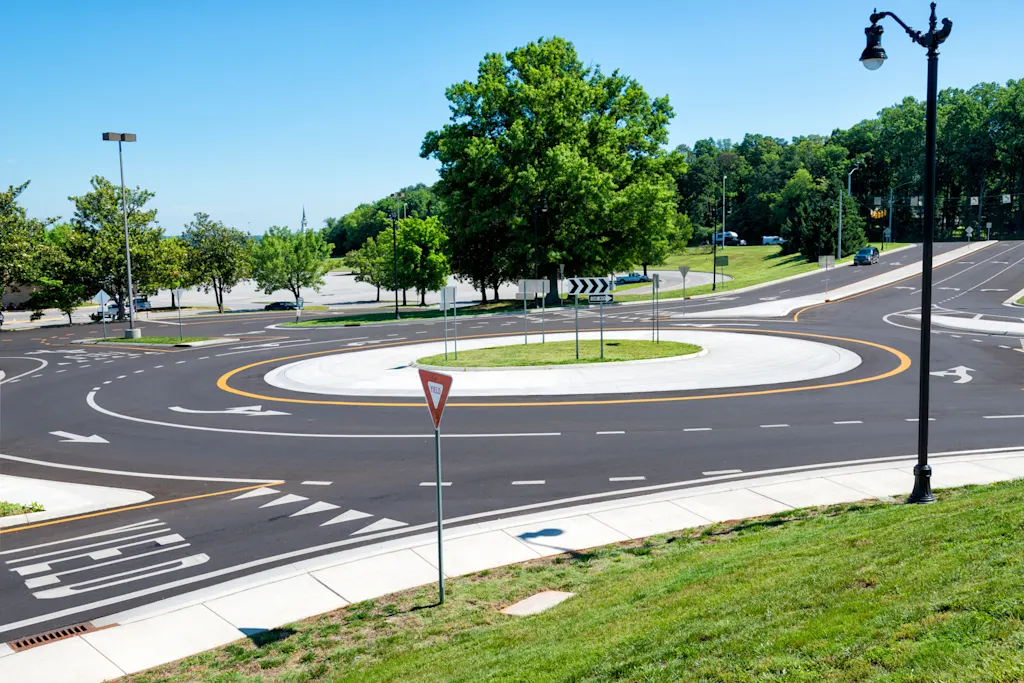
There are two reasons pedestrians are safer at roundabouts: slower vehicle speeds and shorter crossing distances.
Speed is the difference between life and death
Speed is the fundamental factor in crash severity. The difference between a person struck at 45 mph (the standard American arterial speed limit) and one struck at 20 mph (the standard design speed at a roundabout) is the difference between death and life.
Roundabout geometry forces drivers to slow down. Even on a high-speed road, roundabouts are designed to slow approaching vehicles. Once drivers enter the circle itself, speeds drop even lower, giving them ample time to yield to people in crosswalks on the exit leg. The physical design of the roundabout makes speeding through nearly impossible. When drivers are moving slowly, they have time to see pedestrians, react, and stop.
Shorter crossings are safer crossings
Multilane roads get even wider at intersections, with multiple left-turn and right-turn lanes added to process vehicle queues during each signal cycle. Without these additional lanes, traffic would back up to adjacent signals. For pedestrians, this means crossing not just two lanes but potentially six or more, with threats coming from all directions. The longer pedestrians remain exposed to moving vehicles, the greater their risk is.
Turn lanes extend hundreds of feet before intersections, meaning a series of signalized intersections produces bloated corridors between them. These wide corridors invite speeding, and speeding leads to more severe crashes. Roundabouts eliminate the need for long turn lanes in every direction. Without them, the corridors between intersections can remain narrow, which naturally discourages high speeds throughout the entire roadway network, not just at intersections.
Most modern roundabouts are designed so that pedestrians never cross more than one or two lanes at a time without reaching a refuge island. The splitter islands that separate entering and exiting traffic create natural stopping points, breaking what would be a long, dangerous crossing into manageable segments.
Retrofitting suburbia
In the United States, the greatest lifesaving potential for roundabouts lies in sprawling suburban areas along multilane arterials—precisely the environments where traffic engineers were trained to maximize vehicle flow at the expense of all else. These are the locations where pedestrians face the longest crossing distances, the highest speeds, and the most complex traffic movements.
On tight urban streets with traditional grid patterns, signalized intersections can work well for pedestrians. But in suburban contexts, where intersections are spaced far apart and roads are designed for high speeds, roundabouts offer a proven solution for protecting vulnerable road users.
As a certified planner who has worked as an engineer for many years, I don’t care which team gets the bragging rights for promoting pedestrian safety. I only care that we stop designing intersections and corridors in ways that are proven to be deadly. In suburbia, especially, every new or retrofitted multilane arterial crossing should default to a roundabout.

Featured Videos
Today's Top Stories:
More Top Stories:




FROM OUR PARTNERS