- | 9:00 am
AI could help underserved talent in the Middle East beat a broken job market
Roy Baladi is building an alternative to mass applications that prioritizes access, dignity, and real opportunity.
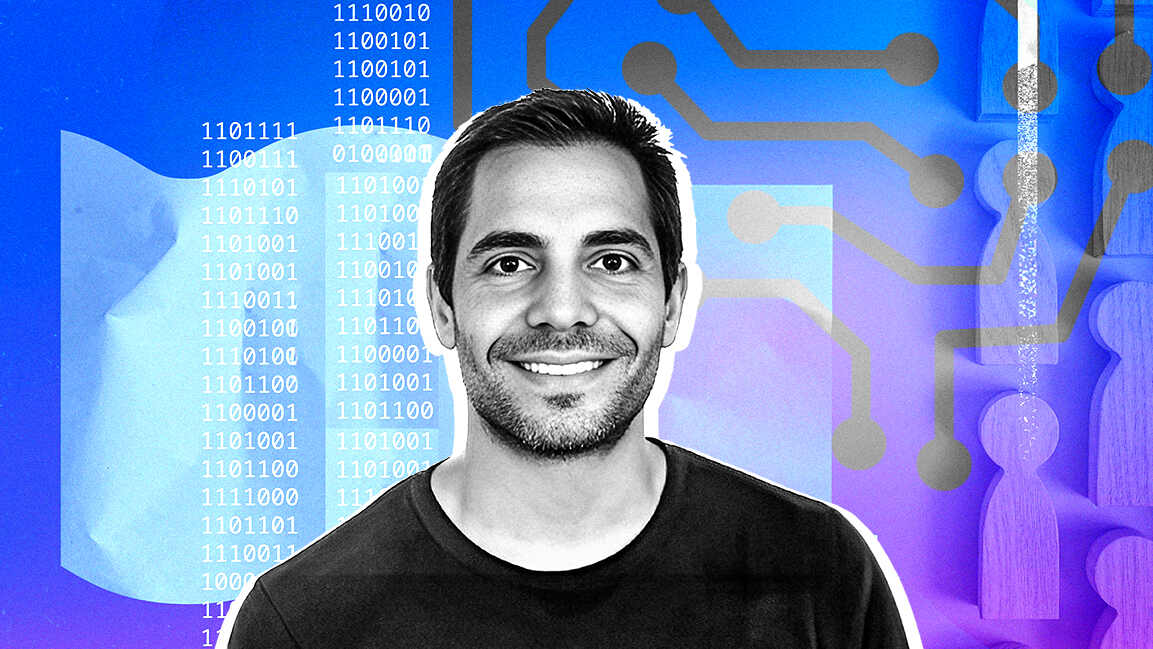


The modern job market is failing in plain sight. Not because people lack talent, but because the systems meant to connect talent to opportunity were never designed for everyone, says Saudi-based entrepreneur Roy Baladi, speaking on the sidelines of the Global Labor Market Conference in Riyadh.
Before founding Jobs for Humanity, Baladi volunteered in California prisons, helping formerly incarcerated individuals prepare for life after release. Again and again, he ran into the same wall. Even when people were motivated and capable, landing a job felt nearly impossible. He saw the same pattern while working with Lighthouse for the Blind, where entire communities existed alongside the workforce yet remained invisible to it.
“These were two completely different worlds,” Baladi says. “The blind and the non-blind. The supported and the excluded.” That disconnect ultimately pulled him away from a successful career in Silicon Valley. After helping scale SmartRecruiters as one of its earliest employees, Baladi left on strong terms and built something new. He believed the hiring market was deeply underserved and that he had both the skills and the network to try to fix it.
That belief became Jobs for Humanity (jobsforhumanity.com).
What began as a mission-driven experiment quickly evolved into a multi-brand, global hiring ecosystem. When Lebanon’s economy collapsed, Jobs for Lebanon launched to help the Lebanese diaspora find work. In Saudi Arabia, Baladi launched Saudiaat (Saudiaat.com), a platform that connects Saudi women to jobs while offering free upskilling. That effort alone helped place 600 women and train more than 2,000.
Today, those initiatives sit under a single AI-powered platform called Humanity AI. Its Middle East-facing brand, Kanz (Ka.nz), which means “treasure,” connects job seekers directly with employers offering verified, real roles.
Outside the region, Jobs for Humanity continues to focus on underserved talent, including people who are blind, deaf, neurodivergent, justice-impacted, refugees, and single parents.
Across all programs, the scale is striking. More than one million people have entered the platform, received application feedback, and gained access to free AI courses and workshops. At least 4,000 to 5,000 people have landed jobs directly through employer confirmations, with many more hired through follow-up connections.
The courses are intentionally practical. Participants learn how to build AI-powered tools that improve productivity without writing a single line of code. Within four weeks, they earn certifications that apply across roles, from finance and customer support to design, development, and operations.
“The goal is not just employment,” Baladi says. “It is agency.”
WHY MASS APPLICATIONS DON’T WORK
Baladi is careful not to position his work as an attack on existing platforms. He credits popular job search platforms with enabling millions of job placements worldwide and calls it extraordinary. But he argues that scale alone cannot solve structural gaps.
“There are pockets of the population that need more support,” he says. “Accessibility, feedback, training, and human context are missing.”
On Humanity AI, every applicant goes through a skill-based AI interview, regardless of how polished their resume is. The system tests what candidates actually know, not how well they format credentials. Applicants who do not land interviews receive detailed feedback and automatic access to free training. Those who do advance move directly into real hiring processes with verified employers.
The emphasis is on quality, not volume. Baladi believes mass application tools only dilute the system further, creating noise without improving outcomes.
“The future does not belong to the people who apply to ten thousand jobs,” he says. “It belongs to the people who know how to use AI to become meaningfully better at what they do.”
AI AS A DIVIDER AND EQUALIZER
Baladi does not sugarcoat the state of employment. Whether the AI boom accelerates or collapses, he expects hiring to tighten. Tech companies are already hiring fewer people, even as AI adoption grows.
That reality, he argues, makes AI literacy non-negotiable.
“There was a time when email separated people who could work from people who could not,” Baladi says. “Then it was the internet. Now it is AI.”
But he draws a sharp distinction between casually prompting tools and actually building with them. Humanity AI teaches participants how to create AI agents that automate workflows, accelerate analysis, improve customer response times, and reduce costs across nearly every profession. Those skills, Baladi believes, are what keep people employable and resilient.
THE BIGGEST UNTAPPED OPPORTUNITY
Of all the groups Humanity AI supports, Baladi is most focused on people with disabilities. Now based in Saudi Arabia, he speaks candidly about how disability hiring often functions in practice.
“In many cases, people with disabilities are treated as quota fillers,” he says. “They are hired to check a box, not to grow.”
Baladi believes that framing misses both the human and business opportunity. Disabilities often come with strengths that are undervalued, from attention to detail and deep focus to advanced written communication and visual precision. When paired with AI skills, those strengths can elevate entire teams.
“When someone with a disability becomes AI-enabled, the conversation changes,” he says. “They are no longer defined by what they need. They are defined by what they bring.”
That shift, he argues, benefits everyone. Employers gain talent and capability. Teams gain new expertise. Individuals gain dignity, growth, and long-term career paths.
CHOOSING OPPORTUNITY WITHOUT FEAR
Baladi does not see AI as something to fear. He sees it as a moment of choice.
“You either ride the wave and redefine your place in the workforce, or you do not,” he says. “Disruption creates opportunity. That has always been true.”
His platform is built on that belief. Not everyone will land a job immediately. But everyone who joins Humanity AI leaves with skills, feedback, and a clearer path forward.
In a labor market defined by uncertainty, Baladi is betting on something simple and radical: Access, when paired with the right tools, can still change lives.