
- | 9:00 am
AI layoffs reverse giving young workers a new opportunity
Experts say workers can blend their technical knowledge with strong interpersonal skills, and strengthen core human skills
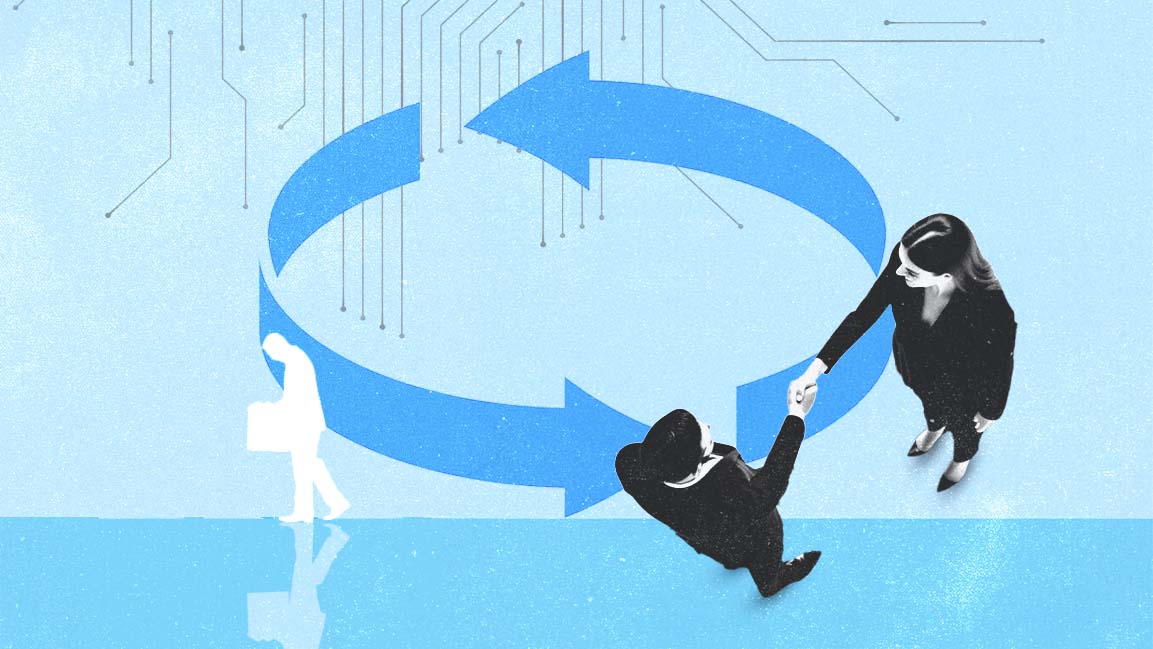


Some companies that were quick to lay off workers because of AI are now quietly rehiring workers after realizing the technology cannot fully replace human skills. Although AI has proven efficient in automating tasks and sifting through large amounts of data, humans are still needed to manage and oversee the technology. At least for now.
According to a report by Orgvue, 39% of business leaders made employees redundant because of AI. However, from that number, 55% admit they made the wrong decisions about those redundancies.
“We’re facing the worst global skills shortage in a generation, and dismissing employees without a clear plan for workforce transformation is reckless,” commented Oliver Shaw, CEO of Orgvue, in the report. “Some leaders are waking up to the fact that partnership between people and machines requires an intentional upskilling program if they’re to see the productivity gains that AI promises.”
One of the latest companies to backtrack on job cuts is automaker Ford. According to Bloomberg, the company rehired more than 300 engineers after AI failed to match their skills and experience.
Ford is not the only company rehiring after AI-driven layoffs. Other businesses that have reversed job cuts include the Commonwealth Bank of Australia (CBA) and software company IBM. Last year, CBA cut about 45 jobs because of AI and later described it as an ‘’error,” prompting the bank to reverse these cuts.
Meanwhile, IBM has also started rehiring after it let AI handle routine HR requests. It found that although AI could handle most requests, it struggled with tasks requiring complex judgment, empathy, and ethical reasoning.
OVERESTIMATED THE PRODUCTIVITY PROMISE
HR expert and founder of consultancy firm Deconstructing HR, Darren Streete, is not surprised by these hiring reversals. The AI hype may have overestimated the technology’s productivity promise, revealing its limitations.
“I’m actually not that surprised,” said Streete. “Because they [companies] haven’t assessed it properly enough and then instilled AI in a quality-controlled way. They are suffering the consequences of not-so-effective output from the AI, be it in customer relations in terms of the outputs of the emails that go out to potential clients, customers, or customer feedback.”
According to Streete, the quality of the AI output is not there yet. AI may have evolved rapidly in the last few years, making remarkable progress, but human expertise and oversight are still needed. He references the term ‘AI Slop’ where the quality of the AI output is low, and still requires human interference.
“Everyone’s now saying the output is not good enough,” he added. “And now they’re bringing people back to recheck the work and to get back to a certain level of standards. There have been leaps and bounds, but those leaps and bounds have been more in terms of efficiency and automation, but that in itself is not the same as increasing the quality of the output.”
AI TO COMPLEMENT SKILLS
Although there may be concerns about AI’s output, the technology’s potential remains vast and continues to improve each year. So, while the hiring reversals could signal relief for young workers and those entering the job market, they shouldn’t relax just yet.
Streete advises young workers to learn essential AI skills to complement the technology rather than compete with it. They need to use it to enhance their work rather than let AI take over completely. “I’ve always seen it as a tool to complement a person and make their working life more efficient, quicker, and be able to get more tasks done than they would be able to do otherwise,” said Streete. “There’s an opportunity for the younger generation that if they’ve done a lot of experiential learning with AI models, when they go into a job, they can be an ambassador, they can be a change agent, or they can be a technology lead.”
Research from Gartner estimates that by 2027, 50% of companies that attributed headcount reductions to AI will rehire staff to perform similar functions under different job titles.
Kurt Muehmel, head of AI strategy at Dataiku, expects jobs to evolve as AI advances. This may result in a back-and-forth movement of hiring and firing as businesses redesign their organization.
“We’re in a period of change, and that this period of change is bigger than any one individual, any one company, any one region,” he said. “This is going to require people to be adaptable in a way which is sometimes potentially uncomfortable, but this is something which is affecting all of us, society at large, as we all navigate this change, both as individuals and as organizations.”
IMPORTANCE OF HUMAN SKILLS
While learning AI seems key to adapting to a changing market, human skills ultimately differentiate people from machines. Unique human skills like critical thinking, creativity, and ethical reasoning, among others, cannot yet be replicated by AI.
A philosophy major, Muehmel is happy to see that AI companies are increasingly hiring graduates from the arts and humanities, underscoring the importance of deep human skills.
“One of the skills that I think is most at risk of being lost is critical reasoning,” he said. “It’s easy to call it just reading comprehension, but the ability to sit with a complex idea, to understand it, to break it down, to identify what you don’t understand, and to go seek out that information is really important. And so I would encourage, especially young people, but really all professionals, to maintain that effort to think, to read, to write, and to not rely on these technologies where it’s not useful or where it’s not necessary.”
Creativity is another important, uniquely human skill. In an experiment by Anthropic in which AI agents were asked to write short-form fiction and critique each other’s work, many agents came up with the same title in their first submission, “The Cartographer’s Last Commission.” It’s important to note that the agents were given zero guidance on the subject matter for their writing.
Commenting on the experiment, Muehmel says there is a lack of diversity in the AI output. “So, I think that’s where we should look at humans for being, having a unique advantage relative to AI is true creativity,” he added.
As companies continue to experiment with AI and automation, young workers today have a unique opportunity to blend their technical knowledge with strong interpersonal skills. They can leverage AI to build expertise while also strengthening core human skills.
“The good thing about us is that we’re autonomous and we are always thinking creatively,” said Streete. “Problem solving, being a critic, looking at information, and applying critical thinking to that information or process, and coming up with solutions on the spot on how to deal with problems are very important competencies as we move forward in the age of AI.”