
- | 6:00 am
Will we ever wear a computer on our faces? This device wraps it around your neck instead
The Viture One headset hides a computer in a band you wear around your neck. It’s an intriguing solution to a problem that is vexing AR companies everywhere: AR technology is small enough to wear but not small enough to be completely concealed.
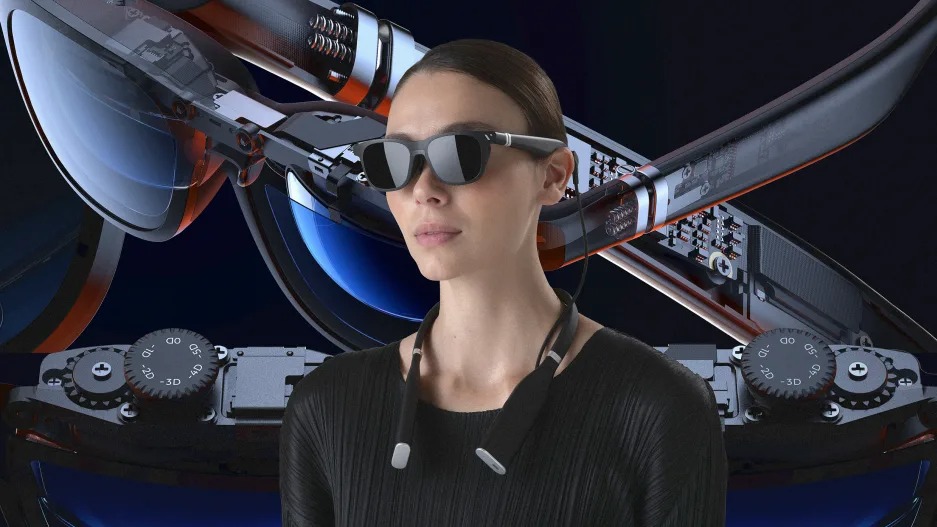


Imagine sitting down on a plane, putting on a pair of sunglasses, and watching Bridgerton on a 120-inch screen. You don’t need to wait for Apple’s rumored AR headset for the opportunity. Because the Viture One, starting at $400 on Kickstarter now, promises a supersized screen tucked inside tiny glasses. And if you’re on stable Wi-Fi, you can also stream Playstation, Steam, and Xbox games from the cloud.
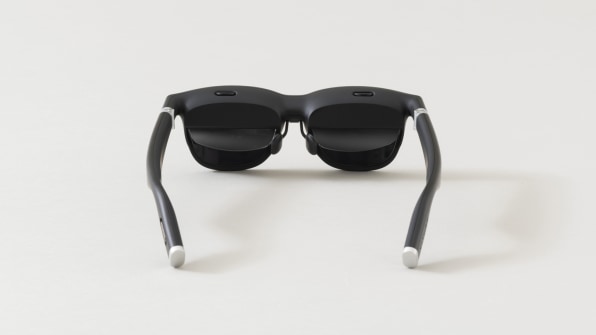
[Photo: courtesy Layer]
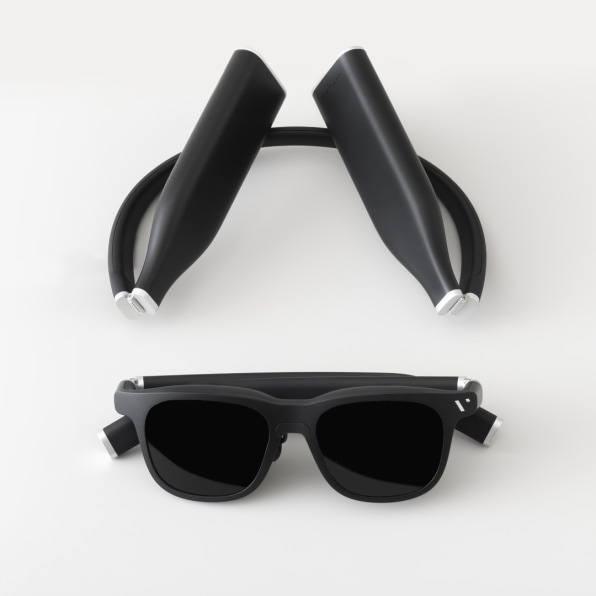
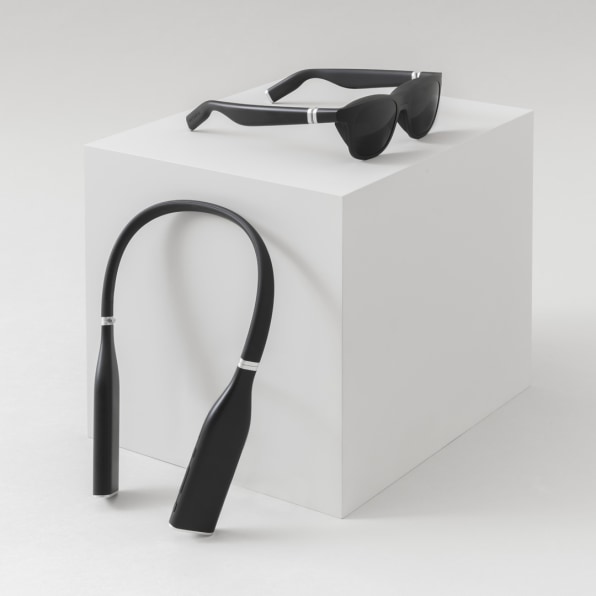
Designed by the London design studio Layer—known for designing products for companies like Bang & Olufsen—the Viture One was created to strike a balance between fashion accessory and wearable tech product. On their own, the frames are relatively conventional looking. However, they connect to a band of processors and electronics that sits on your neck and connects to the frames via a magnetic cable. It’s a necklace that subtly broadcasts the function of the device.
It’s an unusual solution to a problem that is vexing AR companies everywhere: AR technology is small enough to wear but not small enough to be completely concealed. Thus far, companies like Meta and Amazon have tried to embrace fashionable AR headsets but fallen short of creating a sinuous sunglasses aesthetic—because they’ve crammed so many electronics into oversized arms. Meanwhile, Microsoft has sidestepped shrinking its Hololens headset into glasses altogether, arguing that technology is timeless while fashion is fleeting. In any case, most AR lives in a murky middle ground between fashion and technology. It’s a tough sell for consumers who may be willing to wear something techie on their wrist, like a Fitbit or an Apple Watch, but less willing to wear it on their face.
[Photo: courtesy Layer]
“Apple is getting into the space . . . you’re going to get this momentum, which means manufacturers will develop components which are smaller and smaller,” explains Layer’s founder and creative director Benjamin Hubert, alluding to how the iPhone took technology that already existed but made electronic components tinier and cheaper through the sheer scale of its production. “The end goal is you put on a normal pair of glasses or maybe a contact lens. We’re just taking the first steps toward [that].”
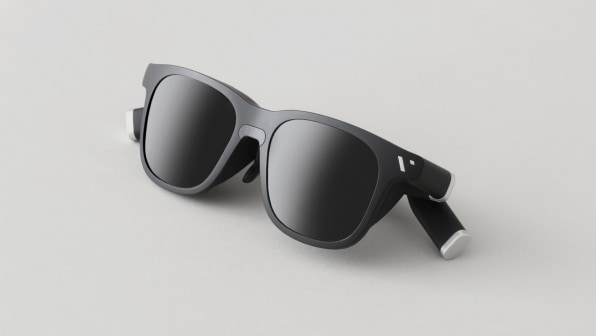
[Photo: courtesy Layer]
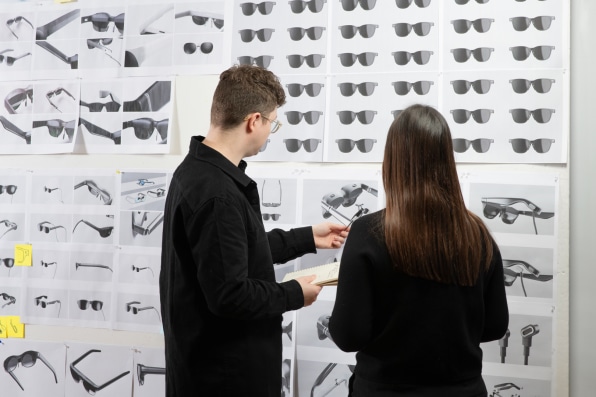
Over the course of hundreds of prototypes, Layer designed the Viture One as you see it here. It looks almost like a pair of Wayfarers, sprinkled with hints of cat’s-eye. That was an intentional strategy to create a new silhouette out of an accepted, popular eyeglass frame rather than a more aggressively haute look, like Snap’s latest Spectacles. But various pieces of the glasses themselves are strategically thickened to sneak in electronics.
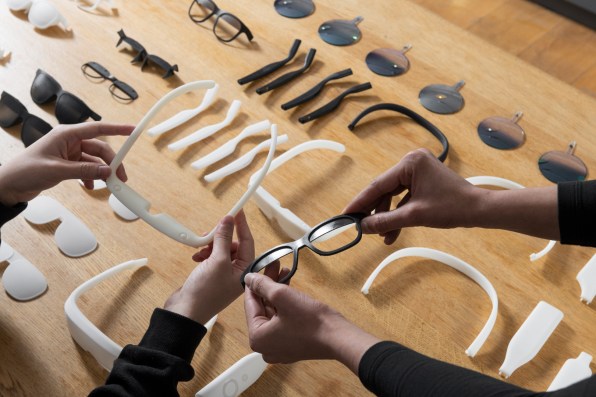
[Photo: courtesy Layer]
“You’ve got a certain mass of electronics that you have to put somewhere. One of the oldest tricks in the [industrial design] book is how to manage mass,” says Hubert. “We’re splitting the volume, there’s a bit more around the eyes, the ear, around the temple line. There’s a little more around the top of the frames. It’s just that little bit, increasing that little bit in little spaces.”
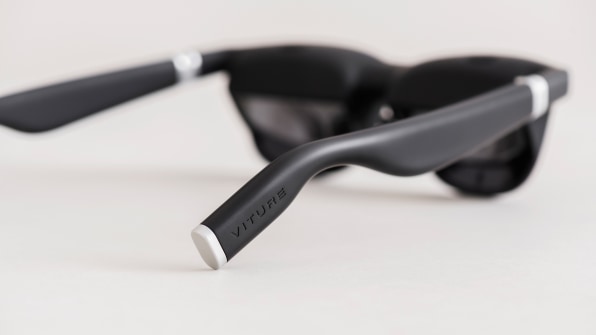
[Photo: courtesy Layer]
The careful approach sidesteps the super-thick arms we’ve seen in other wearables. Hubert also notched the end of the arms following a subtle taper to give the form a more svelte look.
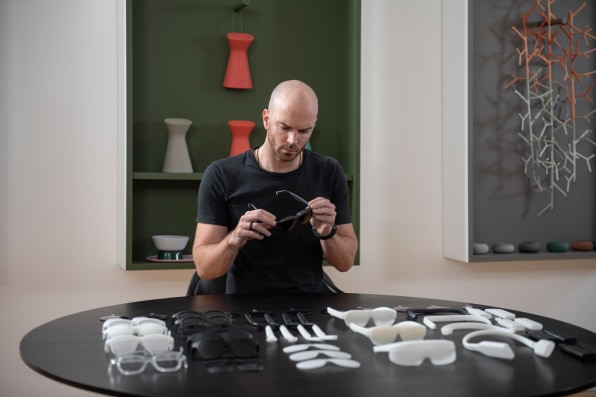
Benjamin Hubert [Photo: courtesy Layer]
The look is only part of the equation, however. Wearing the glasses is meant to feel like wearing normal sunglasses. Heat sinks pull heat generated by the displays away from your eyes, through the arms, and outward over your ears. The goal is to move all perceivable heat generated by the device (a warmth that’s notable in any headset I’ve tried). “You don’t want to put anything on your head—hat or glasses—which makes you sweat,” says Hubert.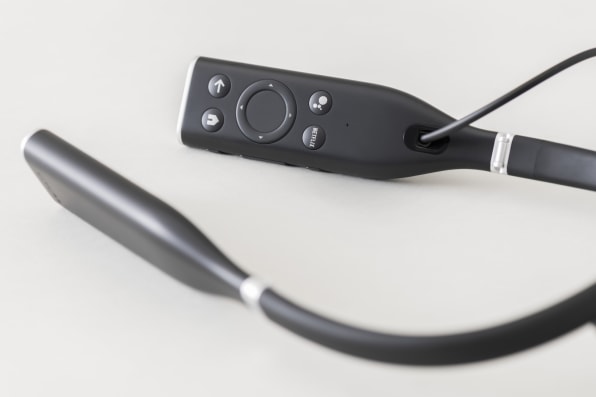
The UV-tinted lenses feature an adjustable film that allows you to tweak the opacity of the lenses by hitting a button on the neck piece. In darker modes, it might feel like you’re in a movie theater-for-one. In lighter modes, the entire display has more opacity, letting in more of the surrounding world.
[Photo: courtesy Layer]
As for the neck computer, that’s a component Layer developed to remove weight that would otherwise sit on your head and place it on your shoulders. Startups like Magic Leap have moved computing power away from eyewear before (in that case, the computer lived on your waist). I can’t help but see something out of The Sharper Image in the Viture’s neck band. Its curved, matte finish, combined with the segmented form, broadcasts that it’s a gadget.
“What’s a comparable piece of technology—or anything—that isn’t clothing that goes around your neck?” asks Hubert. “It’s jewelry. But if you make it like jewelry, suddenly it’s much more gendered and polarizing.” By contrast, the Viture One’s neckband feels like an appliance: built for anyone because it’s just a machine.
[Photo: courtesy Layer]
So why not lean into the machine side even more? The popular, maximalist aesthetics of PC gaming—full of race car and sci-fi design tropes, smothered with plenty of rainbow LED lights—fully embrace the gadget. They don’t try to conceal the device; rather, they celebrate the device as fashion unto itself.But Hubert sees limits to that maximalist design language. “There’s always going to be that audience. It’s interesting how Twitch gaming culture, and gender neutrality of that culture, has increased the desirability to have super-status-symbol gaming products,” Hubert says. “[But] if you think about the future of these projects, they’re going to be for the next generation of community building, retail, all the things that don’t necessarily relate to flashing LEDs. That’s where I think the maturity of the use case will drive the maturity of the design language.”
It’s a convincing argument. And yet, if the aesthetics of mainstream sunglasses alone were enough to sell the world on AR headsets, then Google would have won the world over with its Ray-Ban-friendly Glass redesigns almost a decade ago. AR is still looking for its killer use case. And with our smartphones already doing so much that smart glasses promise, consumers lack clear incentive to take a gamble on a new category. The fact is that, as the world continues to debate the packaging of burgeoning AR technology, form is still waiting on an enticing enough function.

Featured Videos
Today's Top Stories:
More Top Stories:


FROM OUR PARTNERS