- | 9:00 am
The next generation of luxury homes is banking on brand loyalty
Branded residences are reshaping luxury real estate, blending five-star service with the power of global brands from hospitality to automotive.
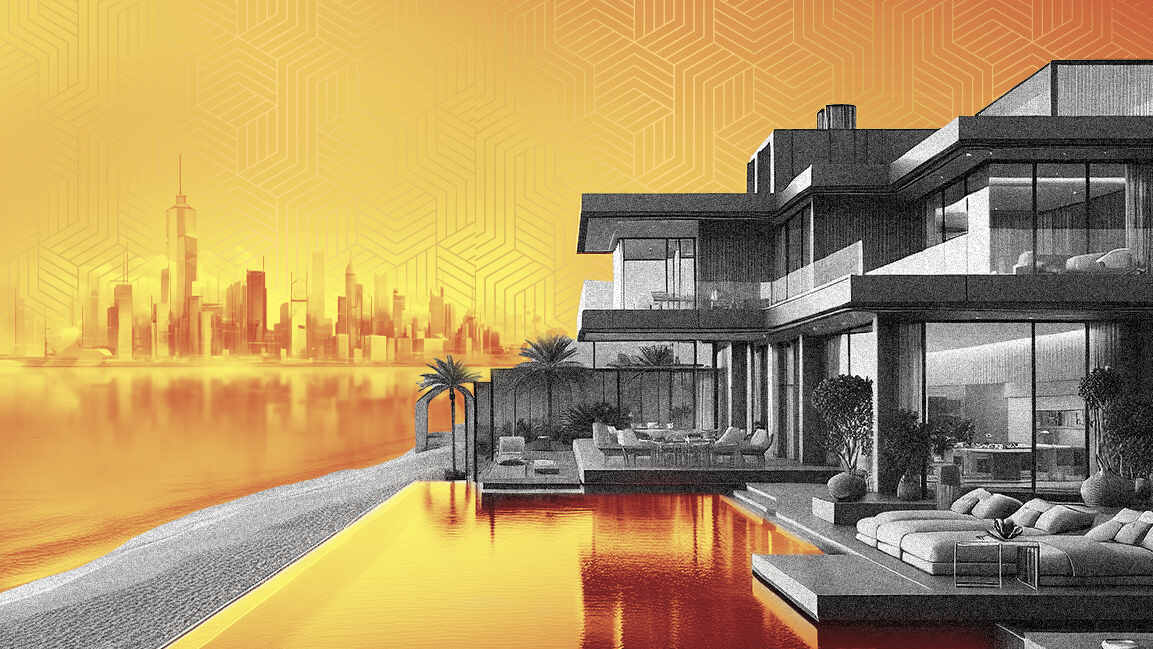


Imagine a home with a concierge, a spa, on-demand room service, and a global brand name etched on it?
Branded residences, once a niche extension of five-star hospitality, have become one of the fastest-growing segments in real estate. Pioneered by hotel groups such as Four Seasons Hotels and Resorts and The Ritz-Carlton, this concept combines private ownership with hotel-level service. Buyers aren’t just buying space; they’re investing in a fully managed lifestyle.
Today, this model goes well beyond just hospitality.
WHEN AUTOMAKERS AND FASHION HOUSES DESIGN YOUR ADDRESS
Luxury automotive brands have discovered that their customers don’t just want to drive the brand; they want to inhabit it.
In Dubai, Binghatti Developers teamed up with Mercedes to create Mercedes by Binghatti Residences. They brought Mercedes’ design style–its precise lines, dynamic shapes, and performance-driven look–into the building’s architecture. The building feels like a part of Mercedes’ identity, not just a branded add-on.
This trend is also evident across industries, including fashion and hospitality projects in the UAE. Developments such as Armani Beach Residences and Anantara Sharjah Residences demonstrate how strong brands, combined with great locations and standout design, can drive buyer interest.
Amany Rajab, Senior Research Manager at Arada, says buyers rarely pay a premium for a logo alone.
“Branded residences incorporate more luxury amenities, facilities, and services beyond what is typically found in non-branded developments, creating a clear competitive edge in highly competitive markets,” Rajab says. “This level of integration enhances exclusivity and caters directly to the high-end segment of the market.”
Services such as on-demand help, housekeeping, concierge, childcare, pet care, and reservation management are key to the value they offer. “These offerings create a more personalised and seamless living experience,” she adds.
Brand reputation also plays a big role. A well-known name reassures buyers about design quality, finishes, maintenance, and delivery. For loyal customers, this connection feels like a guarantee.
When tied to a hotel operator, there’s a financial benefit too. “Buyers may benefit from rental pool models, allowing their unit to participate in income-generating programmes,” Rajab adds.
Ultimately, she says, branded residences offer something more intangible: Identity. “Buyers value the familiarity and trust of a recognised name, along with the depth of design and service that elevates everyday living beyond a standard residential product.”
Adding to this perspective, Imran Khan, Founder and CEO of The PIXL Group, said brand loyalty in luxury real estate is fundamentally about trust. “When a buyer aligns with a name such as Marriott International or Accor, they are buying into a standard they already know and trust, with a proven operating model, service culture, and global recognition,” he said, adding that reassurance removes uncertainty and creates confidence not just for today, but for future resale value. In Dubai, he said, buyers are paying a 40–60% premium because they are not simply acquiring property, but investing in a lifestyle they trust, a name with global weight, and an asset they feel secure in.
Annuj Goel, Chairman of Golden Light Group, added that in luxury real estate, brand loyalty is essentially a matter of confidence. A recognised brand reduces uncertainty because buyers believe the design intent will be delivered as promised, finishes will match the narrative, and the living experience will be protected after handover through stronger management and service standards, he said. “That’s what the premium buys, which is predictability over time,” Goel said, adding that in a high-value asset class, predictability is a form of protection, and protection commands a premium.
Drawing on Golden Light Group’s four decades of experience and more than 143 completed projects outside the UAE, Goel said legacy has shown him that brand is not what is claimed at launch, but what holds up five years later. In his view, the true test of brand equity is post-handover performance, when marketing has faded, and operations begin to speak. In Dubai, where many buyers are global and time-poor, he added, a brand becomes a shortcut to trust. Brand loyalty, in that sense, is less about attachment and more about assurance, he said.
Ankit Gupta, Managing Director of Mantra Properties, said brand loyalty in luxury real estate is less about a logo and more about alignment. Today’s buyer is sophisticated, he added, and simply attaching a brand name to a building no longer guarantees conversion. If the lifestyle does not genuinely reflect what the brand stands for, buyers see through it immediately. The premium comes from affinity, trust, and expectation, he said. When someone connects with a brand globally, they expect a certain standard in design, service, detail, and long-term value, which reduces perceived risk.
Referring to emerging destinations such as Ras Al Khaimah, Gupta said buyers are not just purchasing an apartment, but buying into a larger vision. Citing Jacob & Co. Residences, he said the experience must feel authentic from the moment a resident steps in. “The lobby, materials, spatial drama–it has to feel like you’ve entered the Jacob & Co. universe,” Gupta said, adding that this is only the beginning. The next phase of branded residences will not merely carry a brand name; they will live and breathe the brand in ways the industry has not yet seen. If integration stops at design, it is incomplete, he said. “The future of branded residences is full immersion, and that’s exactly where we’re heading next,” he added.
EMOTION VS. FUNDAMENTAL
So, how much of the buying decision is driven by emotion, and how much by pure investment sense?
It’s a mix. “The decision is typically a combination of both emotional and fundamental factors,” says Rajab.
Research from Arada shows that in Dubai, branded homes can sell for 20% to 60% more, depending on location, brand, and amenities. Worldwide, branded residences usually fetch higher prices than non-branded ones.
Location and returns still matter. These projects are typically in city centres or waterfront settings, reinforcing core investment fundamentals. But brand association adds another layer of comfort.
“Buyers are reassured by the perceived guarantees around quality, management, and long-term positioning that come with a recognised brand,” Rajab says.
Khan said buyers instinctively balance emotion with logic. Fundamentals such as location, design quality, rental yield, and long-term ROI remain non-negotiable, he added. In Dubai, where yields average 6–8% and continue to strengthen, the investment case is already compelling, he said. However, brand is often the emotional driver that accelerates commitment, particularly in off-plan real estate. “Emotion creates momentum, but fundamentals ultimately close the deal,” he added.
Goel said that while fundamentals get a project shortlisted, the brand often gets it chosen. Location, design efficiency, views, and ROI matter, he added, noting that buyers in Dubai are highly informed, benchmark globally, compare yields across markets, and understand supply cycles. But the brand answers the final question: Will this still feel premium and remain liquid later?
Gupta echoed that emotion may start the conversation, but fundamentals close it. While there is an emotional pull toward a brand, he said, buyers today are analytical and disciplined. They evaluate the developer’s track record, delivery capability, financial strength, location potential, and long-term ROI. No serious investor makes a blind purchase purely because of a brand name, he added. It is a layered decision where the brand elevates aspiration, and location, design integrity, and projected performance justify the investment. When those elements align, he said, projects sell out.
In short, emotion might get buyers interested, but solid fundamentals seal the deal.
WHY DUBAI BECAME THE EPICENTER
Few cities have adopted the branded residence model as enthusiastically as Dubai.
This is because of a convergence of wealth, yield performance, and global competitiveness. The UAE’s growing high-net-worth population has created a great market for branded luxury products, backed by solid rental yields and steady capital growth.
“Branded residences with hotel management now represent 38% of all branded developments and are increasingly preferred by HNWIs seeking privacy combined with five-star service,” Rajab adds.
Dubai now has more than 50 completed branded residential projects, with supply expected to triple by 2031. By mid-2025, the city had 48,474 branded units, with 12 new projects launched in just six months.
Khan added that not only Dubai, but the UAE as a whole has created the perfect ecosystem for branded living, supported by ambitious developers, strong global capital inflows, and a buyer market that values differentiation. It is no surprise, he said, that Dubai now ranks alongside Miami and London as a global leader in branded residential living.
Goel said Dubai is built for branded living, with a global buyer base, a luxury culture that values experience, and a market that rewards differentiation. It is one of the few cities where lifestyle, capital mobility, and brand consciousness intersect at scale, he added. In a fast-moving market, brands reduce friction and accelerate conviction, making Dubai structurally aligned with branded residences.
Gupta added that Dubai is a highly evolved market where consumers have experienced the best of global real estate and hospitality. Lifestyle plays a central role in buying decisions in the region, he said, and branded residences fit naturally because they bring hospitality, identity, and experience into private ownership. At the same time, Dubai continues to attract HNWIs and UHNWIs at scale, he noted. These buyers are globally mobile and brand-aware, understand luxury, and value differentiation, making the market both mature enough to appreciate branded residences and ambitious enough to demand them, he said.
Momentum is also building beyond Dubai. Rajab points to growing interest in Sharjah and Ras Al Khaimah, where branded living remains nascent but is gaining traction, as well as Saudi Arabia, where Vision 2030 is accelerating tourism and luxury development.
THE OVERSATURATION QUESTION
As more global brands, from hospitality to automotive, fashion, and jewellery, enter the property market, concerns about oversupply inevitably follow.
Arada tracks monthly launches in this segment and has noticed a slight drop in new branded announcements compared to past years, partly because of limited prime land and rising land prices. Still, absorption rates remain strong.
With approximately 20,000 more units expected to enter Dubai’s market over the next five years, staying disciplined will be key.
“Careful brand selection and strategic alignment between developer and brand are essential to long-term success,” Rajab says. “When there is genuine synergy between both parties, exclusivity and differentiation are more effectively sustained,” she adds. The next evolution may hinge on differentiation rather than density.
Khan said lifestyle and brand prestige naturally influence buying decisions at the luxury level, adding that there is always an emotional element to owning a residence associated with a globally recognized name, and that aspirational appeal adds market momentum.
However, from what he has seen in Dubai, long-term performance depends on depth. Branded residences can achieve stronger resale value, he said, particularly when the brand is fully integrated into service delivery, management standards, and the overall living experience.
Goel said lifestyle and status drive desirability, which in turn supports liquidity and resale performance, but the premium is durable only when backed by real execution in quality, operations, and long-term management. In a transparent and performance-driven market like Dubai, he added, standards are what ultimately sustain value.
Gupta said that while lifestyle and status are visible drivers, performance is very real. Globally, branded residences typically command a 20–30% premium over comparable non-branded assets, he noted. In markets such as Ras Al Khaimah, branded inventory is witnessing stronger absorption and greater investor interest than standard products. The reason is straightforward, he said: brand-backed residences carry global recognition, stronger rental appeal, and better resale liquidity. When executed correctly, they are not just homes, but long-term assets — “almost like owning a collector’s address,” he added.
The deeper shift may be philosophical. As work, travel, and lifestyle increasingly blur, permanence feels less important than performance, how efficiently and elegantly a space supports daily life.
Branded residences respond to that shift. Owning a home is no longer just about location. Increasingly, it’s about affiliation.