
- | 12:00 pm
Abu Dhabi Drone Championship highlights advances in autonomous flight
Leading AI research teams and top FPV pilots competed across multiple formats, with a total prize pool of $600,000.
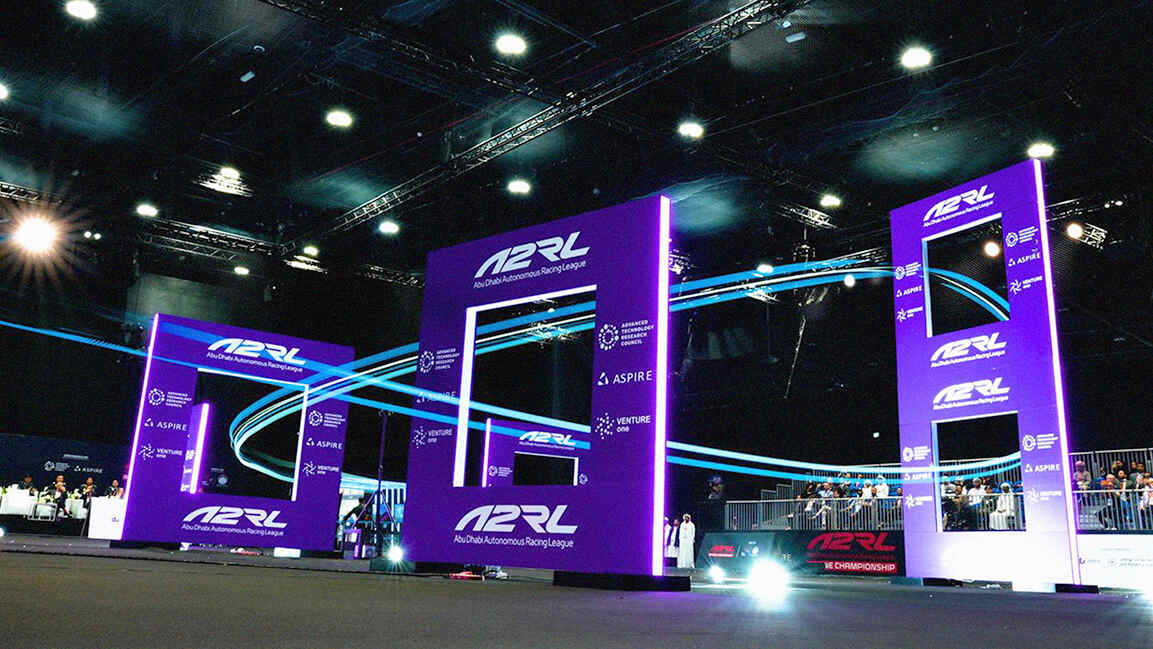


The Abu Dhabi Autonomous Racing League (A2RL) Drone Championship pushed the limits of human and autonomous performance. TII Racing recorded the fastest autonomous lap to win the AI Speed Challenge, while World FPV Champion Minchan Kim narrowly defeated an AI drone in the Human vs AI finale.
Organized by ASPIRE, the innovation arm of the Advanced Technology Research Council (ATRC), the two-day event took place on 21–22 January during UMEX and showcased advances in vision-based autonomy as well as the narrow margin that still separates human instinct from machine execution at high speed.
Leading AI research teams and top FPV pilots competed across multiple formats, with a total prize pool of $600,000. In the AI Speed Race, TII Racing set a benchmark lap of 12.032 seconds, closely followed by MAVLAB at 12.832 seconds.
Stephane Timpano, CEO of ASPIRE, said, “Compared to Season 1, teams are achieving higher speeds with greater stability and consistency, driven almost entirely by software advances. This shows how quickly autonomous capability is maturing in competitive settings.”
The race isolates raw autonomous performance, focusing on perception, control precision, and top speed without interference. Giovanni Pau, Technical Director at TII Racing, noted, “Achieving the fastest lap reflects the depth of our software development. It demonstrates what vision-led systems can achieve when pushed to their limits.”
The Multi-Drone Race formats shifted the focus from speed to interaction in shared airspace. MAVLAB won the Multi-Drone Gold Race, while FLYBY took first place in the Silver Race. These results highlight advances in real-time collision avoidance, trajectory planning, and multi-agent coordination.
The Human vs AI Challenge went down to the wire in a best-of-nine series. Kim and TII Racing were tied at four wins each before Kim claimed victory in the final race as the autonomous drone struck a gate.
All autonomous drones competed using a single forward-facing RGB camera and inertial measurement unit, without LiDAR, stereo vision, GPS, or external positioning. This approach mirrors human perception and ensures that performance gains stem from AI software rather than from sensor complexity, enabling a direct comparison between human and machine performance.
Following the Championship, A2RL Summit 3.0 explored how autonomous racing can guide safe AI deployment in logistics, emergency response, and future air mobility. Leaders from government, research, and industry discussed regulation, simulation-to-reality transfer, and scaling autonomy.
Beyond competition, A2RL serves as a public testbed, exposing AI to extreme conditions to provide benchmarks for real-world applications and reinforce Abu Dhabi’s role as a hub for AI and autonomous systems innovation.

Featured Videos
Today's Top Stories:
More Top Stories:





FROM OUR PARTNERS