
- | 1:00 pm
Luce reveals how Ferrari plans to stay emotional in an electric future
Luce becomes a symbol of clarity and inspiration, expressing Ferrari’s approach to innovation.


Ferrari has never been only about engines. It has always been about emotion, theatre, and the connection between driver and machine. As the automotive industry pivots toward electrification, the Italian marque is now rethinking what that emotional experience can look and feel like in an electric era.
This week in San Francisco, Ferrari unveiled the interior design and name of its first fully electric sports car, Ferrari Luce.
The reveal was positioned as more than a product announcement. Ferrari framed Luce as a design statement shaped as much by interface thinking and material innovation as by performance engineering.
“‘Luce’ is more than a name. It is a vision,” Ferrari said in a statement announcing the launch. “When Ferrari speaks of Luce, it is not defining a technology, but a philosophy: electrification as a means, not an end – a new era where design, engineering and imagination converge into something that did not exist before. Simple, pure and evocative, Luce becomes a symbol of clarity and inspiration, expressing Ferrari’s approach to innovation: uncompromising vision, transparent design, silent energy that is felt in every fibre, and form shaped by function.”
The naming signals a shift in how Ferrari is approaching its electric future. The company describes Luce as a significant addition to its line-up, one that blends its racing heritage with contemporary expectations. With a new design language, advanced technology, and a focus on driving engagement, Luce reflects Ferrari’s intent to evolve without abandoning its core identity.
A cross-disciplinary collaboration
The reveal was hosted in San Francisco by Ferrari and LoveFrom, the creative collective founded by Sir Jony Ive and Marc Newson. The two have worked with Ferrari for five years, contributing to the design direction of the new car. The choice of location was deliberate. San Francisco’s reputation as a global hub for user experience and interface design aligns with Ferrari’s ambition to situate its electric future within a broader technology and design culture.
Ferrari says the collaboration with LoveFrom was intended to challenge convention. The brief was to respect Ferrari’s heritage while rethinking every aspect of the vehicle, from materials and ergonomics to interface design and user experience. LoveFrom was involved from the outset, helping define a cross-disciplinary design approach that could still feel distinctly Ferrari.
Throughout development, LoveFrom worked closely with the Ferrari Styling Centre, led by Flavio Manzoni. The concept evolved within the constraints of production requirements, packaging, and homologation, ensuring the final outcome remained viable as a road-going sports car.
A cabin designed as a single volume
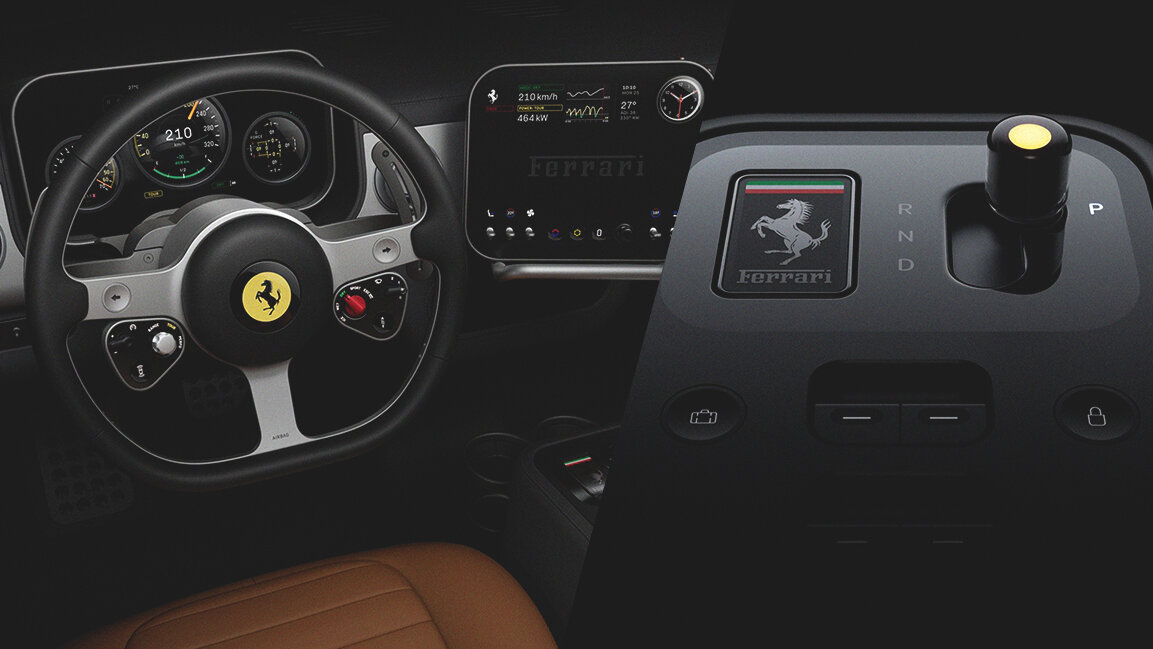
The interior offers the clearest insight into Ferrari’s electric design thinking. Conceived as a single, cohesive volume, the cabin is calmer and more spatially open than previous Ferrari interiors. Visual complexity has been reduced, with forms simplified to support focus and driving engagement.
Rather than reinventing familiar elements, the design team refined each component to its essential form. The result is an interior that prioritises clarity and usability at a time when interaction with technology is becoming increasingly central to the driving experience.
Hardware and software were developed together, allowing the physical layout and digital interfaces to function as a unified system. Core elements such as the binnacle, control panel, and central console are clearly organised around inputs and outputs, reinforcing intuitive use.
Ferrari describes the process as holistic, driven by extraordinary care and shaped by some of the most influential minds in technology design. Every component was engineered with quiet precision, integrating seamlessly into a unified aesthetic and functional whole—one that preserves and intensifies the emotional thrill of driving a Ferrari, even in silence.
Materials as message
Manufacturing processes were treated as an extension of the design philosophy. Ferrari used advanced production techniques to present materials in their most refined form, balancing modern precision with longevity.
Durability played a central role in the selection of materials. Aluminium features prominently, chosen for its compatibility with precision machining. Interior components are made from 100% recycled aluminium alloy, machined from solid billets using advanced CNC techniques. A specialised anodisation process creates a fine hexagonal microstructure on the surface, improving resistance, hardness, and surface texture while maintaining colour depth over time.
Glass elements are precision-milled from Corning Gorilla Glass, selected for its scratch resistance, durability, and optical clarity. The material reinforces the balance Ferrari is aiming to strike between technical performance and tactile quality.
Designing Ferrari’s electric future
Ferrari positions Luce as more than its first fully electric sports car. It represents an attempt to rethink performance through design, materials, and interaction, rather than relying solely on powertrain innovation.

Featured Videos
Today's Top Stories:
More Top Stories:



FROM OUR PARTNERS