
- | 10:00 am
The future of work will be built through global cooperation, not isolation
As AI reshapes jobs and skills gaps widen, the Saudi labor minister argues that collaboration is now a labor market imperative.
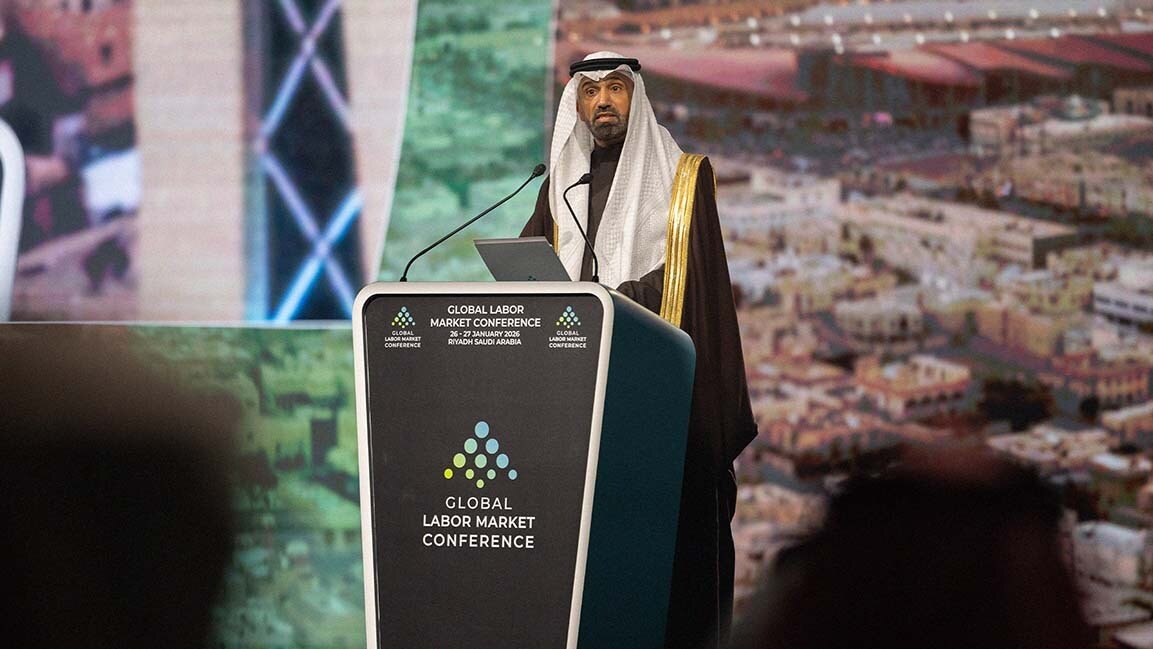


The future of work is no longer something countries can design in isolation. That was the central message from H.E. Ahmed Al-Rajhi, Saudi Arabia’s Minister of Human Resources and Social Development, as he inaugurated the third Global Labor Market Conference in Riyadh.
“Labor markets worldwide are experiencing rapid transformation due to technological advancements, demographic changes, and evolving skills requirements,” Al-Rajhi said, framing the challenge as inherently global rather than national.
The scale of disruption is already visible. Since 2020, more than 2.5 million young Saudi men and women have joined the private sector, a shift Al-Rajhi cited as evidence that labor-market reform can expand opportunities when institutions and incentives are aligned. Still, he stressed that Saudi Arabia’s progress is set within a broader global context.
Globally, more than 260 million young people remain unemployed or lack access to education and training, underscoring why labor market policy is becoming central to economic strategy. “This reality highlights the need to focus on labor markets as engines for job creation,” Al-Rajhi said.
Technology sits at the center of this transformation. Artificial intelligence, robotics, and automation are reshaping roles across sectors, often faster than workers can retrain. “Artificial intelligence is among the most influential factors reshaping labor markets globally,” Al-Rajhi said. While these tools have increased efficiency, he noted, they have also displaced many traditional roles, compressing the timeline for reskilling.
That compression is forcing a rethink of priorities. According to Al-Rajhi, “the future of work is now centered on sustainability and a deeper understanding of labor market transformations,” signaling a shift away from short-term productivity gains toward long-term resilience.
Discussions at the conference reflected this recalibration. Ministers and experts examined how countries are responding, from Singapore’s alignment of education investment with labor market needs to emerging global frameworks for skills development and workforce mobility. “Exchanging experiences among countries and individuals is essential to achieving a deeper understanding of labor markets,” Al-Rajhi said.
For Saudi Arabia, labor market reform has been closely tied to institutional strength. “The success of labor market reforms depends on strong institutions and effective coordination among government entities,” Al-Rajhi noted. Under Vision 2030, he said, the kingdom has focused on “strengthening labor market institutions, expanding skills development, and increasing workforce participation.”
The conference also served as a launchpad for new global initiatives. Al-Rajhi announced the Takamul Academy, a platform aimed at building labor market expertise across regions, with plans to reach 75 countries over the next three years. New research developed with the World Bank was also introduced, offering data-driven insights into how labor markets are responding to rapid technological, environmental, and geopolitical change.
Those forces are increasingly interconnected. The global shift toward environmental sustainability is accelerating demand for green jobs, while geopolitical uncertainty is shaping employment patterns and investment decisions. Together, they are redefining which skills matter and how quickly workers and institutions must adapt.
With more than 40 labor ministers, hundreds of international speakers, and thousands of delegates participating, the Global Labor Market Conference positioned itself as more than a convening. It served as a working platform that moved from diagnosis to coordination. As Al-Rajhi put it, the goal is not simply to understand change, but to ensure that labor markets are prepared to manage it together.

Featured Videos
Today's Top Stories:
More Top Stories:





FROM OUR PARTNERS