
- | 9:00 am
AI is ready to collaborate. But is the Middle East still fixated on automation?
Experts suggest that a more meaningful measure would be how effectively AI assists in thinking with data, making informed decisions, and engaging in shaping the systems that impact them.


It’s a time when more tech companies are laying off employees and warning of the impact of automation.
In July, Amazon announced its millionth worker robot. JPMorgan Chase and Goldman Sachs are harnessing AI to employ fewer people. Ford CEO Jim Farley warned that AI will “replace literally half of all white-collar workers.” Salesforce’s Marc Benioff claimed AI is already doing up to 50% of the company’s workload. Shopify’s CEO, Tobi Lutke, also warned of the impact that AI will have on staffing.
Companies are employing customized AI agents to automate functions in customer support, marketing, coding, content creation and elsewhere. The leap is profound. There’s no doubt that our future will feature more automation than our present.
Automation like that working in Amazon facilities comes with the promise of productivity gains, and maybe one day we can automate everything, but is it a meaningful and sustainable vision of progress?
FINDING A DIFFERENT PATH
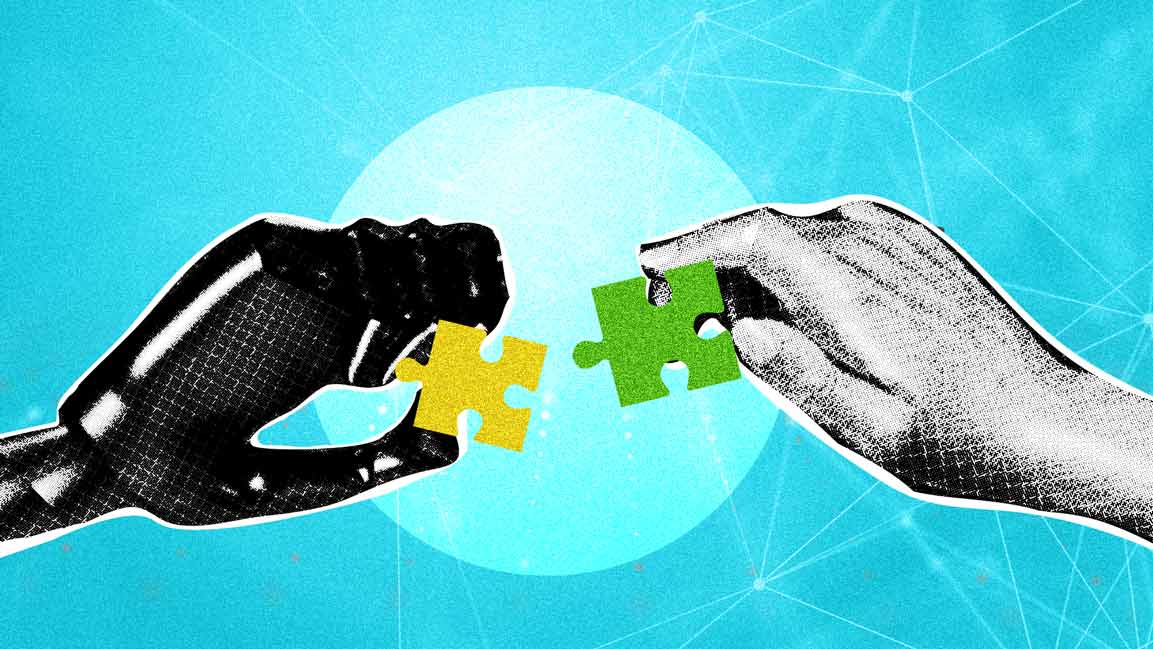
Many AI experts are now advocating for a completely different approach to AI. Instead of viewing AI solely as a means of automation—measuring how effectively a system can independently perform tasks traditionally done by humans—why not harness its extraordinary capabilities for collaboration? By treating AI as a tool for acceleration rather than substitution, we can reorganize and develop systems that integrate both AI and human input. This shift in perspective has the potential to reshape every workflow, decision, and product we create.
“Measuring progress in AI by how well systems can imitate or replace human tasks misses much of what matters in our relationship with intelligent systems,” says Dr. Laura Koesten – Assistant Professor of Human-Computer Interaction, Mohamed bin Zayed University of Artificial Intelligence (MBZUAI).
Dr. Koesten, who studies human–data interaction, emphasizes that progress is not about automation; it revolves around how systems enhance understanding, collaboration, and agency—creating a partnership with AI that leverages the strengths of both approaches. “When AI produces an unsatisfactory result, people should be able to understand why and have the means to correct or steer it in a better direction.”
There is a perspective that automation presents a techno-centric view of progress, overlooking its broader societal impacts. Aditi Nitin, Partner for AI & Data at Deloitte, suggests that a more balanced approach would consider how AI enhances human well-being and improves capabilities and efficiency, thereby reshaping the future workplace.
Also, AI’s autonomy is limited. When it operates independently, it rarely produces satisfactory results, says Prof. Nathalie Martial-Braz, Chancellor of Sorbonne University Abu Dhabi. “It is through interaction with humans that the machine becomes truly effective.”
She adds: “Real progress lies in the complementarity between the analytical power of AI and the human ability to structure, interpret, and give meaning.”
AI is becoming good at many “human” jobs—diagnosing disease, translating languages, providing customer service—and it’s improving fast. While AI will radically alter how work gets done and who does it, the technology’s larger impact will be one of collaboration with humans, not replacement. It’s about humans and AI joining forces, enhancing each other’s strengths.
THINKING OF AI AS A PARTNER
The obsession with autonomy is incompatible with how professionals actually work. In most fields, expertise is deeply social and interpretive. Decisions emerge from collaboration, context, and judgment. For example, professionals like doctors, lawyers, and engineers don’t follow simple, repeatable scripts.
Ahmed Ibrahim, AI Sales & GTM Executive for the Middle East, Africa, Turkey, Romania, and CIS at Cisco, says their work relies on judgment, empathy, adaptability, and context-switching. For such professionals, he says, “AI should function as a co-pilot, managing data-heavy, time-consuming tasks, such as summarizing patient records, drafting legal briefs, or analyzing network telemetry, to free up humans for high-value judgment.”
In medicine for example, Nitin says diagnosis isn’t just about pattern recognition, it needs to be analyzed along with patient history, comorbidities and human dialogue to ensure the patient understands the diagnosis, gets reassurance that the prognosis is right and feels confident about the course of action/remedy. “Prognosis and remedy aside, psychological and emotional states are known to have an impact on human healing, which AI can’t provide alone in this case.”
Thinking of AI as a partner rather than a replacement aligns much better with reality. Dr. Koesten says, “Systems that support professionals by helping them see patterns, test ideas, or communicate complex information can complement, and even augment, human expertise rather than imitate it.”
Currently, researchers from Carnegie Mellon University’s Tepper School of Business are learning how AI can be used to support teamwork rather than replace teammates. Anita Williams Woolley, a professor of organizational behavior, researches collective intelligence, or how well teams perform together, and how AI could change workforce dynamics and how AI can play a positive role.
Woolley collaborated with technologists and others in her field to develop Collective HUman-MAchine INtelligence (COHUMAIN), a framework that seeks to understand where AI fits within the established boundaries of organizational social psychology. The researchers behind COHUMAIN caution against treating AI like any other teammate. Instead, they see it as a partner that works under human direction, with the potential to strengthen existing capabilities or relationships.
Progress depends on how AI enhances decision-making, productivity, and collaboration.
Ibrahim emphasizes that AI’s true potential lies in augmenting human creativity and problem-solving rather than completely replacing it. He states, “At Cisco, we design AI solutions to complement humans, not replace them. Our AI-ready infrastructure securely and ethically integrates AI into human workflows, ensuring seamless integration and optimal performance. By building trust and ensuring adaptability, we position AI as a collaborative tool that drives sustainable growth and innovation.”
DESIGNING AI SYSTEMS
For effective human-AI collaboration on a large scale, experts say it is essential to design AI systems that know when to seek assistance, how to make their logic transparent, and how to enhance human judgment.
Dr. Koesten emphasizes that intelligent systems should not only provide results but also clarify the process behind those results, including their limitations and any uncertainties in the underlying data. Ultimately, individuals should be accountable for the decisions they make.
“Designing AI to expose its reasoning and data foundations allows users to question, interpret, and act responsibly. This approach fosters a more reflective and informed engagement with AI, moving beyond passive usage,” adds Dr. Koesten.
All sound AI systems are built with the AI ethics framework as the backbone, says Nitin, adding that Deloitte has a Trademarked TrustworthyAI framework that suggests all AI must have a human in the loop, it must come with cited sources, it must not allow for hallucinations, and it must be fully secure and governed.
“If these principles are followed, AI systems will always amplify human judgment and will come with the trust seal to help society move forward with AI,” adds Nitin.
Current algorithms are designed to please the requester, says Prof. Martial-Braz, and this makes it essential to train humans to remain in control of outcomes. She says the university’s role is crucial in preventing the black box effect of AI. “Solid training in mathematics to program the tool, but also in the humanities to ensure that the machine relies on objective and verified content.”
WILL HUMANS REMAIN KEY IN AUTOMATION?
In the coming years, experts assert that humans will continue to play a crucial role in automation. This is because, for machines to operate efficiently, their data must be accurate, verified, and structured—tasks that fundamentally require human involvement. Automated systems need human oversight for strategy, governance, ethics, and ongoing improvement.
In areas such as purpose setting, managing context and exceptions, orchestrating human-machine collaboration, ensuring accountability of the systems, and finally, in bringing meaning and judgement to organizations, humans need to play a pivotal role, says Nitin. “AI systems will be built by designing systems augmenting human strengths.”
Pointing out that the human element is not a barrier to automation but a catalyst for delivering business value, Ibrahim says the region’s investment in AI is ultimately an investment in its people. “By positioning AI as a collaborative tool, we are creating demand for AI augmented experts, professionals who deploy, manage, and interpret AI systems. These individuals are essential to building the talent pipeline and realizing regional digital goals.”
Globally, for AI companies such as ChatGPT creator OpenAI and Elon Musk’s xAI, as well as Google, Meta, and Anthropic, the ultimate pursuit is AI that can rival and even surpass the intellectual capabilities of humans. They are spending tens of billions of dollars a year on infrastructure needed for the development of the large language models, which are improving intelligent automation at exponential rates.
The societal impacts are already profound, and experts say if we celebrate AI only when it performs “as well as” or “better than” a person, we risk flattening a much more complex reality—one in which the social, ethical, and interpretive dimensions of how these systems shape human experience matter just as much as their raw performance metrics.
As Dr. Koesten says, a more meaningful measure of progress would be how well AI helps people think with data, make informed decisions, and participate in shaping the systems that affect them. “Automation can process information at scale, but humans bring context, creativity, critical thinking, and ethical judgment.”
The real potential lies in AI and humans working together, where AI remains human-centered, complementing the work they do.