- | 9:00 am
With Apple’s help, storytellers are figuring out Vision Pro
The headset opens up immersive new opportunities for dramas, documentaries, music videos, and beyond. Some filmmakers and developers are diving right in.


More than any other Apple product, the Vision Pro is still—to quote Bob Dylan by way of Steve Jobs—busy being born. Announced at the Worldwide Developers Conference (WWDC) on June 5, 2023 and shipped the following February, the $3,500 spatial computing headset has evolved some since its first release. This year brought a meaty operating system upgrade and a slightly revised version of the device sporting Apple’s powerful new M5 chip.
But much of the progress the Vision Pro has made hasn’t stemmed from the routine tick-tock of software and hardware updates. Apple has also been throwing itself into the equally vital work of getting third-party developers and creators to build experiences that will help the rest of us understand what, exactly, its headset is good for. That was the goal of a Vision Pro developer event the company held at its Cupertino campus in late October.
Unlike the sprawling, online-first WWDC confab, this gathering—part of an ongoing series called “Meet with Apple”—was intimate and focused. Yes, a worldwide audience tuned in via livestream, and Apple later posted videos from the event on YouTube. But in-person attendees got to mix, mingle, and witness onstage presentations in the Apple Developer Center’s Big Sur theater, a 200-seat venue named after the 2020 MacOS release. And every minute of the two-day meeting was devoted to sharing best practices about the art and science of creating immersive media for the Vision Pro.
![This year’s Vision Pro has Apple’s latest M5 chip and a more comfortable Dual Knit Band. [Photo: Courtesy of Apple]](https://images.fastcompany.com/image/upload/f_webp,q_auto,c_fit,w_1024/wp-cms-2/2025/12/i-2-91461534-developers-and-creators-are-figuring-out-apples-vision-pro.jpg)
This year’s Vision Pro has Apple’s latest M5 chip and a more comfortable Dual Knit Band. [Photo: Courtesy of Apple]
The fact that there are best practices to share reflects Apple’s own growing confidence as a creator of experiences for its own device. “We’ve seen a lot of great momentum over the last several months with third-party creators,” says senior director of Apple Vision Pro product marketing Steve Sinclair. “And a lot of that is steeped in learnings that we’ve had over the last 12 to 18 months of making this type of content.”
Such advances are essential to the Vision Pro’s future. In August, Bloomberg’s Mark Gurman argued that the headset was stuck in a catch-22 situation. Without a sizable base of Vision Pro customers, Apple wasn’t incentivized to release vast quantities of content in Apple Immersive Video, its format for 3D 8K video with spatial video. But the lack of such content made the Vision Pro a less tempting purchase, even for people with a spare $3,500 to spend on it.
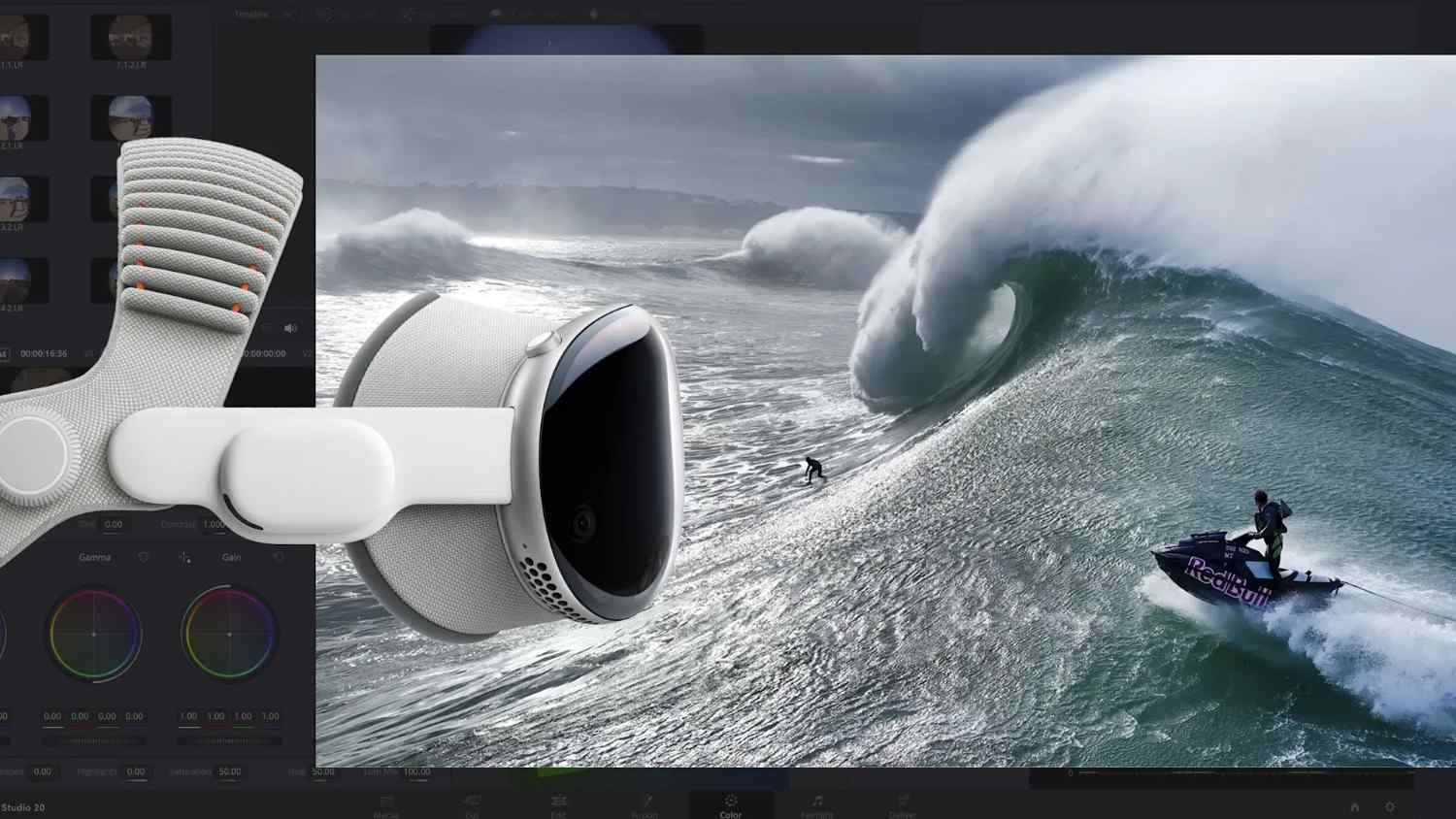
Gurman did say that third-party creators might help increase the amount of available content. He also noted the release of two products from Blackmagic Design: its $33,000 Ursa Cine Immersive camera and a new version of the DaVinci Resolve video editor capable of handling Apple Immersive Video. They will help independent creators tackle immersive production, a process that has historically involved, as Blackmagic business development manager Dave Hoffman puts it, “rigs that were bespoke and really kind of science projects.”
![Blackmagic Design’s Apple Immersion Video-ready Ursa Cine Immersive camera [Photo: Courtesy of Blackmagic Design]](https://images.fastcompany.com/image/upload/f_webp,q_auto,c_fit,w_1024/wp-cms-2/2025/12/i-6-91461534-developers-and-creators-are-figuring-out-apples-vision-pro.jpg)
Blackmagic Design’s Apple Immersion Video-ready Ursa Cine Immersive camera [Photo: Courtesy of Blackmagic Design]
At Apple’s event, I spoke with filmmakers and developers who are already producing Apple Immersive Video and other forms of Vision Pro content. (The terminology can get tricky: Not everything on the headset that’s immersive and/or video is Apple Immersive Video, a specific technical specification.) Given the venue, it’s not shocking that they spoke highly of the assistance the company has given them. Yet they also talked about the adventure of diving into a medium that’s still finding its way.
Figuring out immersive storytelling “has kind of felt like sailing off into the unknown and drawing the map as you go,” says cinematographer Ben Allan, the author, along with his wife, writer-director Clara Chong, of a book about Apple Immersive Video filmmaking. For now, there aren’t that many content consumers along for the trip. But if it some eventual version of Apple Vision becomes a mainstream hit, the pioneers currently adopting the medium will share in the credit.
“In music video, in documentaries, and scripted content, there are things that are working extremely well and that [can] be used as a template for the future,” says Victor Agulhon, the CEO of Targo, whose Vision Pro interactive documentary app D-Day: The Camera Soldier, produced in collaboration with Time magazine, was an Emmy and Apple App Store Awards finalist this year. “How much time it’s going to take to get to a hundred million users, we don’t know. But I do believe that the kind of experience you can get on these headsets today is definitely worth having by hundreds of millions of users.”
Really, truly immersive
In the grand scheme of things, the Vision Pro’s new features scratch timeless itches. Certainly, the desire to conjure up you-are-there experiences was foundational to movie-making as a medium. As VisionOS design evangelist Serenity Caldwell noted onstage at Apple’s event, audiences were thrilled by the realism of the Lumière brothers’ 50-second 1896 film showing a train arriving in a French station. (One contemporaneous reaction: “It speeds right at you—watch out!”)
By putting 23 million pixels of 3D video directly in front of your eyes, the Vision Pro can create effects the Lumières wouldn’t have dared to dream about. Ultimately, though, the headset’s twin Organic Light-Emitting Diode (OLED) displays, eye-tracking sensors, front-facing cameras, and other technologies go only so far to shape the platform. It’s still up to creators and developers to determine how to draw users into stories in ways that are inviting rather than off-putting or disorienting.
That involves a bevy of decisions, some of which Caldwell walked through during her talk. Should you keep the real world surrounding the user fully visible, dim it a bit, or block it out entirely? Is it better to unleash visual spectacle as quickly as possible, or to kick off an experience with more subtle effects? How do you use gestures to ensure that users feel like they’re in control?
Anyone creating Mac apps builds on more than 40 years of lessons about how to put users at ease; the iPhone, iPad, and even the Apple Watch are also mature platforms at this point. The Vision Pro is different. “Immersion is a powerful tool for media experiences, but we have a responsibility as storytellers to consider the audience experience whenever we use it,” urged Caldwell. “Remember, this is still a new platform. Your app might be the first thing someone sees on VisionOS and the first thing they try, so it’s important to make sure that that experience is a great one.”
Even if that’s a sobering responsibility, it can also be an exciting opportunity. Filmmakers Allan and Chong saw it that way. “We saw this technology at the early stages, and just went, ‘Wow, this is going to be a thing, and we want to get in on it as soon as we can,’” recalls Allan. Each has around 30 years of movie-making experience and an appreciation for new tech. In the previous decade, they’d even made a family film projected on a wraparound 5:1 screen at Sydney’s Taronga Zoo, a project Chong calls “a really big head start” in understanding the Vision Pro’s potential.
Allan and Chong have recently completed two Apple Immersive Video films: a five-minute documentary on the most Instagrammed cake in the world and a romantic drama. Both are far afield of the eye-popping extravaganza typical in early Vision Pro experiences. Indeed, their drama consists entirely of two characters talking to each other, something that can be a challenge to make compelling even in a non-interactive 2D movie. “We thought, ‘Well, if we can pull that off, you can do anything cinematically with this format,’” says Chong.
Director and photographer Anton Tammi had an eminently practical reason for getting into Vision Pro storytelling: Singer-songwriter The Weeknd asked him to. The two have worked together on music videos for years. “I guess my style was something that the artist himself really felt that would make sense in the immersive format,” muses Tammi.
Their video, for The Weeknd’s “Open Hearts” single, was released in November 2024. “Because it was one of the very early-stage projects, I guess almost like an R&D project with Apple Immersive, I felt like I really was taken good care of by the Immersive team,” says Tammi. “I learned a lot. I almost went through this school of immersive filmmaking.”
![[The Weeknd, up close and personal in his ‘Open Hearts’ video. Photo: Courtesy of Apple]](https://images.fastcompany.com/image/upload/f_webp,q_auto,c_fit,w_1024/wp-cms-2/2025/12/i-5-91461534-developers-and-creators-are-figuring-out-apples-vision-pro.jpg)
[The Weeknd, up close and personal in his ‘Open Hearts’ video. Photo: Courtesy of Apple]
The video’s vibe isn’t a radical departure from The Weeknd and Tammi’s previous collaborations. It’s just that Apple Immersive Video both opens it up and brings it closer. Over three and a half minutes, it drops you into several worlds, featuring everything from majestic galloping horses to gritty Los Angeles cityscapes to a surrealistic conclusion I won’t spoil here. You also get face-to-face with The Weeknd, who at times seems to be just millimeters away. (Right after removing the headset, I watched the same video on my iPad, where he looked trapped behind glass by compsarison.)
Despite totally feeling like a Weeknd video, “Open Hearts” required Tammi to rethink his filmmaking techniques and priorities. “Because of the crazy attention span shortening that’s happening around us, music videos and social media stories and whatever have extremely fast-paced cutting,” he explains. With Apple Immersive Video, “You can’t do that, and I don’t think the viewers need that.” He estimates that a previous Weeknd video he directed, “Blinding Lights,” includes 300 to 400 cuts. “Open Hearts” has around 30.
History via headset
Even unleashed on the Vision Pro, “Open Hearts” remains a music video in the classic sense. Targo’s D-Day: The Camera Soldier is tougher to nail down. Part app, part documentary, it painstakingly weaves together new and archival footage with still images, CGI video, and 3D artifacts such as WWII dog tags and medals. “It’s a 20-minute experience, and there was a nine-month production,” says CEO Agulhon.
It’s easy to imagine the real-life story that inspired it—involving a Connecticut woman learning about her father’s work as a combat cameraman during the Allies’ landing at Omaha Beach—being told in a conventional documentary. But the Vision Pro both demands and rewards attention in a way that differs from other media. “If you look at the data of what people do when they watch TV, for instance, everyone’s actually on their phones and doing something else,” says Agulhon. Not so once you’ve slipped on Apple’s headset.
Consequently, the 20-minute running length isn’t a fluke. Targo has eight years of experience making interactive documentaries for platforms such as Meta Quest, ranging from 10 to 40 minutes. According to Agulhon, at 20 minutes, “the time flies by for [viewers], but it’s still a very intense experience.”
![Targo’s D-Day: The Camera Soldier documentary app [Photo: Courtesy of Targo]](https://images.fastcompany.com/image/upload/f_webp,q_auto,c_fit,w_1024/wp-cms-2/2025/12/i-4-91461534-developers-and-creators-are-figuring-out-apples-vision-pro.jpg)
Targo’s D-Day: The Camera Soldier documentary app [Photo: Courtesy of Targo]
Targo built parts of D-Day using a game engine, but it’s not gamelike: Nothing the viewer does affects the flow of the narrative or its outcome. Instead, the app has some of the feel of an uncommonly rich museum exhibit, where touching some of the items—if only virtually—is not only allowed but a defining feature.
“One concept we leaned into was that we could transform moments of time into places that people can explore,” says Agulhon. “That’s an effect that only immersive can bring to you.“
Another immersive media studio, Rogue Labs, leaned into an entirely different use for the Vision Pro: Helping people learn to fly helicopters. (Not coincidentally, its founder also owns a helicopter flight school.) Released in November, its app, Flight Sight, melds Apple Immersive Video, CGI helicopters and scenes, and flat videos and maps. To recreate real-world instruction, Rogue staffers shot POV video by strapping a Blackmagic Ursa Cine Immersive camera into the seat where a student pilot would sit. Since helicopters are—in Rogue creative and technical director John Racine’s words—“giant vibration machines,” the filmmakers had to both stabilize the camera and perform additional stabilization in post-production.
Flight Sight isn’t a flight simulator or an FAA-accredited way to log training hours, but that isn’t the point. “It’s more of a supplemental tool that will help you become familiar with the helicopter, hopefully more quickly, and hopefully help you save some money from time that you would spend in the helicopter watching your instructor do some of these maneuvers over and over again,” says Rogue Labs president Cory Hill.
The company also hopes to grow the community of helicopter pilots by sparking the imagination of Apple Vision owners. “Everybody we show it to, whether they’re full-on pilots or someone who’s never been in a helicopter before, they watch it, and they instantly say, ‘This makes me want to learn how to fly a helicopter,’ which is what we want to do,” says Racine. That said, Rogue is also filming additional content in scenic locales, such as Catalina Island and Channel Islands National Park, whose splendor might draw in those of us who are happy to keep our ‘copter piloting strictly virtual.
![A helicopter takes off in Flight Sight. [Photo: Courtesy of Rogue Labs]](https://images.fastcompany.com/image/upload/f_webp,q_auto,c_fit,w_1024/wp-cms-2/2025/12/IMG_0016.png)
A helicopter takes off in Flight Sight. [Photo: Courtesy of Rogue Labs]
Even the coolest single immersive video or app won’t silence all doubts about the Vision Pro being a sufficiently enticing consumer product to lead to bigger things for Apple. But a flurry of recent announcements involving high-profile names might help. In September, the company unveiled a new slate of Apple Immersive Video shows with partners such as the BBC, CNN, CANAL+, and Red Bull, ranging from classical music concerts to a documentary about emperor penguins. A month later, it revealed that select Los Angeles Lakers 2025-2026 season games will stream live, courtesy of Spectrum SportsNet.
Ultimately, as with every new Apple platform before it, the odds are decent that the Vision Pro will end up being defined not by items the company had an active hand in willing into existence, but rather ones nobody saw coming. “There are a lot of stories that people want to tell, and they’re seeing that the immersive capabilities of Vision Pro and the toolsets that we offer, and some of our partners offer, really give them a chance to tell those stories in new ways,” says Apple‘s Sinclair.
And some of those new ways are yet to come, Take longer-form immersive narratives, which Blackmagic Design’s Hoffman contends nobody has yet mastered.
“From my perspective, the tools are there now, and I know there’s a couple of people that are trying to figure out what the challenges are,” he says. “How do we work out situations where you used to do cross shots and closeups and mid-range shots and all that kind of stuff? That dialogue is going on right now, and someone’s going to hit it. Some filmmaker is going to be like, ‘Yeah, this is how we do it.’” A few more of those epiphanies, and the Vision Pro might eliminate any residual sense that it’s uncharted territory for storytellers.