
- | 9:00 am
Email inboxes are AI’s next gold mine
Despite texts, DMs, and Slack, tech companies are racing to own your inbox. Why? It’s the key to unlocking personalized AI.
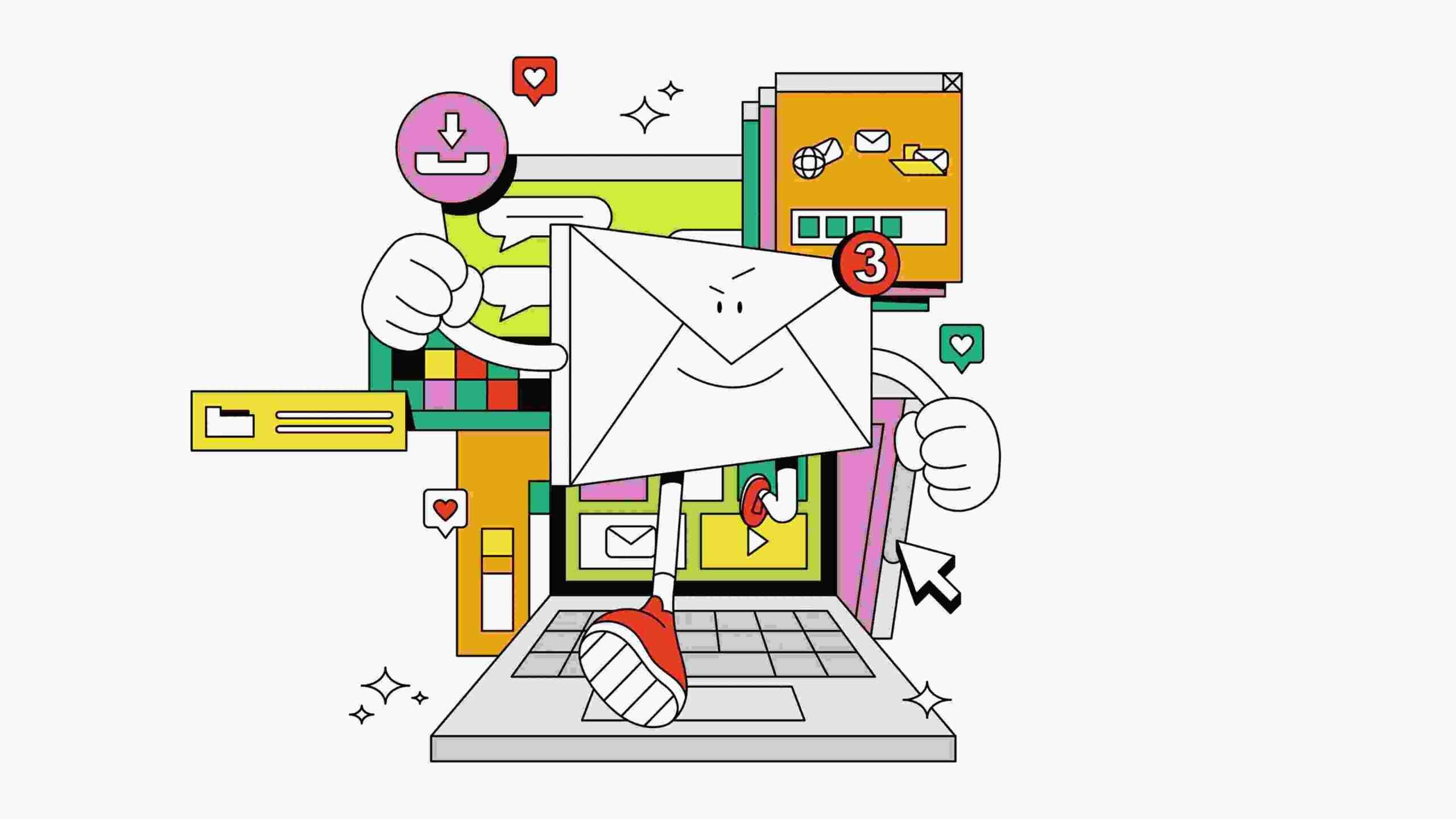


The founder of Slack once deemed email “the cockroach of the internet.” He wasn’t the first to lament the extreme survivability of our inbox. From text messages to social media to office messaging platforms, all sorts of communication technologies have teased the promise of killing email by connecting us to others in faster, richer ways.
And yet, more than 50 years after its invention, ye olde email is more popular than ever. Some 1 billion people spend three hours a day in email—adding up to more than a trillion hours collectively per year, according to the email app Superhuman. And there’s no sign of this slowing down. “More people use Gmail every single month than ever before,” says Blake Barnes, head of Gmail product, who oversees the experience of more than 2.5 billion users on the world’s most popular email platform.
To some, email is an endless guilt machine: The average person receives dozens of messages each day but takes action on fewer than five, according to Yahoo. And the range of emails we receive is wild to comprehend: personal notes. Newsletters. Amazon package updates. Dinner reservations. Jira tickets. LinkedIn invites. Passwords we’ve sent to ourselves. Strange conspiracy theory chain letters forwarded along by a second cousin once removed.
Email has become the junk drawer for our digital lives. A catchall for intimate and automated messages, our inboxes contain too much information for most people to process. “Your last 100 emails are more unique than your fingerprint,” says Anant Vijay, product lead behind the encrypted-email platform Proton Mail. “Even if you’re using another app to do something, there’s an imprint left in your email.”
And therein lies the opportunity. Not only is email refusing to go away, it’s becoming more important than ever in our new, data-hungry world. And startups and incumbent tech companies alike are vying to control it.
A slew of email apps have launched in recent years—including Notion Mail, from emerging productivity giant Notion, and the organization-minded Shortwave—each with a different set of handy UX features for juggling your inbox. At the same time, giants like Yahoo and Google are racing to maintain their dominance. But nowhere is the value of email more evident than writing-assistance titan Grammarly’s acquisition of email startup Superhuman for an undisclosed amount over the summer. (Superhuman was last valued at $825 million, in 2021, according to PitchBook.) In October, Grammarly rebranded itself as Superhuman.
Ultimately, these companies aren’t so much betting that email will be the future of communication but that its treasure trove of data contains all the information needed to create the personalized AI systems of tomorrow. By owning email, they plan to claim your whole life.
The ‘Overwhelming’ inbox
The promise behind most email platforms is sanity. The average person faces 400 unread emails at any given moment. And given that the subject and first few lines of any email tend to be generic, it can be hard for people to extract insights at a glance.
“It’s just overwhelming,” says Kyle Miller, GM at Yahoo Mail, the world’s second-largest email platform, with hundreds of millions of users. “Some users don’t see [inbox zero] as a goal, and that’s okay. What we’re trying to do is help them get out this clutter so then they don’t miss the stuff that’s important.”
To help users tackle the mess, Yahoo recently started gamifying the task with a daily Inbox Challenge that gives users trophies for triaging their messages. Other email platforms are supercharging the auto-sort function. Eleven-year-old Proton, which relaunched its security-focused email app earlier this year, not only compiles your newsletters into one stack, it also displays your average open rate for each, so you can decide if it’s time to unsubscribe.
Notion Mail, launched in April, distinguishes itself by letting you sort email by any content criteria you can think of. For instance, you can ask Notion to label incoming job applications as “Job Candidates” or have your home renovation emails sorted to “Home Improvements.” Superhuman offers similar features, along with an auto-reply service that drafts responses tailored to recipients and in your own voice and tone. All you need to do is hit send.
Modern AI makes these advanced features possible. When Superhuman founder Rahul Vohra was fundraising 11 years ago, an investor asked him how he planned to realize the magical interactions he’d teased in his investment deck. “Frankly, I don’t know,” Vohra said at the time, though he, like many, trusted that the technologies would eventually arrive. Today, Superhuman says that its users reply to 72% more emails per hour after signing up, thanks largely to a combination of auto-sorting and auto-writing tools.
“[Email has] always had all this data, but up until large language models, there was no way for the computer to access that information,” says Andrew Lee, who launched the email client Shortwave in 2022 to pick up where Google left off when it folded its short-lived Inbox app (which bundled messages into categories and allowed you to snooze messages). “You can go through and read [your emails], but it’s a huge amount. We have people with 10 million emails in the system. And now the computer can just go and read 10 million emails!”
Email apps are going beyond mere sorting to use LLMs to extract data and surface insights that allow users to make faster decisions. In the case of Yahoo Mail, that means emails now have action buttons placed right below the subject line. Those actions might be copying a security code or RSVP’ing for a birthday party or paying a bill, “so you don’t even have to open the email,” Miller says.
Superhuman and Shortwave, meanwhile, let you manage the deluge by querying your mail directly. You can ask the AI straightforward questions (“Where is the Q1 off-site?” or “What time is my flight to Denver?”), and these services will analyze your email for the answers, much like Perplexity will hunt for information across the internet.
Proton Mail, which encrypts email to offer a higher level of security, is the rare exception: The company sees cloud-based LLMs as an inherent security risk. But product team lead Anant Vijay Singh believes that within a few years, high-quality AI models will be able to run on your phone or computer—allowing them to analyze your emails securely.
A growing number of email users, however, seem willing to hand over their most precious data in the name of unlocking new efficiencies. To set up a new Shortwave account, for example, you first have to copy over your inbox for analysis on the company’s servers. Shortwave, which has enterprise plans for teams of 50 or more, explains the security risk to prospective clients.
“I have calls with people at investment firms and Fortune 500 companies. I see the concern on their faces. And then they’re like, ‘Nah, but I want it!’” says Lee. “There’s a lot of pressure in these companies for security, but there’s even more pressure to figure out a [corporate] AI strategy.”
Agentic for email
While some of these email services can be used for free, all of them reserve their best features for people willing to pay for a subscription—up to $40 per month for a Superhuman business account. But those initial dollars aren’t the endgame. Modern email apps are positioning themselves at the top of the funnel to pull you in—and offer agentic services that go well beyond managing your correspondence.
Yahoo’s first salvo will be connecting your inbox more directly to your calendar. The company is working on a product that could take information out of your email and offer it back to you as a list—and then pin the items to suggested dates on your calendar. Yahoo plans to further build this out, so its AI agent will eventually handle many of these to-dos for you.
Google is thinking along similar lines. “In the future, you can imagine a world where [your] calendar understands you deeply,” says Google VP Barnes. “It knows when you’re eating dinner with your family. It knows when it’s best to meet a new prospective client, when you’re most fresh.”
Vohra from Superhuman envisions a future where an AI agent is cc’d on emails, allowing it to take over tasks, like scheduling a meeting. “Our two AI agents can find time and book meetings for us despite neither of us actually having access to each other’s calendar,” he says.
Indeed, AI is rapidly breaking email out of its inbox. Shortwave recently launched a spin-off platform, called Tasklet, that lets users program background agents that connect their email and calendar to more than 3,000 services via APIs. For heavy email users, these agents hold a lot of promise. Real estate agents could use plain language to program a daily search of new homes for a prospective client. Meanwhile, product developers could use agents to track updates from disparate apps and correlate them into a dashboard that tracks bug reports and patches.
As for Gmail, Barnes says that not only will it get the power of the AI Overviews we’ve seen in Google Search, but Google Search will get the knowledge of your email to personalize its results: “What if Gemini could help you plan a vacation with all of the context Gmail has? Imagine that experience. We know what kind of places you like to go to. We know the budget you usually spend. We know how many people you’re traveling with.” Eventually, this could evolve into more than a shopping assistant. “It’s like having your own personal chief of staff,” he says.
In a world ruled by AI, most tech strategists believe we’ll no longer be managing our lives by juggling individual apps or even platforms like Slack or Teams. All of this information and communication could sit largely out of sight, most of the time, while an AI with the most intimate and complete portrait of your life helps to make decisions on your behalf.
That’s as exciting for a big data player like Google as it is for a newer startup like Superhuman—because the first challenge is being adept at wrestling that treasured email junk drawer into shape. “We actually feel really great about this,” says Vohra. “Primarily, because we have a massive head start.”