
- | 10:00 am
Hong Kong Unpacked: The coastline keeps moving, but the grammar holds
Inside a city that keeps rebuilding itself without starting over
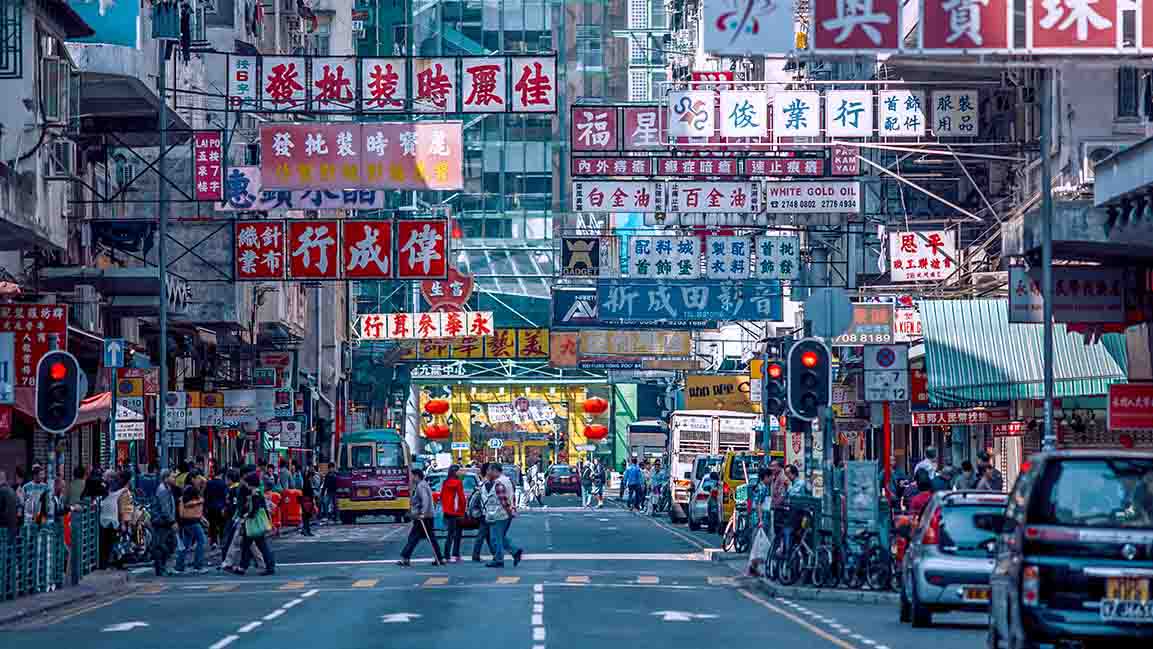


Hollywood Road was one of the earliest roads, completed in 1844, and for its early decades, it ran close to the water. Sailors, merchants, and Chinese traders docked nearby and sold what they had picked up on the mainland. The antique trade settled along it for a practical reason: this was where the goods came ashore.
The road has not moved since. The sea has. Reclamation pushed the waterfront north until a street laid out beside the coastline ended up several blocks inland and well up the hill. The shops stayed where they were, selling the same kinds of objects, now nowhere near the water that put them there.
“It can lead to many fascinating questions and conversations about the geography of the island,” says Lynn Fung, managing director of the Liang Yi Museum, a private museum on Hollywood Road focused on Chinese furniture and decorative arts. The objects, she adds, also raise moral and ethical questions about how they came to be there.
That gap between a fixed street and a moving shoreline is the shortest way into how Hong Kong works. The city repeatedly rebuilds its physical fabric without necessarily resetting the habits, institutions, and relationships that organize life upon it. For nearly two centuries, change and continuity have operated together.
THE GROUND KEEPS MOVING
The clearest place to see it is from above. The Peak Tram has been climbing the hill since May 30, 1888. The first cable funicular in Asia, it was proposed by Scottish entrepreneur Alexander Findlay Smith to open the cooler hill districts to residential development. Before it, reaching Victoria Peak meant a sedan chair.
Once the ascent took minutes rather than hours, the Peak developed into one of the colony’s most exclusive residential districts. On terrain this steep, engineering determines which land can be inhabited and what the city can become.
From Sky Terrace 428, much of the city below is younger than the tram that carried you up: the towers, transport links and reclaimed waterfront. Victoria Harbor is also narrower than it was when the funicular opened. For more than a century, reclamation has moved its shores closer together. From above, the harbor looks less like a fixed boundary than infrastructure under continuous revision.
Across the harbor, the same fact is underfoot. M+, which describes itself as Asia’s first global museum of contemporary visual culture, opened in West Kowloon in 2021. The entire cultural district stands on reclaimed land. A building created to hold the visual memory of Hong Kong, Greater China, and Asia occupies ground that did not exist a generation ago. The city did not find a site for its cultural institution. It manufactured one.
WHAT THE CITY REMAKES
Walk west of the antique shops and the street pattern changes almost without announcement. The lanes straighten, the blocks become more regular, and the surrounding pressure releases into a small park. This is Tai Ping Shan, and its geometry records a disaster.
Bubonic plague broke out here in early 1894. Tai Ping Shan was the worst-hit district, densely built and badly drained. By year’s end, the authorities had condemned nearly 400 residential blocks in Tai Ping Shan for demolition. In their place came a more orderly grid and Blake Garden, the city’s first public park. The Government Bacteriological Institute, overlooking it, opened in 1906. It is now the Hong Kong Museum of Medical Sciences, where one gallery documents what happened on the surrounding streets.
The same logic later operated at a different scale. Kai Tak handled Hong Kong’s air traffic until the small hours of July 6, 1998. After the final departure, its runway lights were switched off at 1:16 a.m.; the first commercial flight landed at Chek Lap Kok at 6:27 a.m. The former runway now carries a cruise terminal and waterfront promenade. Elsewhere on the airport site, a 50,000-seat stadium hosted Chelsea and Juventus in August 2026. Seabed, airport, stadium: three uses inside a single lifetime.
When Hong Kong preserves something, the structure or site often survives while its function changes. Central Market traded until 2003, stood empty, and reopened in 2021 after a revitalization costing more than HK$500 million. Uphill, the Police Married Quarters, built in 1951, reopened as the design hub PMQ in 2014. Preservation here means finding ground for a new job.
WHAT IT CARRIES FORWARD
Lin Heung Lau opened in 1927 and has been in Central for decades. In May 2026, it moved to Sheung Wan, taking familiar elements of the old teahouse with it: trolleys, large kettles, gaiwan cups, and the ordering ritual in which diners stop a passing steamer rather than call a server. At lunch, trolley wheels pass crowded tables as diners lift bamboo lids and decide before the steam moves on. The address changed. The method did not.
Paul Chi-yuen Chan, co-founder and chief executive of Walk in Hong Kong, a cultural enterprise focused on heritage and community experiences, has worked across academia, government, and media. He puts the pattern plainly. “Hong Kong is cosmopolitan on the surface and deeply traditional at heart, and you can read that off a dinner table faster than off any economic indicator.” The city’s openness, he says, is pragmatic, but older codes remain: tea is poured for elders first, and dishes are ordered for the table rather than the individual. “And the shop that has stayed in one family for eighty years is still there, outlasting the international chain across the road that has turned over three times.”
On Graham Street, Kowloon Soy Company gives that observation a shopfront. Founded in 1917, it moved to Market Street during the Second World War and has kept its retail shop at No. 9 ever since. Its Yuen Long factory continues to brew soy sauce by traditional methods.
Wan Chai makes that coexistence visible in a single neighborhood. Virginia Chan, the Canadian-born Chinese founder of Humid with a Chance of Fishballs, runs an independent tour company that uses food to interpret Hong Kong’s history and culture. She has lived in the heart of Wan Chai’s wet-market district for more than four years and calls it “the ultimate blend of heritage and hustle.” Unpretentious wonton noodle shops and cha chaan tengs sit close to specialty coffee bars and international restaurants. The Blue House preserves a different layer of the district’s history; Lee Tung Avenue shows how another historic street can be remade into a polished commercial space.
For Chan, the first misconception to correct is the idea that “Chinese food” refers to a single cuisine. Sichuan mala dishes and Shanghainese soup dumplings belong to different regional traditions. Hong Kong’s local food is rooted primarily in Cantonese cooking but shaped by the city’s own history. Traditional dim sum and roasted meats form one strand. Cha chaan teng culture forms another, with milk tea, pineapple buns, egg tarts, and macaroni soup translating outside influences into everyday local food.
The dining room also has an operating code. At an old-school trolley dim sum restaurant, a guide may explain how to rinse cups and bowls at the table, tap two fingers to thank the person pouring tea, and share a table with strangers. These customs are rarely written down, but widely understood. Knowing them changes a visitor from a spectator into a participant.
The pace is equally revealing. “Service is lightning-fast, tables are shared with strangers, and you order, eat, and pay before you even realize you’ve blinked,” Virginia Chan says of cha chaan tengs and noodle shops. Tight kitchens turn spatial constraint into choreography. A dai pai dong can produce a long menu around a roaring wok station; every surface and movement has a purpose.
The price range mirrors the city. A dollar’s worth of rice rolls, a single-origin coffee, and a three-Michelin-starred dinner can occupy the same few streets. Milk tea and Hong Kong-style borscht tell a similar story: forms from elsewhere rebuilt around local tastes, ingredients, and budgets.
Old Town Central offers the same accumulation. Within half an hour on foot, Paul Chan points out, you can pass sugarcane juice pressed to order, milk tea strained through cloth, wonton noodles made from a family recipe, then sourdough egg tarts and salted-egg-yolk gelato. “None of this was planned as a food district,” he says. “It simply accumulated, layer on layer, on the same few streets.”
Continuity is not guaranteed. The dai pai dong once numbered in the thousands. These licensed street kitchens spread in the 1950s, when licenses were issued in part to support families who had lost their livelihoods in the war. By 2024, seventeen licensed street-side stalls remained. New licenses are no longer issued, and transfers are tightly restricted. Their decline has been shaped as much by policy as by changing demand.
THE INSTITUTIONS THAT HOLD
The Man Mo Temple compound, built between 1847 and 1862, carries one of the route’s oldest surviving civic functions. Its Kung Sor hall was where the local Chinese community met to settle its affairs, and oaths sworn there carried enough weight for colonial courts to recognize them.
Nearby, Kwong Fook Tsz traces its origins to a small temple established in 1851; the present building dates to 1895. It became a refuge for the destitute and dying at a time when many Chinese residents distrusted or avoided colonial hospitals. Conditions there prompted intervention in 1869. Tung Wah Hospital was founded the following year and completed in 1872 as Hong Kong’s first Chinese hospital. Tung Wah has managed Man Mo Temple since 1908. A temple, hospital, and civic hall are connected by the institution, a community built to govern and care for itself.
Continuity here is neither automatic nor sentimental. It survives when a ritual, business, or institution can move into the next premises. It disappears when regulation or economics closes that route. Hong Kong’s grammar holds only because people keep carrying it forward.
WHAT THE CITY ASKS OF YOU
Read the infrastructure as an answer to the terrain and weather. Walk uphill in Old Town Central in summer, and the escalator’s logic becomes clear. Heat settles on the slope, humidity slows the climb, and sudden rain makes every covered connection matter. The Central–Mid-Levels Escalator, air-conditioned malls, and elevated walkways help make dense streets usable. Ride the escalator for a few sections, then step off at Stanley, Cochrane, or Graham streets. Use the system as residents do rather than riding it end to end.
On Hollywood Road, do not arrive with a shopping list. “Look up from your phone, soak in the history, and if something catches your interest, just ask,” Fung suggests. At Man Mo Temple, incense coils hang from the ceiling and burn for weeks. At Chinese New Year, Fung says, people queue for kau cim, shaking a cylinder of bamboo fortune sticks until one falls out. Continue through Tai Ping Shan to Blake Garden and the Museum of Medical Sciences. The fortune sticks are still falling inside a district whose streets were rebuilt after the plague.
Then leave the harbor. The Ngong Ping 360 cable car crosses Lantau’s mountains to Po Lin Monastery and Tian Tan Buddha. It reveals what the skyline conceals: twenty-five country parks and twenty-two special areas together protect around 40 percent of Hong Kong. Its density reflects steep terrain, protected landscapes, and development concentrated on limited urban land.
WHERE TO BASE YOURSELF
Stay in Sheung Wan, Wan Chai, or Old Town Central. Sheung Wan and Central put the escalator, antique lanes, dai pai dong, and post-plague streets within walking distance. Wan Chai gives you the city’s culinary range at street level, from its wet market and local diners to coffee shops and international restaurants.
WHERE TO EAT: WHAT TO NOTICE
Lin Heung Lau, Sheung Wan: Watch for the passing steamers, stop the trolley you want, and decide quickly. The ordering ritual is as important as the dim sum.
Dai Pai Dong, Central: Choose a surviving stall on Stanley or Cochrane Street and notice the kitchen’s exposure to the street as much as the wok hei.
Wan Chai: Begin with a cha chaan teng breakfast, then explore the neighborhood’s newer cafés and international dining rooms. The contrast is the point.
Ming Garden, Kai Tak: Eat Cantonese dim sum in a mall on the former airport site, then walk to the waterfront or Sports Park. The runway became a cruise terminal; the old approach is now a housing and sports district. Here, the location is part of the meal.
THE SHIFT
On the last afternoon, take a sunset sailing aboard Dukling. Billed as Hong Kong’s last original Chinese junk still regularly sailing, it was built around 1955 as a fishing boat. It sank during a typhoon in 2014, then was salvaged and rebuilt the following year; its operator says more than 80 percent of the vessel is original.
At dusk, its scale becomes the point: a low, red-sailed hull moving between container traffic and reclaimed shore. After sinking, salvage, and reconstruction, it remains recognizable at a glance. That is Hong Kong in miniature. Not unchanged, but still legible, moving past a shoreline it keeps redrawing.