- | 9:00 am
Can you eat your food, and the packaging too? That’s the next frontier in food sustainability
Edible packaging is moving beyond novelty into targeted, real-world applications, but its success will depend on design, language, and where it’s deployed
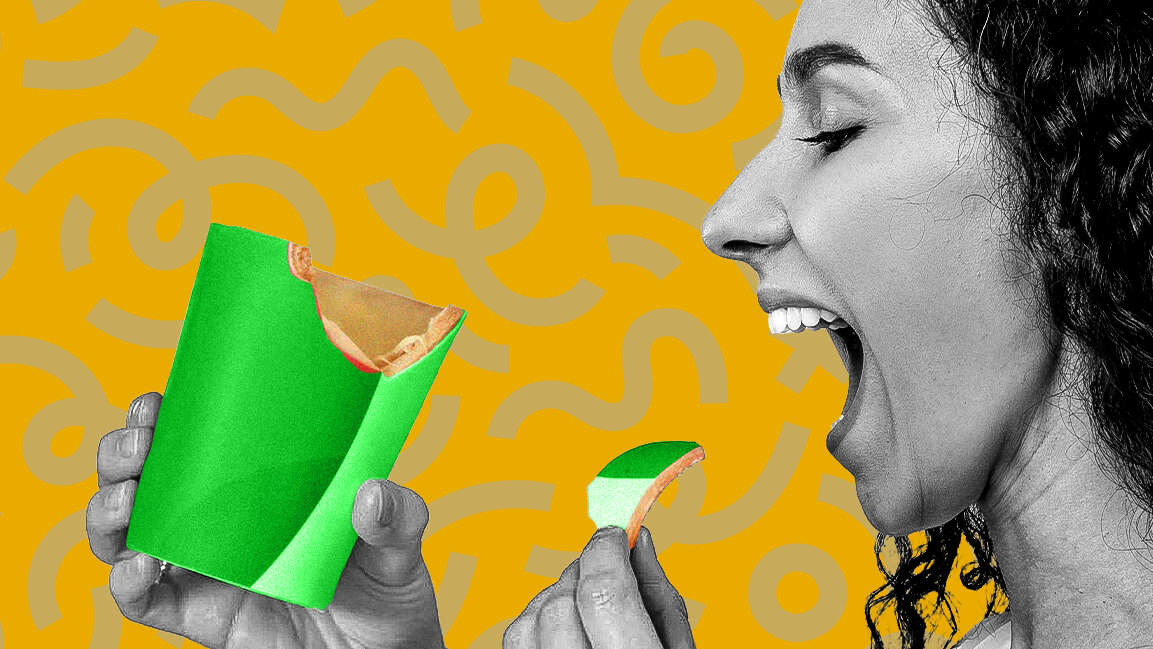


What might seem like a futuristic idea is quickly turning into a real sustainability solution. Across Europe and the Middle East, innovators are starting to see packaging not as waste, but as food.
From potato-starch “paper” to plant-based produce protection, edible materials are moving from lab experiments to live commercial trials.
The big question now is whether these ideas can be scaled up.
FROM POP-UP TO PROOF OF CONCEPT
At the 2026 edition of the Qatar International Food Festival, thousands of visitors tasted something unexpected: the packaging itself.
For Ghanim Al Sulaiti, founder and CEO of Qatar-based Papercut Factory and the diversified group Enbat, the festival marked a turning point.
“What mattered most wasn’t just that it worked,” he says. “It was seeing people genuinely excited by it.
Papercut makes its components in-house using familiar ingredients. Their edible paper is made from potato starch, water, and olive oil. Ice cream cups are crafted from whole wheat flour, water, salt, and cane sugar. The recipes are simple, clear, and focused on food first.
Papercut produces some components internally while collaborating with specialized food-grade manufacturers for others. The partnership model, Al Sulaiti explains, ensures safety standards remain uncompromised.
And that’s the critical distinction. “Edible packaging is treated as food first, packaging second,” he says. That means certified production facilities, sealed transport, allergen transparency, and controlled-use environments.
For now, Al Sulaiti sees its strongest application in cafés, events, and premium single-serve concepts — environments where operational cycles are short and customer engagement is part of the experience.
“Is it the solution to all plastic waste? No. But it’s no longer experimental either,” he says.
WHEN PACKAGING DISAPPEARS
If Papercut represents visible, consumer-facing edible packaging, Swedish food-tech company Saveggy takes a subtler approach.
Instead of swapping out wrappers, Saveggy eliminates them altogether.
The company has developed a plant-based protective layer made from rapeseed oil and gluten-free oat oil. Applied as a microscopic spray after harvest and washing, it extends cucumber freshness from 3 to 4 days to nearly 2 weeks — without plastic film.
In October 2025, Saveggy completed its first large-scale commercial test in Sweden in collaboration with grower organization Odlarna and retail giant ICA. About 167,000 coated cucumbers were sold in more than 250 stores, alongside conventional plastic-wrapped alternatives.
“The launch confirmed clear market demand… and validated the operational conditions needed for scale,” says Kristina de Verdier, head of marketing at Saveggy. “Store-level waste was comparable to plastic-wrapped produce.”
The materials used tell an even clearer story. Saveggy’s coating uses less than 0.3 grams per cucumber, compared to about two grams of plastic film. If used across Europe, plastic use could drop by nearly 3,000 tons a year.
There is nothing to unwrap. Nothing to sort. Nothing to discard.
Consumers are simply advised to rinse the cucumber before eating — just as they would with any fresh produce.
“We’re now developing a next-generation system built for stable, high-capacity operation… planned to be operational after summer 2026,” says de Verdier. “We’re also adapting the solution for bananas, peppers, eggplants, and zucchini.”
Importantly, Saveggy doesn’t call it “edible packaging.” Instead, they present it as an extension of the cucumber’s natural peel, made with just two familiar ingredients and no additives.
This minimalism may prove decisive.
THE PSYCHOLOGY OF EATING THE WRAPPER
Edible packaging has surfaced repeatedly over the past two decades, says London-based food futurologist Dr. Morgaine Gaye, director of bellwether: Food Trends. But adoption has stalled for a reason.
“The difficulty is the vehicle,” she explains.
An edible coffee cup, for example, feels off. “I just want the coffee,” she says. “Now I have to eat the cup too?”
The extra obligation becomes friction.
Where edible formats work better, Gaye argues, is when the packaging becomes inseparable from the product itself — dissolvable flavor packets for noodles, sauce sachets that melt directly into the dish, burger wraps that function as part of the food rather than an add-on.
In other words, success might depend less on the materials and more on how it’s presented.
“Rather than saying, you can eat the packaging… present it as part of the product,” she says.
Fast food, with its quick packaging turnover and short eating time, might be the best place to start. A burger often comes double-wrapped: paper inside a box. If one layer is edible, waste drops right away.
Regarding hygiene, Gaye says there’s little difference from current practices. In fast food, food is already handled with gloves and served fresh. If edible materials follow the same standards as ready-to-eat foods, the risks stay about the same.
BETTER THAN RECYCLING?
The environmental case for edible packaging rests partly on skepticism toward recycling itself.
Recycling systems are energy-intensive and often inefficient. “A lot of the sorting that people painstakingly do at their homes never gets recycled. It ends up in different versions of landfill,” says Gaye.
Compostable materials sometimes need special industrial conditions or additives to break down properly. Gaye points out that refilling is still the best option because it removes packaging completely.
Yet in sectors like fresh produce, universal refillability is difficult to implement. Here, edible or ultra-minimal protective solutions offer a pragmatic middle ground.
Saveggy’s lifecycle assessments indicate a significantly lower footprint than plastic film, particularly as production scales and food waste are reduced. Meanwhile, Papercut’s starch-based wraps and flour-based cups are inherently biodegradable if uneaten.
Still, challenges remain: production costs, regulations that separate food and packaging, climate issues in hot areas, and, maybe most importantly, getting people used to it.
THE MIDDLE EAST CONTEXT
Would edible packaging resonate in the Middle East?
Al Sulaiti’s experience suggests it would. At the Qatar festival, people’s doubts turned to excitement once they understood the ingredients and purpose. Being transparent, offering choice, and clear labeling were important.
Gaye agrees that geography is secondary to product design. “If it’s fit for purpose and reduces friction, it can work anywhere,” she says.
Given the scale of fast-food consumption and the region’s growing sustainability agenda, the Middle East could become an early adopter — particularly in premium and event-driven contexts.
In five years, we could have dissolvable sauce packets that go unnoticed, burger wraps that feel just right, produce protection that quietly reduces thousands of tons of plastic waste, and even language that avoids the word “packaging.”
If edible materials are woven seamlessly into the product experience — and if safety and performance are uncompromising — they may stop being a curiosity and start being a fundamental standard.
The real test isn’t whether people can eat their packaging. It’s whether they stop even noticing it’s there.
Featured Videos
Today's Top Stories:
More Top Stories:

FROM OUR PARTNERS