
- | 4:00 pm
AI gets down to business at Ai Everything Abu Dhabi
From sovereign AI to workforce training and smarter infrastructure, here are the biggest takeaways from Ai Everything Abu Dhabi.
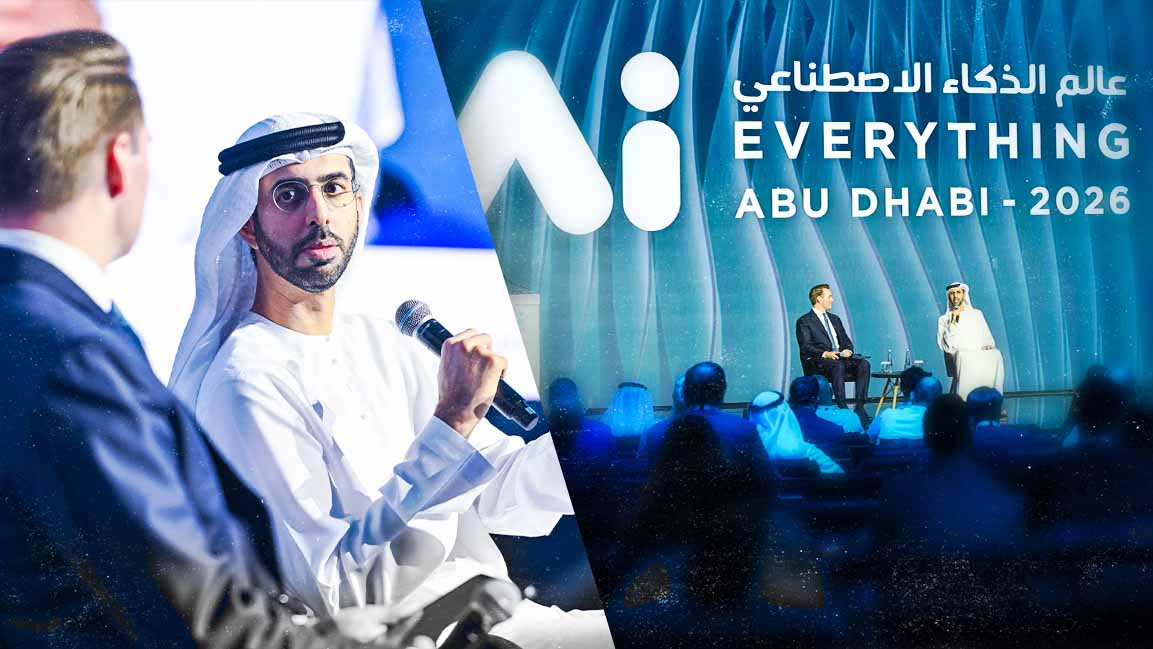


AI is officially out of its experimental phase. Now comes the harder part: actually making it work at scale. For governments and businesses, that means turning big AI ambitions into infrastructure, talent, and real-world deployment.
That shift was at the center of Ai Everything Abu Dhabi 2026, which brought together more than 400 exhibitors, 180 speakers, and 200 investors managing $100 billion in assets. Hosted by Abu Dhabi’s Department of Government Enablement (DGE), the two-day event placed the emirate’s ambition to become the world’s first AI-native government by 2027 alongside wider questions around AI sovereignty, infrastructure, governance, and commercialization.
Opening the summit, Ahmed Tamim Hisham Al Kuttab, Chairman of DGE, argued that the advantage will increasingly belong to economies building those foundations early.
“Societies that start building the foundations today will pull ahead every year, and those that wait will find the gap harder to close,” Al Kuttab said. “Abu Dhabi and the UAE did not wait. We have already built those foundations.”
For businesses looking to capitalize on AI, he said three elements matter: “compute, capital and customers willing to go first.” Abu Dhabi, he added, has been working to bring all three together.
Across the summit, that ambition translated into discussions and announcements spanning sovereign AI and data infrastructure to workforce skills and the environmental demands of scaling the technology, offering a clearer picture of how Abu Dhabi plans to turn its AI ambitions into practical deployment.
BUILDING SOVEREIGN AI CAPABILITIES
Sovereignty emerged as one of the event’s defining themes.
Faisal Al Bannai, Adviser to the UAE President and Secretary General of the Advanced Technology Research Council, positioned AI as a core state capability, with compute, models, and talent becoming increasingly important to countries seeking greater control over their technological future.
“In the UAE, we are adopting the best-in-class models while building our own sovereign capabilities and putting checks and measures in place, knowing we will be agile enough to adapt as we go,” Al Bannai said.
The UAE’s competitive advantage, he added, would lie in deploying practical use cases and moving quickly rather than pursuing technological capability in isolation.
The focus reflects a broader shift in the global AI landscape. According to the CNAS Sovereign AI Index cited by the summit organizers, the Middle East and East Asia account for more than 80% of publicly disclosed sovereign AI investment worldwide.
Arthur Mensch, co-founder and CEO of Mistral AI, used his first appearance at an AI summit in Abu Dhabi to address another question facing governments and businesses: how to balance sovereignty, openness, and safety.
Mensch argued that enterprises increasingly want greater control over how and where AI is deployed, including the ability to retain their intellectual property and move workloads between infrastructure providers.
“Sovereignty is also a global issue,” Mensch said. “Around 55% of the global economy sits outside the US and China. That creates enormous demand for alternative technology suppliers.”
AI, he said, should be treated as a strategic commodity, requiring countries to consider what capabilities they can produce themselves, what they need to import, and which partnerships they need to build.
That push for greater control also materialized in one of the event’s announcements. UAE-based Open Innovation AI and NetApp announced a technology collaboration to explore sovereign AI infrastructure for governments and enterprises.
The companies plan to explore combining Open Innovation AI’s Sovereign AI Fabric, which manages GPU infrastructure across on-premise, hybrid, and air-gapped deployments, with NetApp’s data infrastructure. The proposed setup would support workloads spanning AI training and inference to retrieval-augmented generation and agentic AI.
At its core, the collaboration is intended to help organizations scale AI while retaining control of their data, models, and operating environments, underscoring how the sovereignty debate is increasingly extending beyond AI models to the infrastructure underneath them.
In another push to take agentic AI into the enterprise, Inception42, G42’s sovereign agentic AI company, launched Insight at Ai Everything Abu Dhabi, an AI-native decision intelligence platform designed for boards and executive teams.
Already deployed in executive meetings across government and enterprises, the platform brings institutional knowledge and agentic reasoning into the decision-making process.
Available as SaaS or on private cloud, with English and Arabic interfaces, Insight works across web, mobile, desktop, and voice.
Before meetings, it can generate summaries, build agendas, and simulate decisions; during meetings, it provides real-time insights, AI-powered chat, and integrated voting; and afterwards, it captures decisions, produces smart minutes, and identifies action items.
The product also taps into a persistent problem in the boardroom. According to Board Intelligence’s 2025 Board Value Index for the Middle East, cited by Inception42, 41% of directors identified the quality of information provided to boards as the biggest barrier to decision-making.
“Insight was shaped inside some of the most demanding boardrooms in the UAE, and it has proven its value where the stakes are the highest,” said Ashish Koshy, CEO of Inception42.
The platform can run on sovereign cloud infrastructure and offers zero-trust security, role-based access controls, and AI guardrails, while organizations with specific sovereignty requirements can deploy it on private cloud or in a dedicated environment.
BUILDING AN AI-READY WORKFORCE
Technology infrastructure, however, represents only one part of Abu Dhabi’s AI ambitions. The emirate is also looking at the people expected to use it.
A new AI-native training initiative announced alongside the event is aimed at Abu Dhabi’s entire government workforce as well as the wider public, as the emirate works toward its target of becoming the world’s first fully AI-native government by 2027.
The workforce push fits into a wider question raised at the summit by Omar Sultan Al Olama, UAE Minister of State for Artificial Intelligence: how governments themselves need to change as AI becomes embedded in public services.
Al Olama’s session focused on the use of data and agentic AI to redesign public services, strengthen decision-making, and build greater resilience, placing government transformation – not simply technology adoption – at the heart of the AI conversation.
The approach also signals a shift in what AI readiness means. Access to models and computing infrastructure alone will not make an organization AI-native; employees need the skills to integrate the technology into everyday processes and services.
AI’S SUSTAINABILITY CHALLENGE
As AI adoption accelerates, the infrastructure required to power it is becoming another major consideration.
At the event, Khazna Data Centres published its first standalone Environmental, Social and Governance report, establishing a baseline for measuring the environmental and social impact of its operations as demand for data center capacity grows.
The company aims to cover 50% of its mechanical load with carbon-free electricity by 2030 and 100% by 2035. In 2025, 27% of the electricity used for its mechanical cooling load was covered by carbon-free electricity through onsite solar generation and certified clean-energy instruments.
Operating data centers in the UAE’s high-temperature environment has also pushed cooling efficiency and water management higher up the agenda. Khazna reported that recycled water met 19.8% of its cooling water requirements in 2025, while its DXB8 facility achieved a 99.55% waste-diversion rate from landfill. New facilities in the GCC are being designed to operate at power usage effectiveness values of 1.5 or below.
“Demand for data centre capacity is accelerating, driven by unprecedented growth in AI,” Khazna CEO Hassan Alnaqbi said. “That growth brings opportunity, but it also brings expectations.”
The announcement highlights an emerging tension in the AI boom: scaling the technology requires significantly more physical infrastructure, making energy, cooling, water, and resource efficiency increasingly central to the industry’s growth.
Elsewhere on the show floor, Seagate focused on the growing storage requirements accompanying AI adoption. Citing its 2026 Data Infrastructure Readiness Report, the company said 99% of organizations globally expect AI to increase their storage requirements over the next three years. H3C, meanwhile, showcased AI infrastructure spanning compute, networking, storage, cloud, security, and operations.
FROM GOVERNMENT SERVICES TO PHYSICAL AND CREATIVE AI
The summit also showed how AI applications are expanding beyond conventional enterprise software.
Sharjah Research Technology & Innovation Park’s SPARK AI Hub showcased applications including AI concierge systems, intelligent government service assistants, computer vision for smart buildings, enterprise agents, and digital humans. Khalifa University Enterprises Company used the event to launch ventures from its commercialization pipeline across healthcare, government, industry, and sustainability.
Physical AI was another area of focus. Marc Raibert, founder of Boston Dynamics and executive director of the RAI Institute, addressed how increasingly capable robotics could move into productive applications across factories, workplaces, and everyday environments.
But greater autonomy also brings questions about responsibility.
Virginia Dignum, Professor of Responsible AI at Umeå University, argued that meaningful human oversight cannot simply mean having someone available to assume responsibility when an AI system fails.
For governments, she said the first question should instead be why an AI system is being deployed in the first place. She also called for greater investment in public-sector skills, data infrastructure, evaluation, and procurement expertise so governments can become informed buyers and regulators rather than passive adopters of AI.
Taken together, the discussions at Ai Everything Abu Dhabi reflected how quickly the AI conversation is changing. The focus is moving beyond who has the most capable model to who controls the infrastructure, data, talent, and governance required to put those models to work.
For Abu Dhabi, becoming an AI-native government by 2027 is one part of that larger bet. The announcements emerging from the summit – from sovereign AI infrastructure and workforce training to more sustainable data centers – point to an effort to build the foundations around AI at the same time as the technology itself continues to evolve.