- | 9:00 am
Companies in the Middle East are racing to adopt AI. But is it paying off?
AI adoption in the Middle East is accelerating, but businesses still struggle to measure returns and maintain human oversight.



AI is making individual employees more productive. Whether those gains are reaching the bottom line is a harder question.
Across the Middle East, governments are backing AI-led growth, and companies are introducing the technology into financial services, logistics, and other operations. As spending rises, executives face two questions: where AI creates measurable value, and which decisions still need human oversight.
Executives in fraud prevention and logistics say the answer depends on preparing data and systems, choosing the right processes, and establishing accountability when something goes wrong.
THE AI INVESTMENT GAP
Salah Al Rifai, CEO of Mantika, a company specializing in AI-powered fraud prevention and decision systems, believes businesses are increasingly investing in technology without understanding where it creates meaningful value.
“There is a lot of hype around AI, and many of the people throwing money at AI do not understand really where the capabilities of AI are best used and how to implement it properly into their processes,” he says.
The problem often begins with a company’s existing infrastructure. Businesses may collect enormous amounts of customer and operational data, but that information isn’t necessarily organized or accessible enough for AI systems to use effectively.
Al Rifai says that companies must prepare their internal systems before investing in advanced models. Otherwise, technology designed to improve efficiency can introduce additional complexity.
His concerns reflect a wider industry challenge.
McKinsey’s August 2026 global AI survey, involving 1,719 respondents across 97 countries, found that 80% reported improved individual productivity from AI.
Only 37% of respondents said AI had contributed positively to their organizations’ earnings before interest and taxes. Just 6% met McKinsey’s definition of high performers: respondents who attributed at least 5% of EBIT to AI and reported significant value from it. The survey is global and relies on respondents’ assessments; it does not establish returns specifically for the Middle East.
The research also found that high-performing organizations were more likely to fundamentally redesign their workflows rather than simply introduce AI into existing processes.
That distinction is significant. Automating an inefficient operation may reduce the time required for individual tasks without addressing the weaknesses that make the overall process expensive.
WHEN AUTOMATION DELIVERS
Fraud prevention illustrates the potential trade-off. Financial institutions must identify suspicious transactions while allowing legitimate payments to proceed. Unusual activity can trigger investigations that require employees to examine transaction patterns before approving or rejecting payments.
Al Rifai explains that AI can now handle parts of that process, reducing the need for routine manual reviews.
But efficiency presents another challenge. An automated fraud detection system must distinguish suspicious activity from legitimate customer behavior.
Incorrectly blocking transactions can frustrate customers, while failing to identify fraudulent payments can create financial losses.
The value of automation therefore depends as much on accuracy as on speed.
Al Rifai believes human judgment remains essential when decisions carry significant consequences. “I don’t think AI is here to disrupt human beings. It’s here to disrupt our processes,” he says.
AI may eliminate repetitive tasks, but businesses still need people who can interpret unexpected results, question automated recommendations, and take responsibility when mistakes occur.
As systems become increasingly autonomous, those responsibilities become more important.
WHO’S ACCOUNTABLE?
Agentic AI is changing how businesses approach automation.
Unlike systems primarily designed to generate information, AI agents can execute sequences of tasks, interact with software, and make decisions within defined parameters. For companies, this creates opportunities to reduce administrative work. It also raises questions about oversight.
Al Rifai warns that businesses are increasingly using AI-generated software without adequately reviewing its security and reliability.
His concern is particularly relevant when automated systems interact with sensitive financial information or critical business infrastructure. The consequences of an incorrect decision can extend beyond an inaccurate response. A malfunctioning system may affect customer accounts, payment processes, or operational services before employees recognize the problem.
The UAE has already identified human oversight as a priority in responsible AI development.
Its Charter for the Development and Use of Artificial Intelligence emphasizes transparency, accountability, and human judgment. It also recognizes the need to correct errors and biases arising from automated decisions.
Businesses remain responsible for decisions involving automated systems. They need to establish who oversees those systems, how errors are identified, and when employees should intervene.
AI BEYOND THE SCREEN
In logistics, automated decisions can have clear real-world effects. Tobias Maier, CEO Middle East and Africa at DHL Global Forwarding, sees AI as an opportunity to improve operational efficiency across complex transportation networks.
The company is integrating AI into routing, yield management, and other business processes.
“We have our base systems, and we are now deploying modular agentic AIs on top of that,” he says.
Maier adds: “We have our base systems, and we are now deploying modular agentic AIs on top of that, and really trying to create the best possible ecosystem in a modular fashion, so if certain AI agents are becoming obsolete or outdated, we can very easily replace them.
The strategy comes alongside significant regional investment. In 2025, DHL Group announced plans to invest more than €500 million across the Middle East, with Saudi Arabia and the UAE among its primary markets.
The investments include logistics infrastructure and specialized operations supporting industries such as healthcare and life sciences. Those sectors demonstrate why AI-driven efficiency must be balanced against operational requirements.
A system recommending transportation routes for temperature-sensitive pharmaceuticals, for example, must consider product safety alongside delivery costs. The cheapest route isn’t necessarily the most suitable.
Maier also highlights the importance of combining experienced logistics professionals with younger AI specialists.
The opportunity lies in bringing technological capabilities into an industry where physical infrastructure, regulatory requirements, and unpredictable disruptions continue to influence decisions.
For the Gulf, this combination could become increasingly important as Saudi Arabia and the UAE strengthen their positions as international trade hubs.
THE HUMAN FACTOR
The relationship between AI and human decision-making becomes more complex when technology begins to resemble people.
David Paulson, CEO and founder of AIA Orbis, is developing a humanoid AI project in the UAE. He believes increasingly sophisticated machines could transform how people interact with artificial intelligence.
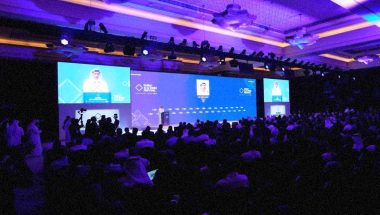
At the Dubai AI Festival, Paulson showcased AIA, a 3.5-meter-tall AI-powered humanoid, developed in the UAE. AIA is designed to demonstrate how AI could move beyond screens and interact with humans in physical form.
“We will give them a name. We will create their emotional connection. They will become our friends,” he says.
He sees humanoid systems becoming companions and possibly taking on teaching roles, but human intelligence will remain integral to developing advanced AI, rather than becoming entirely replaceable.
MEASURING REAL VALUE
Cláudia Pinto, Senior Government Advisor for Sustainability and Founder and CEO of Empowering Women Middle East, identifies a problem that extends well beyond AI.
Organizations frequently develop ambitious strategies without establishing how they will measure their results.
“A strategy only becomes real when it has a clear owner, a budget, a timeline, and a KPI that someone checks every quarter,” she says.
“What I see most often is a gap between the boardroom and the frontline. The vision is right, but the teams that must deliver it were never brought into it.”
Although Pinto is discussing sustainability, the same principle applies to AI adoption.
Companies can announce major technology investments, introduce automated systems, and train employees to use new tools. None of those activities necessarily demonstrates that business performance has improved.
Pinto believes organizations must acknowledge where their strategies haven’t delivered the intended results. That transparency matters most when businesses face pressure to show progress in AI adoption.
THE REAL COMPETITIVE ADVANTAGE
The Middle East’s investment in AI creates significant opportunities for companies willing to rethink their operations. But the next stage of adoption will require more than increasingly powerful models.
Al Rifai emphasizes operational preparation and human judgment. Maier sees opportunities in combining AI with established logistics expertise. Pinto stresses accountability and measurable outcomes, while Paulson raises questions about how people may eventually relate to intelligent machines.
The value of AI will depend on where companies deploy it, how they measure the results, and who is responsible for the decisions it informs.
A company can automate thousands of tasks without fundamentally improving its performance. Another can transform a single critical process and achieve a measurable advantage.
For executives under pressure to accelerate AI adoption, that differentiation deserves attention.
The next phase of competition will depend on who can show that the technology leads to better decisions, real results, and accountability when things go wrong.