
- | 11:00 am
Dubai AI Festival: Dubai sets sights on 1,000 AI companies and 5,000 jobs
The festival features more than 20 global unicorns, 20 government agencies and ministries, 20 venture capitalists and 20 multinational enterprises.
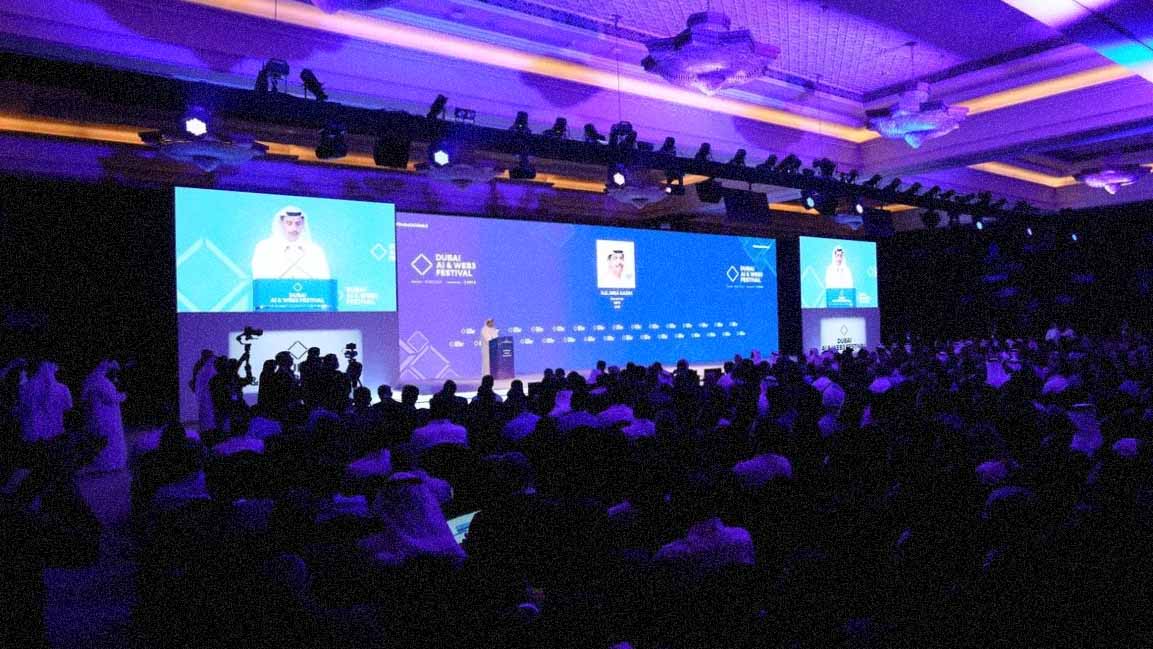


Dubai is stepping up its artificial intelligence ambitions as the third edition of the Dubai AI Festival brings together global technology companies, investors and policymakers to shape the future of the AI economy.
Held under the directives of Sheikh Hamdan bin Mohammed bin Rashid Al Maktoum, Crown Prince of Dubai, Deputy Prime Minister and Minister of Defense, the event brings together policymakers, investors, technology companies and entrepreneurs to discuss AI adoption and the development of the global AI economy.
The festival features more than 20 global unicorns, 20 government agencies and ministries, 20 venture capitalists and 20 global enterprises.
Its international participation includes more than 100 Chinese technology companies showcasing digital innovations and a dedicated Bharat Pavilion featuring 23 Indian companies focused on cloud, data center and GPU infrastructure.
Discussions span AI governance, ethics, the future of work, immersive technologies, infrastructure and investment, reflecting the range of issues shaping AI development and deployment.
The festival’s first day also saw a series of announcements covering new targets for Dubai’s AI sector, legal technology, AI recruitment and large language models (LLMs), among other developments. Here are the key announcements.
DUBAI AI AMBITIONS
Dubai has raised its targets for the Dubai AI Campus, aiming to attract more than 1,000 specialized AI companies and create over 5,000 highly skilled jobs by 2030.
Sheikh Hamdan approved the new targets during the festival’s opening on October 26, following a review of plans for a purpose-built campus facility within the Dubai International Financial Centre (DIFC) Zabeel District.
The campus has already attracted more than 500 AI companies and over AED1 billion ($272 million) in investment, according to the Dubai government. It has also contributed to the creation of more than 2,000 specialized technology jobs, with its original five-year targets reached two years ahead of schedule.
In a post on X, Sheikh Hamdan said the emirate had set its sights higher, with the new targets intended to strengthen Dubai’s position in the AI sector and the wider global economy.
The expansion reflects Dubai’s efforts to build an ecosystem that brings together technology companies, investors and specialized talent. Beyond attracting businesses, the emirate is seeking to increase the capacity to develop and deploy AI applications across industries.
THE REGION’S FIRST AI-POWERED VIRTUAL COURTROOM
AI adoption is also extending into professional training, with UAE-based legal technology company Legaline Platform introducing Meta Legal Space, a virtual courtroom designed to help law students and legal trainees practice advocacy.
Launched at the festival, the platform simulates court hearings using AI-powered judges, clerks, witnesses and expert participants. Legaline describes it as the first AI-powered mock-trial environment in the Middle East and North Africa.
The simulator allows trainees to present arguments, cross-examine witnesses and respond to objections. They can practice against AI-powered opposing counsel or another student, while virtual witnesses are assigned distinct personalities and behavioral traits, requiring trainees to adapt their questioning.
The platform supports litigation, arbitration and mediation across UAE onshore legal frameworks, as well as those of the Dubai International Financial Centre and Abu Dhabi Global Market.
Its cases are developed by practicing lawyers and cover commercial, civil and labor disputes, including disagreements over supply contracts, construction defects and unfair dismissal. Exercises are assigned difficulty levels and estimated durations to help instructors tailor sessions to trainees’ experience.
Legaline founder and chief executive Dmitry Grinik said the platform allows trainees to make mistakes and develop courtroom skills before handling real cases. The company has not published independent studies demonstrating the simulator’s effectiveness in improving legal performance.
AI LINGUISTIC ACCURACY
Dubai-based deep-tech company ZWAG AI is addressing the challenge of ensuring AI-generated language is accurate across different linguistic systems.
The company announced the launch of its Center of Excellence for Linguistic Sovereignty at the festival. The initiative is designed to bring together universities, cultural organizations and governments to document linguistic structures and improve how AI systems process languages.
ZWAG AI argues that large language models can produce fluent-sounding responses while failing to preserve grammatical rules, cultural context and formal registers, including in languages such as Arabic, Thai, Tamil and Swahili.
Its Mātṛ platform is designed to address these limitations through a correction layer that evaluates AI-generated outputs against language-specific rules and selects or corrects responses in real time. The company says the system can work across different AI models without requiring retraining.
ZWAG AI’s Translation Studio public beta currently supports more than 2,400 languages, according to the company.
“We shouldn’t have to water down our native languages to fit a machine’s logic,” said Priya M. Nair, co-founder and chief executive of ZWAG AI. “Our mission is teaching AI to respect our heritage, our values, and our mother tongues, and it starts with getting the language right.”
The new center will work with academic institutions, professional translators, linguists and native speakers to build and refine language profiles through a global contributor program. Its broader objective is to improve linguistic representation in AI systems as their use expands across markets and communities.
AIJobsUAE RECRUITMENT PLATFORM
The demand for AI expertise is also creating new challenges for employers seeking candidates who combine technical skills with industry-specific knowledge.
UAE-based talent platform AIJobsUAE launched at the festival to connect businesses with professionals specializing in AI. Its focus includes emerging roles such as AI architects, forward-deployed engineers, and finance specialists who use AI in their work.
The platform offers a curated marketplace for AI-related vacancies, advisory services to help employers define the skills required for new roles, and specialist recruitment support covering candidate identification and evaluation.
Ryan D’Souza, founder of AIJobsUAE, said conventional job boards often generate large numbers of applications without delivering the combination of technical expertise and industry knowledge employers need.
The platform aims to combine technology with human judgement to match candidates with business requirements. Its launch comes as organizations across sectors seek to move beyond AI experimentation and recruit the talent needed to implement the technology in operational settings.
RISKVANTAGE AI’S CONTRACT NEGOTIATION PLATFORM
Enterprise legal work is another area attracting AI developers, with US-based RiskVantage AI introducing RiskVantage Negotiate, a platform designed to automate contract review and negotiation while making risk assessments traceable and auditable.
The platform uses a neuro-symbolic architecture that separates risk decisions from language models. Legal teams can assess contractual clauses against predefined risk thresholds and review the rules behind individual findings.
It also uses domain-adapted small language models, which the company says can be deployed on private cloud infrastructure or on-premises systems to meet data security requirements in regulated industries.
Features include automated risk assessments, contract redlining, deviation reports, collaboration tools and audit trails. The platform supports documents such as non-disclosure agreements, software licenses, service contracts and statements of work, and can integrate with enterprise systems and electronic signature tools.
RiskVantage AI said internal testing found that the platform reduced first-draft issues by 60% compared with manual review. The company also reported approximately 97% accuracy in an internal benchmark measuring legal concept detection and extraction. These figures are company-reported results and have not been independently verified in the information provided.
The company is also developing two additional products: RiskVantage Diligence, designed to analyze merger and acquisition data rooms, and RiskVantage Integrate, which aims to align acquired companies’ contracts with a parent organization’s requirements.

Featured Videos
Today's Top Stories:
More Top Stories:




FROM OUR PARTNERS