The next frontier: UAE’s space ambition targets global market and a bigger domestic ecosystem
Experts say that space startups are becoming more important for scaling up capabilities and competing in the global market
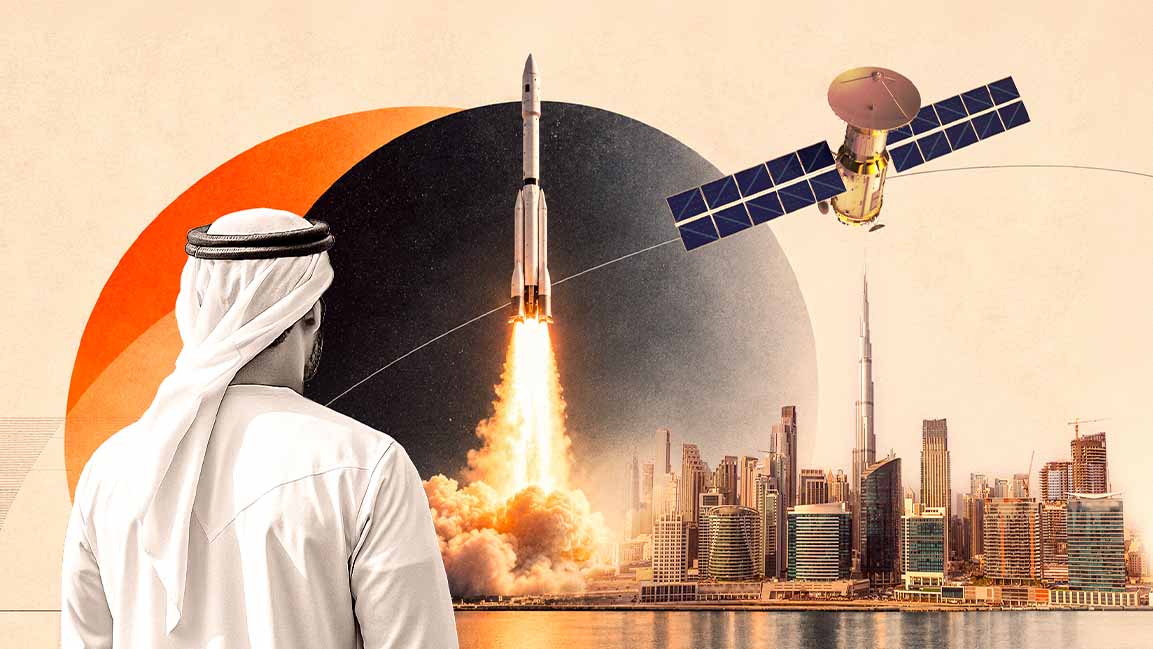


After half a century of exploring and developing space as a new frontier, it now serves as critical economic infrastructure. Countries rely on it for everything—from financial transactions and GPS navigation to weather forecasting and missile tracking.
This dependence will deepen as satellite networks expand and new space segments, from orbital data centers to commercial space stations, become economically viable.
Against this backdrop, the UAE is making space a bigger priority. Its space economy and satellite services market is now worth about $7.2 billion, driven by government investments, satellite tech advancements, and demand in the telecom and defense sectors.
But can it turn its space capabilities into a globally competitive space economy?
To achieve this, the UAE, which aims to be among the world’s ten largest space economies, needs more local demand and to keep investing in testing, qualification, and manufacturing.
STRONG DOMESTIC DEMAND
“The UAE is seeing growing domestic demand across both upstream and downstream space technologies, which creates opportunities to develop deeper capability across propulsion, launch systems, satellite technologies and access to space,” says Dr. Elias Tsoutsanis, Chief Researcher at the Technology Innovation Institute’s Propulsion and Space Research Center in Abu Dhabi.
The government is driving the strong domestic demand, says Arjun Sreekumar, Associate Director, Defense, Aerospace & Space Industry Lead at KPMG Middle East. “That is natural in a country whose growth agenda is built on technology. Robotaxis already run in Abu Dhabi and Dubai, ADNOC’s crewless supply vessels are designed to be steered by satellite, and AD Ports is building satellite links into its network for resilience. None of this works without space.”
Like any infrastructure, Sreekumar adds, space infrastructure is better owned than rented from abroad. “That is why the UAE is pushing to own the critical layers: alternative navigation, resilient satellite communications and high-revisit imaging. That ambition is itself a source of demand.”
Growing domestic demand is expected to attract more private companies into the UAE space sector, strengthening its ecosystem and positioning local capabilities to serve global space companies and wider international markets.
Currently, more than 170 entities operate in the UAE space economy.
According to the latest Space Economic Survey from the UAE Space Agency, total spending grew by 27.1% in 2024 to reach AED 5.52 billion (about $1.5 billion). The commercial sector made up 48% of total space economy spending, or about $719 million, showing its growing size and investment activity.
Recently, emphasizing the importance of the sector in the economy,
Dr. Ahmad Belhoul Al Falasi, Minister of Sports and Chairman of the UAE Space Agency, said, “Our priority is to build on this momentum by attracting investment, enabling UAE-based companies to compete internationally and developing the talent needed to drive the sector’s growth.”
PARTNERSHIPS AND FUNDING
By 2031, the UAE aims to raise the sector’s economic value by 60%, invest more in space assets and infrastructure, increase the number of companies and UAE-based startups, and expand international markets for its space exports.
While investment momentum is positive, Dr. Tsoutsanis says the next opportunity is to “strengthen investment across the different stages of technology development and commercialization, particularly as technologies move from research into deployment.”
He says that ongoing investment in infrastructure, such as testing facilities and advanced manufacturing, is important, along with more public-private partnerships and international cooperation.
International partnerships are increasingly linking national space strategies with private sector opportunities. While the UAE can give international companies access to a growing regional market, manufacturing and testing facilities, institutional customers, and investment capital, they can also help the UAE build its capabilities faster. International cooperation can help create new markets.
In 2026, key developments in international partnerships included a
$1 billion investment by a consortium led by Abu Dhabi-backed Marlan Space and Franco-American company Loft Orbital to build the Altair Next-Gen satellite constellation in Abu Dhabi. Space42 and Viasat also committed up to $1 billion to create Equatys, a shared space and ground infrastructure platform.
The UAE also launched the International Space Cooperation Program, supported by about $74 million to boost international R&D, technology transfer, and commercialization.
The UAE is also working to get more economic value from satellite data. Space42’s Foresight now has five satellites and provides high-resolution geospatial intelligence. Its AI-powered GIQ platform quickly turns satellite data into useful information for emergency response and infrastructure maintenance.
ROLE OF STARTUPS
Currently, the UAE makes up about 3.38% (around $20 billion) of the global space market, which is worth over $620 billion. In the MEA space market, estimated at $18 billion, the UAE holds a strong 40% to 45% share (about $8–9 billion).
To grow capabilities and market share, space startups are becoming more important, especially for increasing production capacity.
Sreekumar says competition among UAE space startups is getting stronger. “Most operate in different parts of the industry: satellite manufacturing, orbital data centers, AI-designed engines, and reusable rockets. When they do compete, it’s for three key things: national contracts, engineers, and sovereign capital.”
He adds, “The UAE has sharpened that contest with local-content shares on missions and priority access for startups. The field is also open to the world: foreign ventures are setting up in Abu Dhabi to compete alongside local firms, which keeps standards high. The proof is export: a European government has already bought a fifth of one Abu Dhabi constellation’s capacity.”
Startup funding has improved, mostly at the early stages.
“The AED 3 billion (about $800 million) National Space Fund works through demand rather than checks: it pays for national missions and reserves half of its work for UAE private firms, including startups,” says Sreekumar. “The new space economic zones add incubation and priority access to government contracts, and private money is arriving: an Abu Dhabi geospatial-AI startup raised $6.8 million from angel investors in August at a $114 million valuation.”
The main gap is at the growth stage. Venture-led Series A and B rounds are still rare, and the biggest investments still go to national platforms.
Three things would change that, says Sreekumar. “Growth funds with a space mandate, venture debt that understands hardware timelines, and multi-year capacity contracts with start-ups that lenders can underwrite.”
LOOKING FORWARD
Experts say that over the next five years, space technology will likely become a bigger part of national and regional economic infrastructure.
Sreekumar says that in the coming years, space will act less like a sector and more like a utility. He points to three main changes driving this. First, intelligence is moving into orbit. The UAE’s first commercially built satellite, launched in October, has GPUs so it can report events instead of just sending raw images. A 50-satellite follow-up with onboard language models is being built in Abu Dhabi. Second, connectivity will become a single network that combines software-defined geostationary satellites, low-orbit direct-to-device services, and high-altitude platforms. AI will switch each robotaxi, vessel, or port between them based on latency, cost, and interference. Third, value will shift downstream to ports, insurers, farms, and autonomous fleets.
“For the region, the prize is a sovereign data-and-connectivity layer built in the Gulf and exported from it; the UAE already aims to double its space revenues,” adds Sreekumar.
Dr. Tsoutsanis says that opportunities cover the whole value chain, from propulsion, spacecraft, and launch technologies to downstream applications and services.
“AI will further accelerate this by improving how satellite data, autonomous systems and space operations are used, while supporting economic diversification, advanced industries, talent development, and high-value employment across the region,” he adds.
The UAE’s next phase of space development will be measured not just by how many satellites it launches or how much capital it attracts, but by the strength of its local companies, their technology, and their ability to compete globally.