
- | 10:00 am
Reusable rockets made it. Asteroid mining didn’t. Kelly Weinersmith’s Soonish explains why
The Soonish coauthor reflects on reusable rockets, asteroid mining’s collapse, AI’s mixed impact, and the limits of techno-optimism
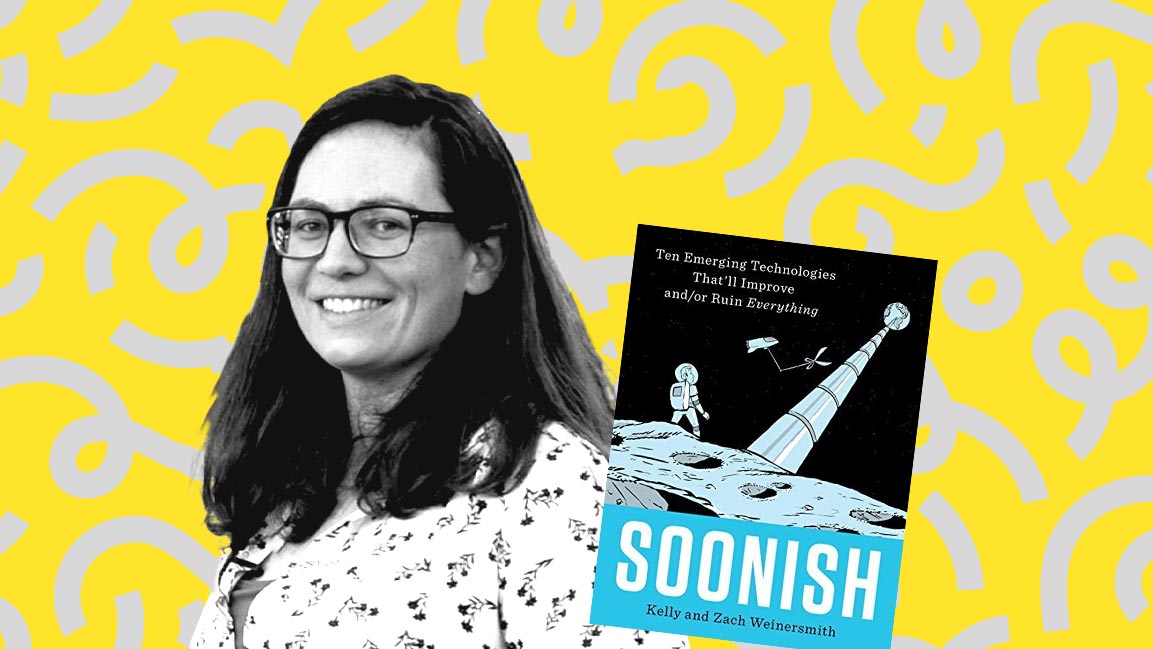


When Soonish hit shelves, its premise felt electric. A wave of emerging technologies, from ultra-cheap space access to asteroid mining, could fundamentally reshape life on Earth and beyond. Nearly a decade later, co-author Kelly Weinersmith says the biggest lesson wasn’t that the future would arrive fast. It was that it would arrive unevenly.
In a conversation with Fast Company Middle East, Weinersmith described how the book’s original pitch was far more bullish on near-term Mars settlement than the final manuscript.
“The first two chapters in Soonish were about cheap access to space and asteroid mining,” she said.
“All of the folks that we talked to were saying these two technologies are going to allow us to settle Mars, because the only reason we haven’t settled Mars yet is that it’s way too expensive to move mass to space.”
The logic seemed straightforward: reusable rockets would slash launch costs, while asteroid mining would eliminate the need to haul construction materials out of Earth’s gravity well. “They kind of convinced us that we were going to be starting space settlements on Mars in like the next decade,” she said. “We pitched the book as, ‘We’re going to be living on Mars in a decade.’”
But as reporting deepened, so did the complications.
“The book ended up being about how we are not going to be living on Mars in a decade,” she said. “It’s about way more than just sending mass to space. There’s medical stuff we don’t know about. There are legal, financial, and ethical issues to address. It’s way more complicated than just sending stuff into space.”
SPACEX MOVES FASTER THAN PREDICTED
One surprise was how quickly reusable rockets became standard practice. While writing, Weinersmith and her husband were framing reusability as an emerging breakthrough. Then reality outran their manuscript.
“We kept needing to revise it to update it with amazing things that SpaceX was doing with their reusable rockets,” she said. Today, reusable launches are no longer speculative. They are expected.
Companies like SpaceX normalized the concept, dramatically lowering the cost of sending satellites into orbit. Other players, including Rocket Lab and Blue Origin, have further expanded the commercial space ecosystem, including into tourism.
“That happened way faster than we thought,” she said. “Now people don’t even think twice about reusable rockets.”
The rapid progress underscores a theme Weinersmith returns to often: technological timelines hinge on unpredictable breakthroughs. A new material, a regulatory shift, or a deep-pocketed backer can compress decades into years.
ASTEROID MINING’S COLLAPSE
If reusable rockets overperformed, asteroid mining did the opposite.
During the book’s research phase, firms like Deep Space Industries and Planetary Resources were making headlines and attracting funding, including support from Luxembourg. Weinersmith interviewed executives and saw serious momentum.
But within a few years of publication, both companies had either folded or pivoted away from mining.
When she later asked insiders what happened, the answer pointed to law and capital. Under the Outer Space Treaty, nations cannot claim sovereignty over celestial bodies. While companies may be able to extract resources without claiming territory, the legal framework remains largely untested. “There was difficulty finding financial backers,” Weinersmith said. Investors hesitated to fund ventures that might trigger international disputes or produce materials no one could legally own.
The episode illustrates a broader tension in frontier tech: Engineering may move quickly, but governance often lags.
AVOIDING FUTURISM’S GAP
One deliberate choice in Soonish was restraint. Weinersmith and her coauthor avoided hard predictions after noticing a pattern in earlier futurist books.
“Everyone was wrong a lot,” she said. “We tried really hard not to make too many firm predictions.”
Instead, they focused on forces that shape outcomes—consumer demand, funding appetite, regulatory frameworks, and scientific bottlenecks. A single materials breakthrough, for example, could revive long-dormant ideas like space elevators. But without it, those ideas remain speculative.
That same caution explains why they skipped certain buzzy topics. Artificial intelligence, she said, felt over-covered. “There were a lot of people dealing with AI in a lot of detail. We felt like people didn’t really need to hear what we thought.”
Still, she sees its accelerating impact. AI systems have reportedly cracked longstanding mathematical problems, and many programmers now rely on AI tools to draft and debug code. At the same time, artists in her circle have lost commissions to generative tools.
“It does seem like there are ways that people are working with AI to speed them up,” she said. “But I can’t say I’ve dug into the literature on which sectors are likely to be losing jobs and how quickly that’s happening. A lot of that is playing out right now.”
IDEAS THAT MAKE THE CUT
The book closes with what Weinersmith calls a “graveyard of lost topics.” Among them: space-based solar power, which proposes collecting sunlight in orbit and beaming it back to Earth.
The concept is elegant. Solar panels in space could capture energy 24/7, but the economics are daunting. Launching and servicing infrastructure in orbit is expensive, and transmitting large amounts of energy downward raises safety and geopolitical concerns.
Self-driving cars were another near miss. The authors worried they would arrive too soon to feel futuristic. Instead, autonomy remains in development limbo—advanced in some cities, stalled in others.
“We were trying to find topics that weren’t going to come too soon, but weren’t so far out that they felt like fantasy,” she said.
WRITING THE FUTURE TOGETHER
Co-authoring with her husband added its own complexity. The pair initially planned to cover 100 emerging technologies in short bursts. That approach felt thin. They pivoted to fewer, deeper dives, spending months researching each chapter, refining search terms, and interviewing experts.
“Trying to figure out what it is we could offer that people might enjoy reading—that was hard,” she said.
Today, Weinersmith continues to explore big scientific questions. She remains affiliated with Rice University as an adjunct but focuses primarily on writing and podcasting from Charlottesville, Virginia. After coauthoring A City on Mars, she now hosts a science podcast and is working on a new book about parasites, her original field of study.
If there’s a throughline in her work, it’s this: Technological optimism is powerful but incomplete. Engineering feats can arrive shockingly fast. Legal systems, social norms, and biological realities rarely move at the same speed.
And that, more than any single rocket launch or startup failure, may be the most reliable prediction of all.