
- | 10:00 am
Coral restoration isn’t a conservation problem. It’s an infrastructure problem. Archireef is fixing that
Reframing marine restoration as part of coastal infrastructure, where design, data, and ecology operate as one system


Two years underwater. Careful fieldwork, concrete blocks, a lot of hope, and survival rates that never climbed above 20%.
For Vriko Yu, co-founder and CEO of Archireef, that failure was the turning point. The science wasn’t the problem. The foundation was. Corals were being asked to take root on surfaces they could never hold onto, and no amount of effort was going to change that.
It forced a harder question: what if the gap in marine restoration wasn’t knowledge, but infrastructure? Not knowing what nature needs but building the system that lets that knowledge survive contact with the real world.
What followed was Yu’s methodical rethink of how restoration integrates with coastal construction. The outcomes, tracked across years at real sites: 95% coral survivorship, measurable biodiversity uplift, and results defensible enough to move through a regulator’s inbox or an investor’s diligence pack. Restoration, rebuilt from the ground up.
BELOW THE SURFACE
Yu didn’t arrive at nature-tech through a breakthrough. She arrived through failure. “I didn’t start from technology,” she says. “I started from two years underwater, watching most of what we planted die.”
Before Archireef, she and co-founder Dr. David Baker were using established marine restoration methods: concrete blocks, metal rebar, and careful fieldwork. After two years, survival rates still sat under 20%. They tried again. By year four, the conclusion had become unavoidable. “The effort wasn’t the problem. The substrate was. We were asking corals to take root on surfaces that were never going to hold them.”
That realization shifted her understanding of the field. Marine science, she notes, has long known how to grow reefs. The challenge has been delivering that knowledge into environments where reefs are under the most pressure today. “The gap wasn’t a lack of science. It was a lack of infrastructure for science.”
Archireef emerged from that gap, positioning eco-engineering within coastal infrastructure and supporting measurable biodiversity uplift and regulatory-grade monitoring. The aim, she explains, is not to replace marine biology, but to extend its reach into real-world deployment, where outcomes can be tracked and verified over time. “We’re giving it a way to land on real coastlines, inside real projects, with results that hold up years later.”
For Yu, the shift is conceptual as much as technical. The future of restoration, she believes, is “not just knowing what nature needs, but building the system that lets that knowledge survive contact with the real world.”
REWRITING THE REEF
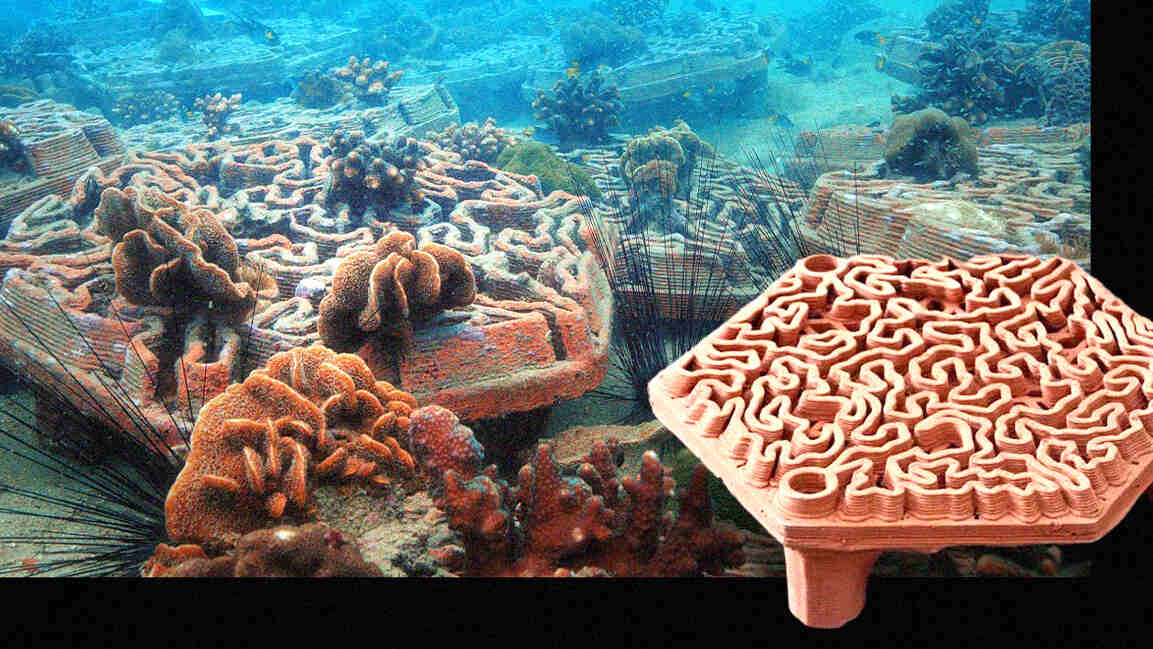
The technical challenge at the heart of Archireef’s Reef Tiles was deceptively simple to state and extraordinarily difficult to solve. “The hardest part was making clay behave like infrastructure.”
Concrete, she explains, is easy to scale but actively works against coral settlement. Its alkaline chemistry suppresses the very process on which restoration depends. Terracotta is the opposite: biocompatible, recognizable to corals, something they will settle on and hold. The problem is that terracotta has historically been brittle, slow to manufacture, and limited in the shapes it can take. “To restore reefs at the pace and scale that infrastructure projects demand, we needed it to behave like a precision-engineered component, durable, manufacturable in volume, and shaped to give corals what they actually need underwater.”
That constraint pushed Archireef toward adaptive 3D printing and algorithm-driven design. The reasoning was practical: no two coastlines are alike. Depth, wave energy, sediment, temperature, and target species all vary, and “a tile that works in Hong Kong may fail in Abu Dhabi.” Tuning each structure to its specific site while still producing at scale required a design process capable of meeting both demands simultaneously.
The deeper lesson, Yu says, reframes what scalability actually means in this context. “Scalability isn’t replicating the same tile everywhere. It’s repeating the discipline behind it, and letting the tile itself respect each coastline.”
That idea becomes clearer when placed in practice. Scale, Yu says, is often misunderstood. “Scale isn’t about how many tiles you put in the water. It’s about where restoration sits in the project lifecycle.”
She points to one of the earliest real-world deployments in Abu Dhabi in 2022. Two divers installed a 40-square-meter Reef Tiles pilot in a single day. The results were tracked over time. “Within six months, fish abundance was six times higher than at the control site. Within a year, we counted five times more cryptic species.” For her, this kind of evidence matters because it is tangible enough for developers, regulators, and investors to evaluate without abstraction.
But she is clear that the more important insight was not the ecological outcome. It was when restoration entered the process. “Restoration is still treated as a downstream add-on. Something that gets discussed after the design is locked, the budget is set, and the construction schedule is fixed.”
By that stage, she argues, the critical decisions have already been made. True scale, therefore, requires a shift upstream into masterplanning, capital allocation, procurement, and the early risk structure of coastal development.
Progress, she notes, is already underway. “We’re getting closer.” Emerging disclosure frameworks such as TNFD and CSRD are bringing biodiversity into the same decision-making space as carbon, changing what standard practice looks like in coastal infrastructure.
Within that shift, the role is to provide what she calls a design-and-data layer, enabling restoration to be embedded from the start rather than added later as remediation.
EVIDENCE IN THE WATER
The 95% coral survival rate that Archireef recorded at its monitored sites in Hong Kong after three years is, by any measure, striking. Yu receives it with both pride and perspective. “It tells me that nature doesn’t need much from us, except the right conditions and the patience to let it work.”
The number carries weight, she says, precisely because of what came before it. Those early years, when survival was below 20%, and most of what they planted didn’t make it through its first year, are never far from her thoughts. The difference between then and now was not a change in what nature is capable of. “We didn’t change what nature can do. We changed the conditions around it. A stable, pH-neutral, biocompatible foundation was enough.”
She is careful, though, not to let any result carry more weight than it should. Every reef is different, every coastline tells its own story, and no outcome should be treated as universal. “But when you have a real site, a clear method, and years of monitoring behind you, you stop speaking in hope and start speaking in evidence.”
That shift, she argues, matters well beyond the science. Predictable restoration changes the conversation entirely. It stops being an experiment that depends on goodwill and starts being something institutions can actually build around. “Once restoration becomes predictable, it stops being an experiment that depends on goodwill, and starts being something governments and businesses can plan around, finance, and stand behind.”
From there, the challenge becomes one of interpretation. Bridging marine ecology with institutional systems is, at its core, a translation problem. Yu is direct about Archireef’s approach. “We don’t try to simplify nature. We give it a common language for measurement.”
The distinction matters to her. “A reef isn’t a spreadsheet, and a coastline isn’t a KPI.” But businesses, regulators, and governments still need to know what changed, how it was measured, and whether the result can be trusted. That is precisely the gap Archireef is built to close.
The method is structured and deliberate: photogrammetry, ReefSfM, eDNA analysis, and visual surveys, all of which track biodiversity uplift and species richness against clear baselines. These tools, she explains, do something specific and valuable. They turn what a marine biologist sees underwater into evidence that can travel, through a project team, an ESG report, a regulator’s inbox, and an investor’s diligence pack, without losing its scientific integrity along the way.
Once those outcomes are defensible, they slot into the institutional frameworks the world is already moving toward. TNFD, IFC Performance Standard 6, EU CSRD. The effect is a meaningful shift in how decision-makers relate to nature. “They stop describing nature in vague terms and start pricing it in.”
The ambition, though, is never data for its own sake. “The point is making ecological change legible enough that someone can act on it, without losing what matters in the field.”
TIMING IS EVERYTHING
On the gap between biodiversity ambition and real-world delivery, Yu is unsparing. “The gap is operational.”
Most organizations, she observes, have set their targets. The ambition is genuine. What they lack is the infrastructure to deliver or verify those targets at the site level. The questions that matter, she argues, are stubbornly practical. What do you measure before construction begins? What intervention fits this specific site? What baseline are you comparing against? Who monitors it five years from now? “How does the result hold up to an auditor, or a journalist, or a court?”
The language itself, she cautions, is part of the problem. Biodiversity net gain means different things in different markets, and without a method to back it up, the term loses its weight. “Without a method behind it, it becomes a label, not a commitment.”
What is missing, she says, is a closed loop: site screening grounded in data, intervention grounded in science, and monitoring grounded in long-term accountability. Archireef’s approach is built around exactly that. “We don’t deploy a tile and walk away. Every deployment comes with multi-year monitoring, because a biodiversity claim that isn’t tracked over time isn’t really a claim.”
Close that loop, and the nature of biodiversity commitments changes entirely. “It stops being an aspiration. It becomes something that can be delivered, checked, learned from, and improved.”
LISTENING TO NATURE
The opportunity that the UAE and wider MENA region represent comes down to one thing. “The opportunity in the UAE and across MENA is timing.”
The region is rebuilding its coastlines at an extraordinary scale: ports, waterfront cities, energy infrastructure, and climate adaptation work. That pace creates real pressure on marine ecosystems, but it also opens a window that most of the world no longer has. “In most of the world, we’re trying to retrofit nature into infrastructure that was built without it. Here, the conversation can start at the masterplan.”
The Abu Dhabi pilot was significant precisely because it made that conversation local. It wasn’t a research story imported from Hong Kong. It was a site in UAE waters, installed quickly, monitored properly, and showing measurable ecological change within months.
What struck Yu most wasn’t the speed of the recovery. “It was how quickly the institutional appetite met us. Regulators, developers, and operators here aren’t waiting for the rest of the world to define what good looks like. They’re shaping it.”
That dynamic, she believes, defines the public-private opportunity in the region.
“Governments set the standard. Developers embed it. Scientists keep it honest. We sit between them, turning method into deployment.”
The ambition she holds for the region is not incremental. It is structural. “The ambition shouldn’t be more pilots. It should be a region where coastal restoration is simply how coastal infrastructure gets built.”
Her view of innovation is grounded rather than abstract. “Innovation, for us, is mostly about accountability.”
Technology, she is clear, was never meant to command the ocean. “The ocean is not a machine. You cannot command a reef to recover.” What it can do, she explains, is sharpen the conditions around recovery: better design, more careful observation, faster learning from what actually happens in the water. Archireef’s AI-enabled monitoring, she is quick to clarify, was not built to make nature predictable. “It’s there to make us better listeners.”
That changes how restoration is understood. It is no longer a one-time intervention, but a continuous loop. “It stops being a single act of placing something in the water and becomes a cycle: design, deploy, monitor, learn, improve.” Once that loop is in place, the nature of the work itself begins to shift. Outcomes can be measured more consistently, compared across sites, and tracked over time.
Yu believes that is where the real change happens. “Once outcomes are measurable and consistent, restoration shifts from a soft cost on a project to something that can be financed, benchmarked, and underwritten with confidence.”
She describes this as a quiet but fundamental shift. “Not the technology itself, but what becomes possible when ecological work earns the same evidentiary standards that infrastructure has always been held to.”