- | 9:00 am
Why Saudi Arabia’s urban future is about livability. Not just smart systems
The country has become one of the world’s largest smart city laboratories—testing technology, infrastructure, and urban design across its national landscape.


In Saudi Arabia, about 84% of its population now lives in cities, putting significant pressure on urban systems. Population growth, climate challenges, traffic jams, and higher expectations for quality of life are all adding to the strain. To address this, Saudi Arabia has launched a broad smart city plan to improve everything from traffic flow to energy use.
The groundwork for this transformation was laid in 2015, when the government unveiled plans to upgrade 17 cities, including Riyadh, Makkah, and Jeddah. A year later, Vision 2030 was launched, marking the kingdom’s first blueprint for smart city development.
Today, these plans are becoming a reality. Riyadh is launching a smart city program that includes planting more trees and introducing self-driving transport. Al Khobar is using AI-powered traffic signals to reduce congestion, and Makkah is developing into a smart city ready to handle 30 million pilgrims each year by 2030.
THE RISE OF THE COGNITIVE ECOSYSTEM
The smart city model has now moved beyond simple connectivity and automation toward the “cognitive city”—urban environments that not only collect data but learn from it and respond in real time.
Digital twins—virtual replicas of physical environments—anchor this vision, allowing operators to simulate traffic flows, monitor infrastructure, and optimize resource use.
“Digital twin technology is creating tangible value in areas such as urban planning, infrastructure optimization, and predictive maintenance by enabling simulation and real-time operational insights,” says Mosab Erar, vertical business director at Hikvision MEA.
Yet the path forward is not without hurdles. “Key limitations often stem from fragmented systems and data silos, which require strong data governance frameworks and seamless cross-platform integration to fully realize the potential of digital twins in complex urban environments,” adds Erar.
THE HUMAN SIDE OF HIGH-TECH
As cities become increasingly connected, Yasser Elsheshtawy, an adjunct professor at Columbia University, warns that planners should not treat older cities as blank slates for new technology.
“Retrofitting smart infrastructure into long-established cities such as Makkah or Riyadh is fundamentally different from building a new city like NEOM because existing urban environments are shaped by lived practices, informal adaptations, and deeply rooted social relationships,” he says.
His concern is that pursuing efficiency could come at a human cost. “The biggest challenge is that ‘smart’ systems can easily become overly technocratic, prioritizing efficiency and centralized control at the expense of people’s sense of ownership over their neighborhoods,” says Elsheshtawy.
“The goal should be to enhance flexibility, resilience, and everyday usability—allowing technology to enable urban life rather than dominate it quietly.”
DESIGNING THE ‘FIVE-MINUTE’ OASIS
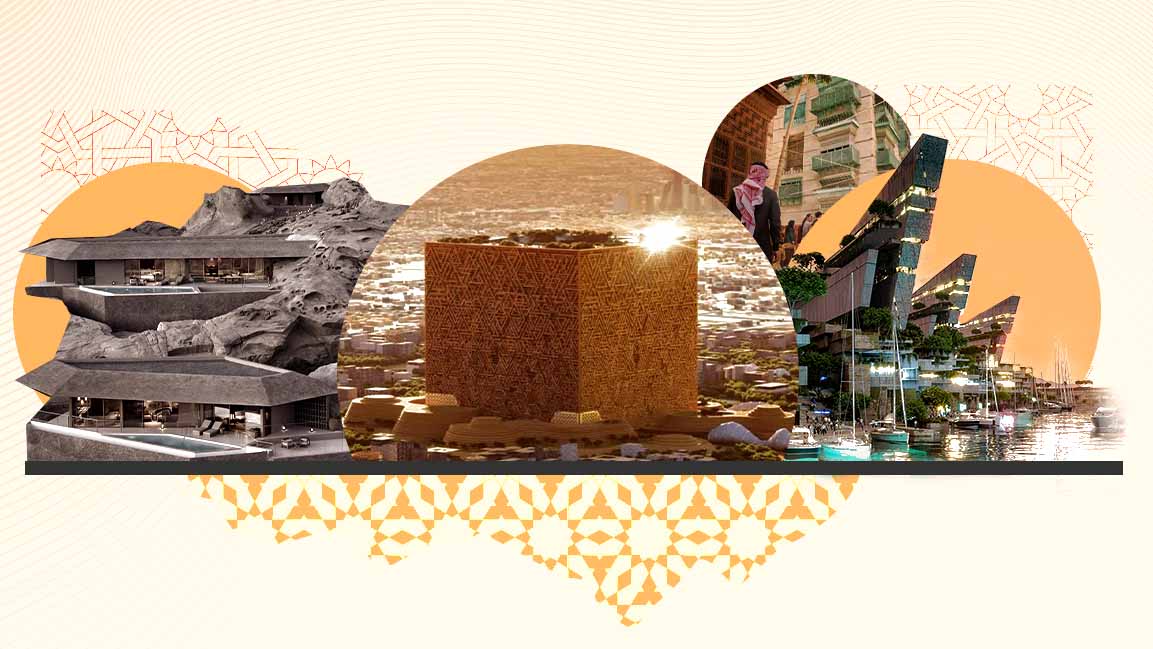
While megaprojects like NEOM, Qiddiya entertainment city, and Red Sea Global signal the scale of Saudi Arabia’s ambition, the most meaningful changes are those transforming everyday life.
For example, Riyadh is developing New Murabba as a 15-minute city, where people can access everything they need on foot. In reality, planners are taking this idea even further.
Mustafa Chehabeddine, design principal at global architecture firm KPF, explains that the first residential district at Riyadh’s new downtown functions as a network of five-minute communities.
“KPF is designing Community 2, the first residential community at New Murabba, as a 15-minute city,” he says. “But, during Riyadh’s hot season, the challenge is to make the radius even smaller.”
To counter extreme heat, the design prioritizes proximity and comfort through shaded, accessible spaces. “We’re implementing five-minute communities within the neighborhood, with pedestrian heat refuges provided every one or two minutes, whether that’s a shop, shaded landscape area, or protected courtyard,” he explains.
The approach blends traditional courtyard urbanism with new technologies such as motion-activated misting systems and cooling fans, ensuring walkability even in the hottest weather.
THE CHALLENGE OF LEGACY INFRASTRUCTURE
It’s one thing to build a city from the ground up, but quite another to modernize long-established urban centers.
“Retrofitting established cities such as Makkah and Riyadh comes with challenges, including infrastructure constraints, integration with legacy systems, and the need to minimize disruption to daily operations,” says Erar.
Bruce Fisher, design principal at KPF, points to the structural consequences of decades of car-centric planning, particularly in cities like Jeddah.
“Jeddah is a sprawling, largely gridded city built on an urban planning model of square super-blocks, wide roads, and highways that have pushed the city steadily northward over the past four decades,” he says.
He adds that the city is “primarily a car-centric, largely unwalkable city.”
“To meet even the minimum standards of a smart city, it must densify in strategic locations capable of supporting transit-oriented development.”
Sometimes, the best solutions come from the past as well as the future. Fisher points to Jeddah’s historic Al Balad district, with its winding, shaded, walkable streets, as a good example of people-friendly urban design.
“Transit is the critical enabler of this kind of smart, culturally resonant, and environmentally responsive urbanism — one that puts people, rather than cars, at the center of urban form,” he says. “A kilometer of mass transit may lack the visual drama of a kilometer-tall tower, but the two work best in tandem — transit unlocks the density.”
CHANGING THE CAR CULTURE
Currently, over 85% of daily trips in Riyadh are made in private cars.
Saudi Arabia is investing in AI-powered transportation and public transit. In 2025, WeRide started a robotaxi service in Riyadh with Uber, and the Saudi company Front End announced plans to use autonomous aerial vehicles.
Elsheshtawy believes the real challenge remains behavioral. “AI-driven mobility can optimize traffic flows, improve safety, and enhance coordination across transport networks, but congestion will persist if people continue to rely overwhelmingly on private cars,” he says.
He argues that public transport requires more than efficient systems. “It demands convenient last-mile connectivity, walkable environments, shaded pedestrian routes, mixed-use development around transit hubs, and a cultural shift that makes public transport a desirable option.”
Projects such as the Riyadh Metro offer a glimpse of that future. By combining data-driven mobility, multimodal integration, and transit-oriented development, the system aims to change how the city moves. It’s real “smartness,” Elsheshtawy notes, lies in its potential to reconfigure urban behavior—encouraging a shift away from car dependency.