- | 9:00 am
How the Middle East’s retailers stopped reacting and started anticipating
Inside the supply chains being rebuilt around intelligence, resilience, and transparency
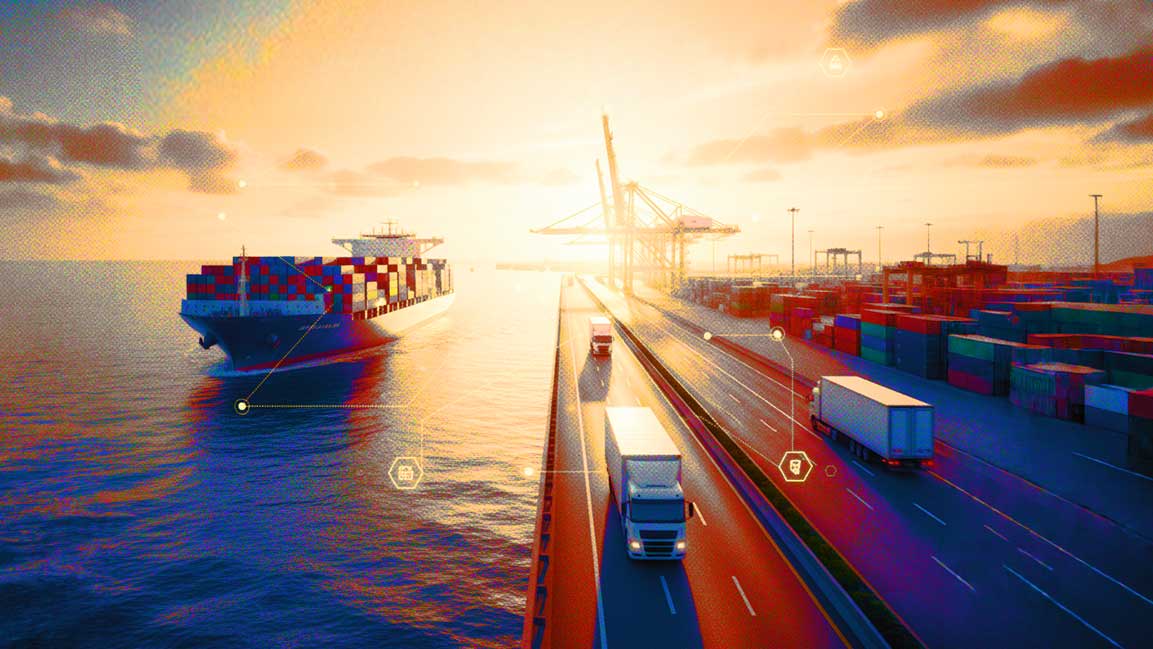


A logistics director in Dubai gets a notification on her phone at 3 AM. A supplier in the port of Jebel Ali just flagged a potential shortage. By 5 AM, her team has rerouted inventory from warehouses across the UAE and identified an alternate supplier in the region. By the time European markets open, nothing has changed on the shelves.
Five years ago, this scenario would have meant stockouts, emergency freight costs, and angry calls from corporate headquarters.
Today, it is just Tuesday. The gap between those two realities is exactly where the next generation of retail is being built. So, what changed?
The short answer is technology. The more accurate answer is a shift in thinking toward intelligence, resilience, and transparency, and what happens when all three are built into the same system.
NETWORKS, NOT PIPELINES
The supply chain of the next five years will look nothing like the one most retailers built their businesses on. “Supply chains are evolving from linear, sequential pipelines into real-time, interconnected networks that continuously adjust inventory, sourcing, and fulfillment based on live demand signals and external disruptions,” says Yasser Taher, CEO of MAGRABi Retail Group.
The engine behind that shift is data. Where retailers once reacted to disruption after it hit, the new model anticipates and adapts before the damage is done. For MAGRABi, that capability is not just an operational upgrade. It is a direct expression of how the business thinks about its customers. As Taher puts it, “the supply chain becomes not just an operational function, but a key enabler of a seamless and consistent customer experience.”
The infrastructure numbers alone tell the story. Saudi Arabia has committed more than $267 billion to logistics infrastructure by 2030, spanning 59 digitally enabled logistics zones and a Landbridge rail corridor linking Jeddah to Riyadh. The ambition, as Shahd Alrashed, Chief Growth Officer – KSA, at Agility, frames it, is to reposition the Kingdom “at the center of trade flows linking Asia, Europe, and Africa.”
But government investment is only half the picture. The private sector is moving just as fast. Agility Logistics Parks added 226,000 square meters of warehouse capacity across Saudi Arabia in 2025 alone, with new facilities in both Jeddah and Riyadh. For Alrashed, the strategic logic is straightforward. Supply chains are no longer built solely for efficiency. They are being rebuilt for optionality. “Supply chains are shifting from fixed, linear pipelines to more flexible regional networks built around resilience, speed, and optionality,” she says. The infrastructure being laid across the region is designed to support that shift, giving operators faster access to trade corridors and the flexibility to scale distribution as demand shifts.
At the operator level, the shift is already reshaping how companies are built. Anass Boumediene, Co-Founder and Co-CEO of eyewa, is unequivocal: “The linear supply chain is already dead.”
eyewa runs multiple supply chains simultaneously. A same-day contact lens order ships from a central warehouse. A prescription order in Riyadh goes through lab assembly, lens procurement, quality checks, and optometrist sign-off. Add cross-border corridors, Amazon and Noon fulfillment, and 280 stores acting as micro-fulfillment nodes. There is no single supply chain. There never was.
“The old model assumed a single happy path. The new model assumes every order is different and the system needs to be smart enough to find the best route on its own.” The retailers that win, in Boumediene’s view, will orchestrate stock, assembly, and fulfillment paths simultaneously and invisibly, without the customer ever seeing the complexity behind it.
THE INTELLIGENCE LAYER
The case for AI in supply chains is no longer theoretical. The real opportunity, according to Alrashed, is “the ability to turn large volumes of data into faster, more informed operational decisions” across demand forecasting, route optimization, and the detection of disruptions before they escalate.
The Agility Emerging Markets Index 2026 found nearly one in five organizations already using AI for forecasting and planning. These tools are becoming standard infrastructure, not a competitive edge.
At the operator level, the conversation has already moved from potential to practice. “AI is not a buzzword anymore. It is solving real problems today,” says Boumediene. He breaks the opportunity into three areas, each grounded in how eyewa actually runs its business.
The first is demand sensing. For contact lenses, a social media trend can shift demand within a week. For prescription eyewear, misallocation results in stockouts or dead stock. Traditional forecasting handles neither well.
The second is exception management. Lab bottlenecks, missed courier handovers, stores running low on key SKUs. eyewa’s AI triages and automatically resolves the routine ones. “The team only handles what genuinely needs human judgment.”
The third is decision support. When eyewa modeled a 15% price cut on one lens brand, the analysis showed the margin break-even required a volume uplift most would have missed. “AI should surface trade-offs. Humans should make the call.”
For Taher, the AI conversation is less about ambition and more about foundation. Analytics capabilities are only as good as the data infrastructure beneath them. MAGRABi’s move to a Snowflake-based BI platform reflects that thinking, improving the group’s ability to unify data, generate insights faster, and scale decision-support across the business. Taher calls it building an “AI-ready and predictive analytics-enabled foundation.”
The distinction he draws is worth keeping. Speed is not the primary objective. Precision is. In his framing, AI is not a supply chain tool. It is a customer experience tool that happens to live in the supply chain.
BUILT TO BEND
Boumediene thinks most retailers are solving the wrong problem. “Most retailers get resilience wrong because they think it’s about buffers,” he says. “It’s actually about optionality.”
The distinction matters more than it might appear. Buffers, whether extra inventory, additional warehouses, or redundant staff, are expensive to maintain and wasteful when nothing goes wrong. Optionality means building multiple paths that can be activated when disruption hits, without carrying the full cost of all of them at once. It is a fundamentally different architecture and a fundamentally different way of thinking about risk.
eyewa’s optionality is geographic. Warehouse nodes across eight markets mean a disruption in one corridor stays contained. Multiple lab vendors and couriers, with their own fleet handling 70% of deliveries, mean volume shifts fast when a partner hits trouble.
The piece most operators miss is channel flexibility. eyewa is majority offline by revenue. When e-commerce faces pressure, stores absorb demand. “We didn’t build it for resilience originally. We built it for growth. But it turns out the same infrastructure serves both purposes.”
Taher frames resilience as a two-track problem. The structural track is about reducing concentration risk, diversifying sourcing and building partnerships deep enough to hold under pressure. The technological track is where responsiveness lives, with real-time monitoring allowing organizations to identify disruptions before they compound.
For MAGRABi, visibility is reinforced by vertical capability. The group’s Lens Innovation Center gives it direct control over a critical part of its supply chain, reducing external exposure in ways that take years to build and are hard to replicate.
The through-line is consistency. Resilience, in Taher’s framing, is not about surviving disruption. It is about ensuring customers never feel it. “Resilience is about building flexible, adaptive networks that can absorb shocks while maintaining a consistent level of service.”
THE TRUST INFRASTRUCTURE
Consumer expectations have moved well beyond the product itself. “Customers expect clarity not only on the products they purchase, but also on how they are sourced, produced, and delivered,” says Taher. Quality standards, ethical sourcing practices, and the integrity of the supply chain behind the label. All of it is now fair game.
For MAGRABi, transparency is not a communications strategy. Trust, in Taher’s view, is built over time through consistency, not through claims. “Transparency is not only a reputational asset, but a key component of sustainable growth.” In a market where consumers have more information and more choices than ever, the brands that win will be the ones with nothing to hide.
In most retail categories, transparency is a brand value. In eyewear, it is a clinical obligation. “In eyewear, transparency isn’t a nice-to-have. People are trusting you with their vision.” At eyewa, every prescription order is tracked through every state change, from purchase order through lens QC to final frame handover. That traceability is not a feature. It is the foundation on which every delivery promise is built.
Pricing transparency, Boumediene argues, is fast becoming a competitive battleground. In the Middle East, consumers compare prices across ten platforms in under a minute. “The brands that build lasting trust are the ones with pricing that makes sense.” No artificial markdowns, no inflated anchors. Just prices that hold up to scrutiny.
THE NEW CALCULUS
A more complicated calculation has replaced the old trade-off between speed and cost. “Speed and efficiency still matter, but leaders also need to consider continuity, risk exposure, and long-term value,” says Alrashed.
A supply chain optimized purely for cost becomes extraordinarily expensive the moment it faces a shock it was not built to absorb. Resilience is not a premium on top of efficiency. It is a component of it.
Taher reframes the tension as a question of time horizon. Short-term optimization is precisely what leaves retailers exposed. “The goal is not to build the fastest or lowest-cost supply chain, but one that consistently delivers reliability, quality, and a high level of customer satisfaction.” The mechanism is data. Without clear visibility into where investments will have the greatest impact, decisions default to instinct, which favors whatever is cheapest or fastest.
Boumediene pushes further. “You can’t optimize for all three simultaneously.” His answer is to make the trade-off at the order level. A same-day contact lens order prioritizes speed. A prescription order prioritizes accuracy. A cross-border order to Oman prioritizes cost. Three order types, three optimization models, running simultaneously. “Most leaders treat supply chain strategy as one dial you turn for the whole business. It’s not. It’s a hundred small dials.” Leaders who build the measurement infrastructure to manage that complexity gain a compounding advantage that becomes very difficult to close.
ONE SYSTEM, NOT TWO
Boumediene is direct: “This isn’t a future thing. It’s happening now, and the gap between companies that get it and companies that don’t is widening fast.”
At eyewa, it plays out in a single journey. A shopper finds the brand on Instagram, walks in for an eye test, has their prescription uploaded digitally, and chooses home delivery. One journey, five systems. The customer expects seamless. Building it is anything but.
The shift happens when stores become digitally instrumented. Footfall sensors, real-time POS data, inventory visibility across 280 stores and 8 warehouses, eye-test appointments feeding demand planning. Every physical touchpoint makes the network smarter. The store, as Boumediene puts it, “becomes a sensor, a warehouse, a service center, and a brand experience all at once.” The retailers still thinking in channels will struggle to compete with those thinking in networks.
Taher lands in the same place from a different angle. Digital-physical integration is not a technology story. It is a visibility story. When platforms, store networks, logistics systems, and customer data fully connect, retailers gain a real-time view across the entire value chain. In eyewear, the balance matters: digital sharpens speed and precision, but the physical network delivers judgment and care a screen cannot replicate. “Every interaction, online or offline, contributes to a consistent and personalized customer journey.” In that model, the supply chain is not behind the experience. It is the experience.
BREAKING THE BARRIERS
Taher identifies fragmentation as the primary obstacle. Legacy systems, siloed data, and limited collaboration create a visibility problem that no single technology investment can fix. The solution, in his view, is the supply chain control tower: a centralized capability providing real-time visibility across the entire network. Getting there is less a technology problem than a discipline problem. The tools exist. The harder work is building the foundations.
Boumediene is more specific about where the friction lives. The barriers, he argues, are not really about technology. They sit in on how data, teams, and decisions are structured.
The first is fragmented data. Retailers accumulate disconnected systems across ERP, warehouse management, POS, and marketing. “You cannot build intelligence on top of a fragmented data foundation,” says Boumediene. The fix is unglamorous: a unified data layer that stitches together all operational systems. At eyewa, it is “the single biggest enabler of everything else we’ve built.”
The second is politics. Supply chain transformation touches every team, and people protect their territory. “No amount of technology fixes a political problem.”
The third is the action gap. “Plenty of companies build great dashboards. Very few actually change decisions because of them,” says Boumediene. The distance between seeing a problem and doing something about it is where most initiatives die. The solution is embedding intelligence into daily workflows: automated alerts, dynamic routing, and pricing that responds to actual sell-through. “Intelligence that doesn’t trigger action is just an expensive waste of potential.”
THE FUTURE-READY SUPPLY CHAIN
Taher sees future-ready supply chains converging around three things: data intelligence, operational flexibility, and strong technological foundations. The organizations that get there will be the ones that anticipate disruption rather than react to it. But he is careful to frame it as a human and technology story. “Technology enables speed and intelligence, but it is the combination of strong data infrastructure, operational discipline, and customer-centric thinking that ultimately defines a high-performing supply chain.”
Boumediene is more specific. Future-ready supply chains, in his view, come down to five operational capabilities.
The first is real-time visibility. “Not a daily batch. Not a weekly report.” Every SKU, every warehouse, every store, every fulfillment stage, visible right now.
The second is dynamic fulfillment orchestration. “The system picks the best path for each order based on inventory position, cost, speed, and capacity, and reroutes mid-flight when conditions shift.” That is what turns a pipeline into a network.
The third is embedded analytics. Intelligence cannot live in a dashboard that five people check once a week. It has to sit inside the warehouse picker’s device, the store manager’s morning brief, and the procurement team’s replenishment triggers. If it is not in the workflow, it does not exist.
The fourth is composable architecture: the ability to swap couriers, add markets, or plug in new sales channels without rebuilding the entire stack.
The fifth, and the one he rates highest, is a culture of relentless measurement. “The future-ready supply chain isn’t the one with the best technology today. It’s the one that measures everything, learns fast, and iterates constantly.” That habit, more than any platform, is what separates the leaders from the rest.