
- | 10:00 am
Why Anne-Lise Cremona believes the future of perfume looks a lot like its past
The Henry Jacques CEO on her years inside big perfume, earning trust in the Gulf, and building Ulysse around her own return home
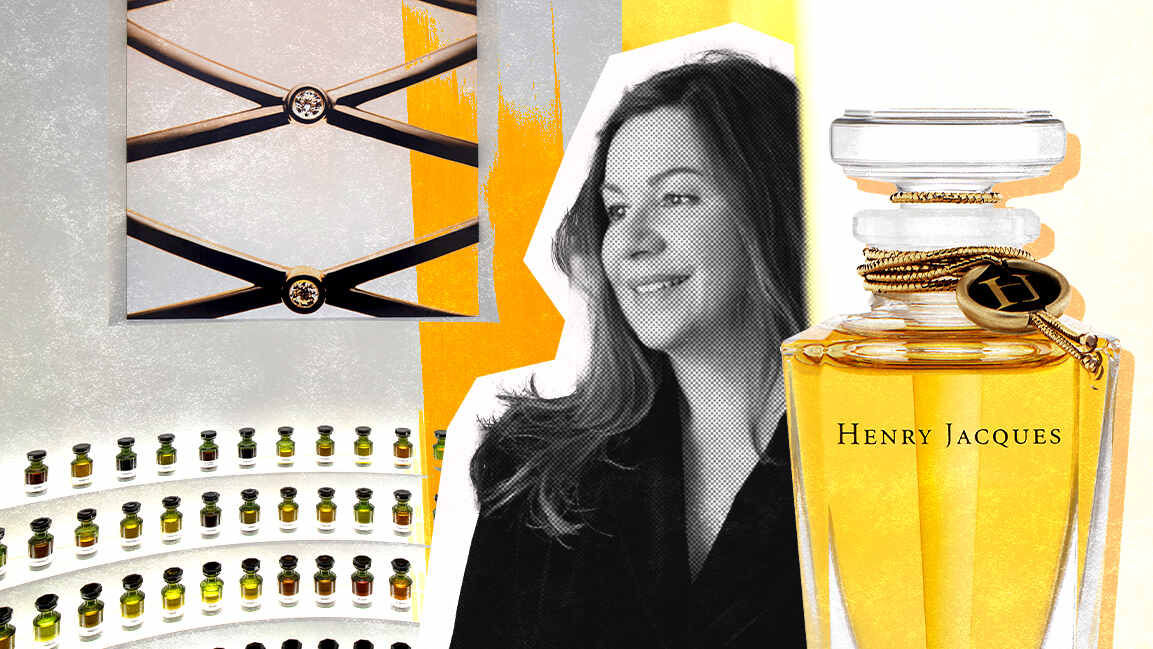


Most people who inherit a family business either preserve it carefully or reinvent it aggressively. Rarely both. Anne-Lise Cremona spent more than twenty years inside major perfume conglomerates before returning to run Henry Jacques, the French haute parfumerie her parents started, and came back determined to do exactly that: protect what made the house distinct while building something considerably larger around it.
Henry Jacques has since expanded from a private, bespoke house into retail boutiques across multiple continents without sanding down what made it distinctive. Ulysse, one of Anne-Lise Cremona’s favorite creations from the house, reflects that same philosophy. Cremona spoke about the lessons she drew from her years leading global fragrance brands, the philosophy she has upheld since returning to Henry Jacques, and what she hopes will remain unchanged decades from now.
A RETURN TO FIRST PRINCIPLES
Years spent leading some of the industry’s largest fragrance businesses gave Cremona a front-row view of an industry increasingly built for speed. “Working within large groups showed me the challenges of an industry increasingly driven by speed, short-term objectives, and market imperatives,” she says, pointing to intense launch calendars that left little room for the time craftsmanship actually requires.
What struck her most, she says, was watching intuition get replaced by trend-chasing, and clients reduced to data and profiles rather than being treated as individuals with their own emotions and stories.
That experience didn’t push her away from perfumery. It clarified what she wanted to protect. “It also reinforced my conviction that the future of perfumery lies in reconnecting with what truly matters, craftsmanship, authenticity, and a more responsible approach to creation and materials,” she says.
Coming home, she says, wasn’t a retreat from the industry so much as a return to Henry Jacques’ founding principles, giving creation the time it needs, protecting creative freedom, and keeping emotion and human connection at the center of the process.
When Cremona joined Henry Jacques, the wider perfume industry was moving toward mass production, multi-brand distribution, and synthetic compositions, with advertising increasingly overshadowing the fragrance itself. “That contrast clarified my vision, not to follow the industry’s direction, but to protect and elevate what made Henry Jacques unique,” she says. According to Cremona, preserving the house’s heritage meant something specific: sharing its savoir-faire with people capable of appreciating it.
That vision took shape through a partnership with Artistic Director Christophe Tollemer, uniting a house of composition with a house of design to create the Les Classiques collection.
The two introduced a single-flacon design used across every fragrance, housing the natural Les Essences at concentrations that remain the highest in the market, and revived a ritual most of the industry had abandoned: a single drop applied to the skin with a crystal glass wand. “In an era of sprays, differentiated flacons, and personality-driven marketing, few believed in this approach, but I did,” she says. The house tested that conviction at its first retail space, Harrods, and Les Classiques has since become Henry Jacques’ signature collection, with Les Essences outselling every other variation across its boutiques worldwide.
Looking back, Cremona credits that period with shaping how she leads today. “My experiences have taught me to lead with conviction, to balance heritage with innovation, to remain independent from industry pressures, and above all, never compromise on quality,” she says. Her belief, ultimately, is a simple one: that anything built with true integrity eventually finds its audience.
TIME AS THE REAL LUXURY
Cremona describes what she calls a tyranny of short-term thinking, the constant demand to react to every trend, every immediate expectation, every market signal. “But chasing what changes constantly can lead to losing sight of what truly creates lasting value,” she says.
Her answer is to build perfume around something more durable than trends. “At Henry Jacques, we believe that perfume cannot be built around trends. Trends are temporary; creativity, craftsmanship, and emotion endure,” she says. Rather than responding to external pressure, the house is guided by its own convictions, letting creativity and savoir-faire lead, not the market.
That philosophy extends beyond fragrance creation. It shapes the way Henry Jacques approaches craftsmanship and its relationships with clients. Refusing to compromise on quality means sourcing the finest raw materials, letting nature run its course, and relying on the most skilled artisans – all things that are rare and, by nature, slow.
The client relationship follows the same rhythm. Those who understand Henry Jacques’ vision, approach, and standards will follow, Cremona believes, and that shared understanding is what builds genuine, lasting relationships. “Creating something meaningful, building authentic conversations, and truly understanding each individual cannot be rushed,” she says. “Ultimately, what defines true excellence is the ability to give time its full value.”
She believes that this long-term mindset will shape Henry Jacques’s thinking about longevity. Cremona adds, “Henry Jacques believes that longevity lies in the ability to preserve traditional savoir-faire and rituals while remaining in harmony with modern lifestyles.”
Creatively, that means protecting the house’s olfactive signature while still letting it evolve, deliberately, rather than in response to whatever trend is current. Culturally, it means resonating with a generation looking for both self-expression and responsibility, where a fragrance serves as an imprint of identity as much as a conscious choice. Commercially, the same principle holds.
“It translates into a model rooted in meaning rather than excess; every element, from the quality of the materials to the craftsmanship behind each creation to the relationship with clients, is designed to endure, reflecting values that matter over time rather than momentary appeal,” she says.
RESPECTING A DEEPER TRADITION
Selling French perfume to a market this fluent in oud and attar, in Cremona’s account, starts with earning trust rather than making a pitch. “First and foremost, we earned the trust of our clients by demonstrating our deep respect and appreciation for the region’s unique perfume culture,” she says. She points to the Gulf’s extraordinary olfactive heritage, generations of knowledge built around oud, attar and perfume rituals, as something Henry Jacques never set out to replace or redefine, only to engage with.
That engagement, for Cremona, works as an exchange rather than a substitution. Henry Jacques brings its own French perspective, shaped by its heritage of creation, craftsmanship and refinement, while embracing a perfume culture built on entirely different foundations. “It is a continuous dialogue between different elements of savoir-faire,” she says. When approached with humility, respect, and authenticity, she argues, the two traditions don’t compete. They elevate each other.
The same philosophy shapes how the house approaches its own traditions. Building inside a category as codified as fougère is, for Cremona, the point rather than a limitation. “At Henry Jacques, we love building on the past. Reinterpreting existing, powerful codes allows us to keep them alive and give them a new expression,” she says, describing it as the mechanism that perpetuates the house’s signature.
That instinct is backed by scale. Henry Jacques draws on an olfactive library of more than 3,000 perfumes, a resource Cremona treats as an endless source of inspiration for new work. The house’s perfume committee pairs perfumers with more than twenty years of experience at Henry Jacques alongside younger noses, letting new creations emerge from the friction between heritage and fresh perspective. “We love merging tradition with innovation in every way,” she says. “We are convinced that modernity is not about breaking away from tradition, but about allowing it to evolve and remain meaningful in today’s world.”
NO PERSONA, JUST POSSIBILITY
Ulysse, in Cremona’s telling, isn’t a loose metaphor. “Ulysse is deeply connected to my own journey. It is a metaphor for the path I have taken to preserve and share my parents’ vision of Haute Parfumerie in a rapidly changing world,” she says. She draws a direct parallel to Odysseus, describing her own path as one of learning, transformation, perseverance, and conviction, with plenty of setbacks along the way before Haute Parfumerie found its place, first at Harrods and now across Henry Jacques’ boutiques worldwide.
One line from the myth stays with her in particular, Odysseus’ words on returning to Ithaca. “I know nothing more beautiful than this land,” she says, adding that the sentiment resonates deeply with her own. Through Henry Jacques and Haute Parfumerie, she says, she’s celebrating the beauty of nature and life, as well as the values that shaped who she is.
Cremona outright rejects the premise of the question. “Anyone can wear Ulysse. What we hope is not to impose a feeling or a story, a persona, but to allow space for something deeply personal to emerge,” she says. Rather than design toward a specific wearer, the intent is to leave room for whoever wears it to bring their own story to the scent.
That openness, in Cremona’s view, is where the fragrance actually lives. When someone wears Ulysse, she says, the story becomes theirs, an intimate connection between the scent and their own identity, memories, and moments. “In the end, we want them to feel exactly what they want to feel,” she says.
“Because that freedom, that personal interpretation, is where the true beauty of perfume lies.”