
- | 9:00 am
How UAE restaurants are disrupting the art economy
For decades, artists followed a linear path from galleries to the secondary market. Today, UAE culinary spaces are accelerating that journey by becoming primary channels for exposure and sales.


Art has escaped the confines of white-walled galleries and hushed auction houses to find a new, high-traffic home. Across the UAE, restaurants and cafés now provide a vital creative infrastructure that is changing how people discover and experience art.
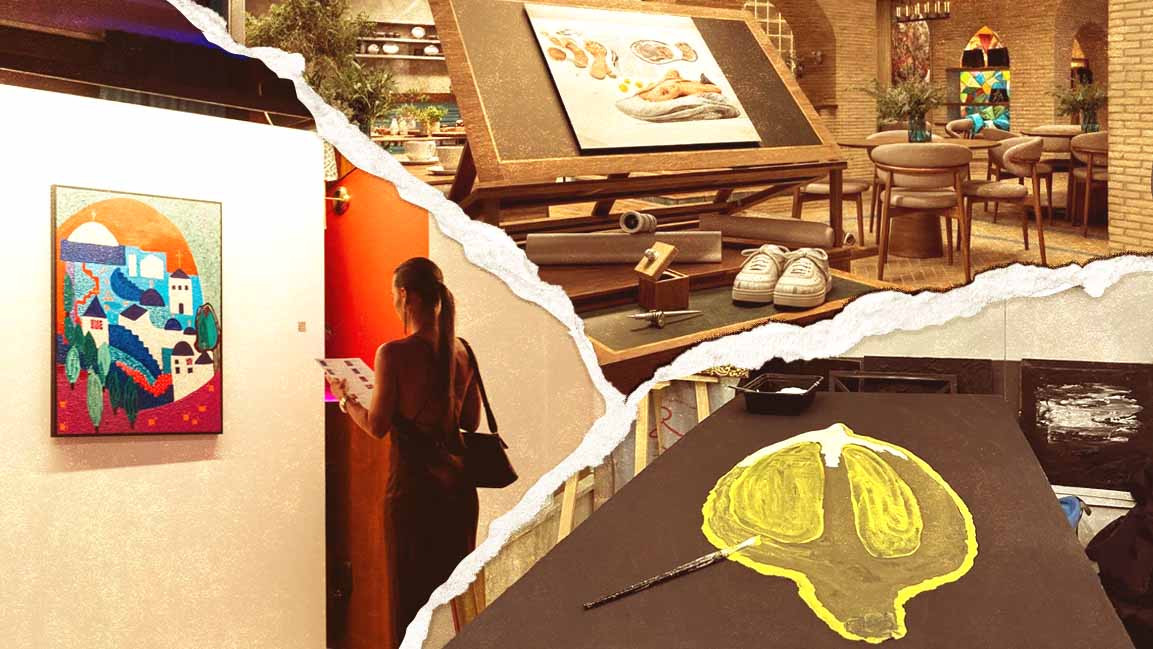
From the monthly exhibitions at Dubai’s IKKA to the founder-led coffee paintings at Abu Dhabi’s Bovini, the lines between curator, restaurateur, and entrepreneur are becoming increasingly blurred. This isn’t simply about creating a photo-ready backdrop; it’s a sophisticated disruption of the art economy.
THE RESTAURANT AS A LAUNCHPAD
For decades, the path for an artist was linear: find a gallery, hope for a solo show, and eventually reach the secondary market. Today, culinary spaces in the UAE are shortening that distance by acting as primary distribution channels.
At Peruvian-Japanese hotspot IKKA, the strategy is deliberate. By operating a rotating in-house gallery, the restaurant allows artworks to debut directly to a demographic of high-net-worth diners before they ever hit the gallery circuit.
“We felt that art here is still largely observed rather than lived,” says Dzenita Skrobo, marketing manager at IKKA. “It tends to be treated as something prestigious, or frankly, as an Instagram moment, rather than as an experience that brings people together to connect. Art was never meant to be just another VIP event to attend so you can post about it.”
By embedding the gallery within a high-end dining room, IKKA introduces art “gently and naturally,” creating a safe space for those who might find traditional galleries intimidating. But the impact is more than just atmospheric; it’s an incubator.
“We wanted to become something genuinely useful to emerging artists… offering them not just a wall to exhibit on, but a real platform,” Skrobo explains. “We made sure they were introduced to gallery directors and curators who move through our space. In more than one instance, an artist who exhibited with us went on to show at other galleries as a direct result of those introductions.”
THE MULTI-SENSORY CONCEPT
In Dubai’s City Walk, Design Dome takes this convergence to a visceral extreme. The new concept store and café is a sprawling nomadic vision that merges fashion, art, and coffee under one roof. Founder Lalit Tilani says the decision to bring these worlds together was born from a desire to showcase unsung heroes and centuries-old craftsmanship from the Silk Route—regions like Kazakhstan, India, and Andalusia—in a space that feels like home.
“A good life lies in sharing—not just knowledge and wisdom, but also the handcrafted work of artists and designers who don’t just sell products; they sell emotions and good vibes,” says Tilani.
Design Dome functions as a hybrid incubator where a guest might walk in for a signature blend from “The Modern Nomad Coffee” and leave with a pair of hand-painted sneakers or a mother-of-pearl jewelry box from Damascus.
“The space inspires art collectors by allowing them to express their unique identity through exclusive offerings,” Tilani says. “It’s setting a new trend in which being surrounded by designer collections encourages discovery and engagement.”
CONTEMPLATION OVER DISTRACTION
In Abu Dhabi, Saschia Bovini, founder of Italian-Lebanese fusion venue Bovini Restaurant & Cafe, has taken creative authorship a step further. The artworks on the walls aren’t just curated; they are his—painted using coffee itself as the medium.
This creates a recursive loop of brand identity: the customer drinks the coffee while contemplating a piece of fine art made from the very same beans. Bovini sees this as a way to combat the digital noise of modern dining.
“The presence of art can transform waiting time at a restaurant into a moment of reflection rather than distraction,” Bovini explains. “It can also encourage people to reconnect with conversation and human presence instead of automatically turning to their phones.”
By selling an artwork directly to diners who have formed an emotional attachment with it during their meal, Bovini is bypassing the formal gatekeepers of the art world.
“When someone discovers an artwork while sharing a meal or a conversation, the experience becomes more personal and memorable,” he says. “Art becomes part of everyday life rather than something reserved for exclusive spaces.”
OPERATIONAL REALITIES
While the gallery-restaurant model offers a romantic vision of cultural synergy, the logistical hurdles are significant. Maintaining a curated exhibition in a space filled with steam, moving plates, and high foot traffic requires more than just a hammer and nails.
At IKKA, the team had to build gallery-grade walls from the ground up, consulting with Zawyeh Gallery to ensure the materials and lighting met professional standards. “Each exhibition brought different mediums: photography, video installations, oil on canvas,” says Skrobo. “None of it would’ve been possible without our engineering team… who worked tirelessly to ensure each one was presented as it deserved to be.”
Tilani echoes these challenges at Design Dome, noting that maintaining hand-crafted, imported items is often more difficult than the initial import. “The key is the team. There is constant learning with new products and collections entering the space every week.”
A TREND THAT’S HERE TO STAY
Is this merely a short-lived reaction to the Instagrammable era, or an irreversible market evolution? The consensus among these disruptors is that we have moved past the point of no return.
“The love for curated art experiences has always been exclusive,” Tilani observes. “The aroma of coffee and cultures blending is becoming a trend for the new generation… this is becoming a permanent feature in many cosmopolitan cities.”
While IKKA has temporarily paused its schedule due to regional circumstances, the venue’s vision remains steadfast. “We were the first restaurant in Dubai to introduce a permanent, rotating in-house art gallery,” says Skrobo. “The response… tells us we were right to believe that people here are hungry for this kind of experience. Something that does not ask them to perform appreciation, but simply invites them to feel it.”
As the UAE continues to position itself as a global cultural hub, the restaurant floor has become the new gallery floor. In this emerging economy, dinner-table conversations—rather than just a critic’s review—ultimately dictate the value of a piece of art.