- | 10:00 am
How MIRRIAH is bringing solar power to the smallholder farmers left out of the clean energy transition
Nidal Tafah explains why the green transition will fail in rural Africa if it continues to be delivered by people who do not understand it
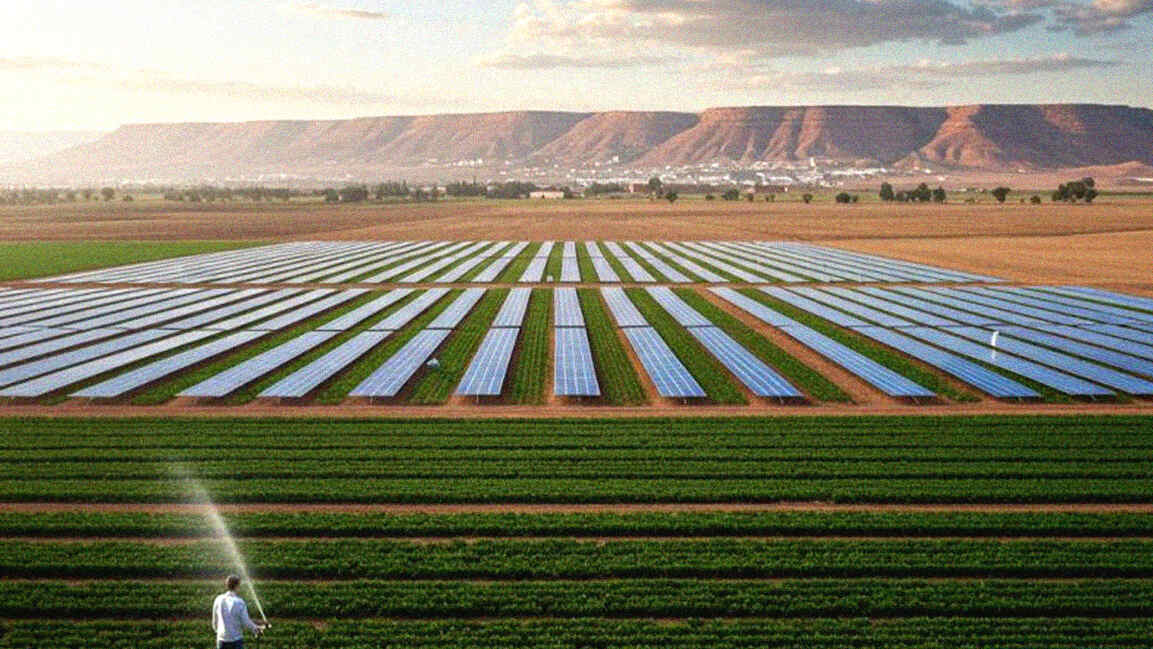


For years, conversations around agricultural innovation have focused on bigger systems, smarter infrastructure, and more advanced technology. But for many smallholder farmers in rural Morocco, the challenge has been far more basic: access to reliable water, free from the volatility of rising fuel costs or the burden of debt that often comes with them.
That gap is where MIRRIAH saw an opportunity to rethink the model altogether. Founded by Nidal Tafah, one of 30 fellows selected this year by the Cartier Women’s Initiative, a programme that identifies and supports women impact entrepreneurs tackling the world’s most pressing challenges, the company builds solar-powered irrigation systems tailored for small plots and off-grid farming communities, combining clean energy with financing and local support networks designed around the realities of rural agriculture rather than the assumptions of large-scale farming.
Tafah talks about why incremental fixes were never going to solve structural problems, how trust matters as much as technology in rural communities, and why the future of sustainable agriculture may depend less on reinventing farming and more on finally designing systems that include the people who have long been left out.
RETHINKING THE STARTING POINT
The problem, Tafah argues, was never about improving an existing irrigation system. For smallholder farmers in rural areas, the fundamentals simply do not exist. Many are off-grid, outside formal credit systems, and invisible to traditional agricultural supply chains, which leaves little room for incremental fixes.
“You cannot incrementally improve a system that was never designed to include them in the first place,” she says.
That reality shaped MIRRIAH’s choice to build around solar and off-grid technology. It was not positioned as the most advanced solution, but as the only viable way to bypass missing infrastructure. “We had to start from a different premise: that the smallholder farmer in secluded rural Africa is the customer, not the afterthought,” she says.
That shift also exposed a deeper mismatch in how irrigation is typically designed. Tafah says most systems are built for scale rather than the realities of fragmented land ownership. “Standard irrigation systems are designed for hectares, not for extremely small plots,” she says, noting that they are usually sold as large upfront investments installed by teams far removed from the communities they serve.
For smallholder farmers in remote villages, that structure rarely works. MIRRIAH instead rebuilt the model around day-to-day realities, introducing modular irrigation kits that can fit small plots and expand over time. Financing was also redesigned to move farmers away from recurring fuel expenditure and toward ownership.
Alongside the product and financing shift, the company built a locally trained network of rural youth responsible for installation and aftercare in areas where traditional providers rarely operate. “MIRRIAH is not just a solar irrigation system,” Tafah says. “It is a social business model designed to finally include the people who have always been told they are too small to serve.”
Fuel costs sit at the center of that exclusion. For many farmers, they are not just an expense but a constraint on every decision they make. Tafah says diesel can consume up to 40% of a farmer’s income, with price volatility adding another layer of uncertainty.
“That is not just a cost problem,” she says. “It is a vulnerability that traps families in a cycle they cannot plan their way out of.”
MIRRIAH’s response has been to replace that volatility with predictability. Solar energy eliminates exposure to fuel price fluctuations, while the financing model is structured around existing diesel spending, ensuring the transition does not increase financial pressure.
“The sun does not raise its prices,” she says.
The company’s aim, she adds, is to ensure that switching does not feel risky. “We made sure the farmer is never paying more during the transition than they were already paying for diesel,” Tafah says. “The risk of switching becomes lower than the risk of staying.”
SCARCITY AS A DEBT TRAP
Saving 13.6 million cubic meters of water carries weight in policy rooms, but Tafah is clear that it means something entirely different at the farm level. For the farmer, it translates into more harvest from the same land, more days the crop survives, and more income at the end of the season. “The farmer feels it in their hands at harvest, and in the security their family carries for the rest of the year.”
Smart drip irrigation reduces water use by up to 45% and, because water is delivered precisely to the root rather than dispersed across the surface, yields increase significantly. Efficiency and output move together, meaning the water-saving story and the income story are ultimately the same story told from two different angles.
That connection runs deeper than harvest yields. For Tafah, water scarcity is not only an environmental issue. In rural farming communities, she sees it quickly becoming a financial one. Failed harvests force farmers to borrow for the next season, and when unreliable water access continues year after year, that debt becomes increasingly difficult to escape. “Water scarcity does not just dry up land,” she says. “It dries up income, then it dries up choice.”
That link between water insecurity and debt has shaped MIRRIAH’s approach to resilience. Rather than framing it as aid or short-term support, the company focuses on ownership and cost predictability. When farmers have stable access to water and more predictable energy costs, Tafah argues, they are better positioned to invest in growth rather than operate in survival mode.
“Resilience in rural communities is not built through aid. It is built through ownership. When a farmer owns a system that gives them predictable water and predictable energy costs, they stop borrowing to survive and start investing to grow.”
Delivering that kind of ownership, however, depends on more than the product itself. The most important lesson from MIRRIAH’s early deployments had little to do with technology.
“Farmers do not adopt technology,” Tafah says. “They adopt the people who deliver it.” Trust in rural communities cannot be built from a head office, which is why 80% of MIRRIAH’s team is rural, including co-founder and CTO Said El Hafidi, who is himself an illiterate smallholder farmer. When farmers see people who look like them, speak like them, and understand their land, the conversation changes completely.
What farmers need, she has found, is not more sophisticated technology. It is technology delivered by people they trust, financed in a way they can actually afford, and backed by someone who will show up when something breaks. Reliability and proximity, not complexity, are what make the difference.
WOMEN, WORK, AND THE GREEN TRANSITION
In Tafah’s view, rural resilience already runs through women, even if it is not always formally recognized. They manage household finances, play a central role in daily farm operations, and often hold together the social and economic fabric of their communities. “When you equip a woman with technology and ownership, the impact multiplies through the entire family and the entire village.”
That perspective has shaped MIRRIAH’s work with 30 women’s cooperatives transitioning to solar power. Tafah describes them not as recipients of support but as active partners in decision-making and deployment. “They are not beneficiaries. They are partners and decision-makers.” The same philosophy extends to hiring, where the company prioritizes lived experience and intent over formal qualifications, particularly in communities where access to education has historically been uneven.
“We hire women for their will and lived experience, not for the diplomas the system has historically denied them.” For Tafah, excluding women from rural development is not simply an oversight. “Rural resilience without women at the table is not resilience. It is a delay.”
That conviction about who needs to be in the room extends to who needs to be on the ground. For Tafah, the clean energy transition in rural regions does not hinge only on technology or funding, but on who delivers it. Externally driven models, she argues, often struggle to take root precisely because they lack a genuine understanding of local realities.
“The green transition will not succeed in rural Africa if it is delivered by outsiders who do not understand the realities of the people they are trying to include. Sustainable practices are not adopted because they are not explained. They are adopted because they are delivered by trusted people with skin in the game.”
That thinking underlies MIRRIAH’s creation of 150 green jobs, which Tafah frames less as an employment milestone and more as a network for knowledge and trust distribution. Spanning technicians, installers, and trainers embedded within the communities they serve, these roles represent a shift in trajectory for young people who might otherwise have left their villages or remained without stable opportunities.
“Every green job we create is a young person who would otherwise have left their village or stayed without prospects. Now they are technicians, installers, trainers, and ambassadors of the green transition in their own communities.”
The result, she suggests, is not just adoption but genuine ownership. “Local job creation is what turns the green transition from a policy on paper into something a community owns, defends, and grows.”

Featured Videos
Today's Top Stories:
More Top Stories:



FROM OUR PARTNERS