- | 1:00 pm
Dubai’s economy records $128.8 billion in real GDP in H1 2026
Financial and insurance activities grew 8.8%, accounting for 14% of Dubai’s real GDP.
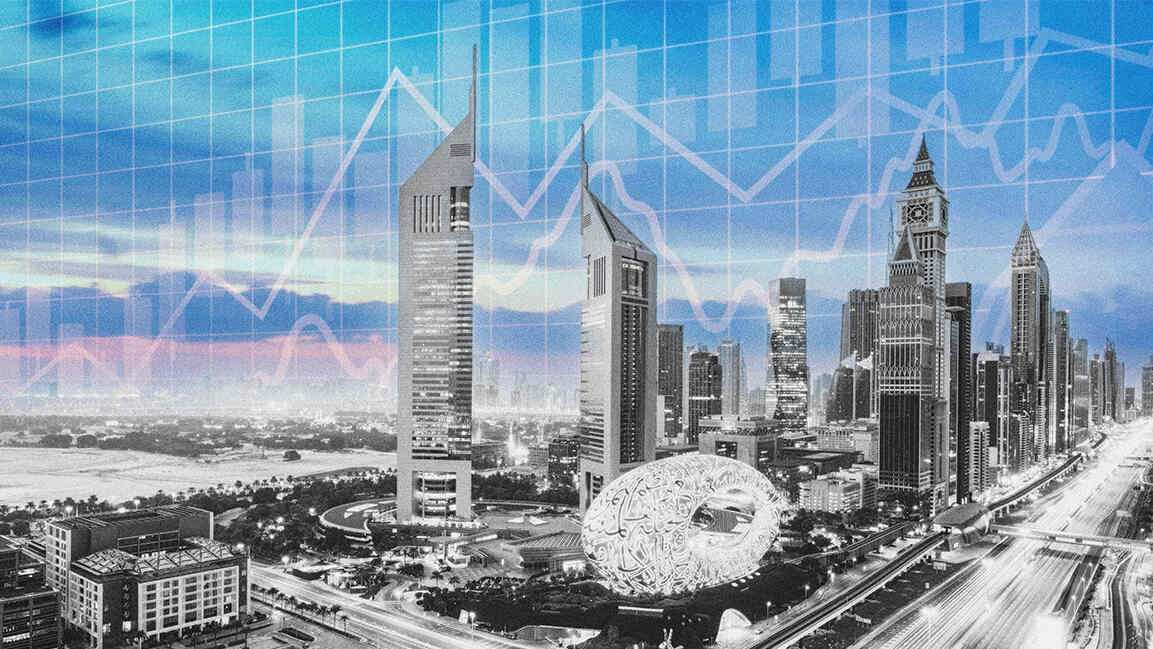


The Government of Dubai reported real gross domestic product (GDP) of approximately $128.8 billion in the first half of 2026, down 2.3% from around $131.8 billion in the same period of 2025, according to data released by the Dubai Data and Statistics Establishment at Digital Dubai.
GDP at current prices reached approximately $137.4 billion, up 0.2% year on year, as performance varied across sectors amid shifts in the global economic environment. Financial services, healthcare, information and communication, and construction recorded growth during the period.
Financial and insurance activities grew 8.8% in real terms, with value added rising to approximately $18 billion from $16.9 billion a year earlier. The sector accounted for 14% of real GDP, up from 12.5% in H1 2025.
Human health and social work activities recorded real growth of 14.3%, with value added reaching approximately $1.7 billion, compared with $1.5 billion in the same period last year. Electricity, gas, water supply and waste management grew 5.4%, generating around $2.8 billion in real value added.
Information and communication grew 2.7% in real terms, with value added reaching approximately $6.7 billion, compared with $6.5 billion a year earlier. Construction expanded 2.4%, generating around $9 billion in real value added.
Government services grew by 2.9% in real terms, while education grew by 1.2%.
Helal Saeed Almarri, director general of the Dubai Department of Economy and Tourism, said growth in strategic sectors reflected the economy’s resilience and supported the Dubai Economic Agenda, D33, which targets investment, innovation, talent and competitiveness.
Hamad Obaid Al Mansoori, director general of Digital Dubai, highlighted economic diversification, digital transformation and AI as drivers of competitiveness and efficiency.
Younus Al Nasser, chief executive of the Dubai Data and Statistics Establishment, stressed the importance of reliable economic data for planning and decision-making amid varying sector performance.
Hadi Badri, chief executive of the Dubai Economic Development Corporation, said investment interest remained strong, particularly in future-focused sectors, adding that improvements to the business environment, infrastructure and talent availability would support further investment.
Wholesale and retail trade remained Dubai’s largest economic activity, accounting for 20.5% of real GDP in H1 2026. Financial and insurance activities contributed 14%, followed by real estate at 11.8% and transportation and storage at 10.7%.
Trade activity declined 6% in real terms, with value added reaching approximately $26.3 billion, although it grew 2% at current prices. The report linked the decline in real terms to higher inflation. Dubai’s foreign trade increased 4% year on year during the period.
Transportation and storage recorded value added of approximately $13.7 billion, down 7.4%.
Real estate grew 5.4% at current prices, with value added reaching approximately $17.7 billion, compared with $16.8 billion in H1 2025. In real terms, however, the sector contracted 2.5%, with value added at around $15.1 billion.
Manufacturing value added reached approximately $6.6 billion at current prices, up 0.5% year-on-year. In real terms, the sector declined 0.9%, with value added of around $6.4 billion.

Featured Videos
Today's Top Stories:
More Top Stories:



FROM OUR PARTNERS