- | 9:00 am
Can Gen AI design a better city—or just a faster one?
AI is changing how cities are designed. The bigger question is what kind of cities it will help us create.



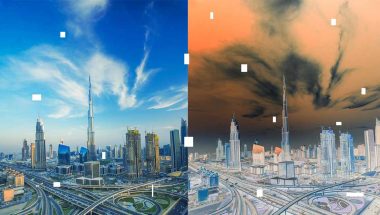
When Dubai unveiled its AI-powered urban planning platform, it signaled more than another digital government initiative. It marked a turning point in how one of the world’s fastest-growing cities intends to shape its future—using generative AI to model neighborhoods, test scenarios, and evaluate planning decisions before they’re built.
For a city that has built its reputation on ambitious transformation, this move means more than just improving efficiency.
As cities around the world face rapid population growth, climate challenges, and more complex urban systems, Dubai is becoming an early example for a much bigger question. Can AI help us design cities that are not only faster to build, but also more resilient, inclusive, and deeply human?
The answer could shape the next era of urbanism.
PLANNING FOR A CITY IN CONSTANT TRANSITION
Dubai’s AI-powered urban planning arrives at a pivotal moment for cities everywhere.
The United Nations estimates that by 2050, almost 70% of people will live in cities. In the Gulf, fast population growth is putting more pressure on housing, transport, infrastructure, and public spaces. Dubai expects its population to reach about 5.8 million by 2040.
The Dubai 2040 Urban Master Plan aims to make the city more sustainable, connected, and focused on people. Planning for this kind of growth needs a new approach.
Traditional planning often evaluates housing, transport, utilities, and public space as separate systems, producing studies that are updated periodically and frequently react to problems after they emerge. Generative AI offers the possibility of understanding those systems simultaneously, revealing how decisions in one area influence outcomes across the entire city.
Dr. Bhakti More, Dean of the School of Design and Architecture at MAHE Dubai, believes this is where AI could fundamentally reshape urban planning.
“Generative AI can enable planners to analyze complex urban data and simulate future development scenarios, supporting evidence-based decisions across infrastructure, housing, mobility, and public space,” she says.
“With predictive analysis of real-time data, generative AI can help planners achieve the strategic goals of the Dubai 2040 Masterplan and keep pace with a population that is growing quickly and shifting constantly,” Dr. More adds.
CLIMATE RESILIENCE BEGINS AT STREET LEVEL
That predictive capability may prove most valuable in addressing one of the Gulf’s defining urban challenges: climate resilience.
As temperatures rise, it is now key to ensuring neighborhoods function as planned. A district might look good on paper, but if people cannot walk, meet, or spend time outdoors comfortably, it will not succeed in the long run.
Fatma Alkhayat, CEO and Co-Founder of ARKAT, says that climate resilience is ultimately experienced at the human scale.
“Climate resilience won’t be won at the scale of the masterplan,” she says. “It will be won in the everyday moments that shape how people experience a city.”
People’s choices to walk to a café, spend time in a public square, or leave the car at home depend on small details like how streets are laid out, the amount of shade, landscaping, materials, and how public spaces are designed.
“This is where AI has the greatest potential,” Alkhayat says. “It allows us to simulate thermal comfort, wind movement, solar exposure, and shading with remarkable precision, helping us understand how a neighborhood will actually perform before it’s built.”
Those seemingly small design decisions create ripple effects across an entire city. Comfortable streets encourage walking. Increased pedestrian activity supports local businesses, strengthens public life, and reduces dependence on private vehicles. By modeling these relationships before construction begins, AI can make climate performance a design principle rather than an afterthought.
Dr. More believes AI is already helping architects and planners evaluate climate-responsive strategies, from optimizing building orientation and street layouts that capture prevailing winds to selecting materials that reduce heat absorption.
Yet she also cautions against overestimating the technology.
“AI is only as reliable as the datasets behind it, and incomplete or outdated information can weaken its predictions.”
BRINGING ECOLOGICAL INTELLIGENCE
For decades, biodiversity has been treated as a separate environmental consideration, often addressed after development decisions have already been made. AI offers the opportunity to change that by bringing ecological intelligence into the earliest stages of planning.
Sheena Khan, Head of Environmental Programs at Terra, Expo City Dubai, believes AI’s greatest contribution is not to replace ecological expertise but to expand it.
“One of the greatest opportunities for AI is not replacing ecological expertise, but expanding the amount of ecological information available for better decision-making,” she says.
Initiatives such as Dubai’s participation in the global City Nature Challenge are already helping build richer environmental datasets, with residents documenting local plants, animals, and fungi through citizen science platforms. When combined with satellite imagery, environmental sensors, and ecological surveys, these datasets can enable AI to identify biodiversity hotspots, detect habitat fragmentation, and reveal opportunities for ecological restoration before development begins.
Yet Khan warns that AI can only recognize what it has been taught to value.
Desert ecosystems are a case in point. Because they appear sparse compared with forests or wetlands, conventional vegetation metrics often underestimate their ecological significance.
“Desert landscapes can appear sparse or unproductive when assessed using conventional vegetation metrics, yet many support highly specialized species that have evolved over thousands of years.”
With robust ecological data and ongoing field verification, AI could help planners uncover environmental value that isn’t immediately visible, rather than simply optimizing for landscapes that appear greener.
THE LIMITS OF OPTIMIZATION
Optimization is one of AI’s greatest strengths.
AI can find the best transport routes, suggest optimal building placement, and help decide how to use land, energy, and infrastructure. But being efficient is not the only thing that makes a city successful.
Cities are places for people first, and technical systems second.
“Optimization is only as good as the question being asked,” says Alkhayat. “AI can optimize land use, traffic flow, or solar performance because those are measurable variables. But cities are also shaped by identity, memory, belonging, and culture—qualities that resist being reduced to data.”
The distinction matters because some of the qualities that make cities memorable cannot be measured on a dashboard. The most efficient public square may not become the most vibrant. The highest-performing neighborhood may not foster the strongest sense of community. Technical optimization can improve urban performance, but it cannot define what makes a place meaningful.
Massimo Imparato, Dean of the School of Architecture and Interior Design at Canadian University Dubai, says that framing speed and quality as opposing forces misses the point.
“High-quality architecture has always relied on efficient processes that allow designers to focus their intellectual and creative efforts where they matter most,” he says.
Viewed this way, AI is less a replacement for designers than a force multiplier. By automating repetitive analysis and generating multiple design options, it frees architects and planners to concentrate on the decisions that require creativity, judgment, and empathy.
“It is misleading to consider speed as the enemy of quality,” Imparato says. “Efficiency should not replace design judgment; it should enable it.”
CULTURE SHOULD SHAPE DECISIONS
In the Gulf, traditional architecture changed over centuries to fit the climate, materials, and community life. Courtyard houses, shaded walkways, and cooling methods were not just for looks; they showed a deep understanding of how people lived in their surroundings.
Can AI learn from those principles?
Imparato believes it can, but only if designers resist the temptation to confuse learning with imitation.
“AI can certainly learn the characteristics of traditional Emirati architecture by analyzing historical examples, climatic data, construction methods, and spatial patterns,” he says. “The real challenge is not to reproduce the past, but to reinterpret its underlying principles so they remain meaningful and effective in contemporary and future contexts.”
Alkhayat says that cultural identity should be included from the start, not just added as decoration after planning is finished.
“Culture shouldn’t be treated as a visual style applied at the end of a project,” she says. “It should shape the decisions that define how people live, gather, and experience a place from the very beginning.”
WHY DIGITAL TWINS CANNOT REPLACE REALITY
Dubai has created an AI-powered virtual version of the city that includes over 195,000 buildings, 280,000 pieces of infrastructure, and 330,000 public facilities. The Dubai Digital Twin Platform will help government agencies test future plans, improve city planning, manage infrastructure more efficiently, and make quicker, data-driven decisions.
But this brings up another question: can digital models ever really take the place of testing things in the real world?
Imparato believes they should not.
Digital twins are great at measuring things that can be counted. They can accurately simulate how infrastructure works, what the environment is like, and how resources are used. But in the end, cities are shaped by something much less predictable: people.
How residents move through a neighborhood, adapt public spaces, or create new patterns of social interaction cannot always be anticipated by an algorithm.
That is why Imparato sees digital simulations and real-world experiments as approaches that work best together, not against each other.
“Tactical urbanism provides an excellent example,” he says, referring to temporary interventions that allow planners to test ideas before making permanent investments.
Imparato says future architects will need to “combine design thinking with computational thinking, programming logic, data literacy, systems thinking and the ability to collaborate with intelligent digital tools.”
Dubai’s decision to use generative AI in city planning is more than just a tech upgrade. It shows how cities are changing, moving from fixed plans to systems that can keep learning, adapting, and responding to change.
This ability could change how cities grow, not just in the Gulf, but everywhere.