- | 1:00 pm
What the biggest announcements at ATM 2026 mean for Middle East tourism
Throughout the four-day event, airlines, tourism authorities and hospitality operators announced new partnerships and initiatives across the region.



This year’s Arabian Travel Market (ATM) brought together more than 55,000 travel professionals and 2,800 exhibitors in Dubai under the theme “Travel 2040: Driving New Frontiers Through Innovation and Technology.” The event came as Dubai’s tourism sector continued to show signs of recovery and growth, with the emirate recording stronger visitor numbers in the months leading up to ATM.
According to data released by the Dubai Department of Economy and Tourism (DET) as ATM opened, the emirate welcomed approximately 869,000 international overnight visitors in August 2026, bringing total arrivals during the first eight months of the year to 6.97 million.
The August figure marked Dubai’s highest monthly visitor volume since February, while monthly arrivals have recorded double-digit growth since March. Hotel occupancy reached 66% in August, up from 36% in March, with the emirate’s hotel inventory approaching 149,000 rooms.
Hotels recorded 21.61 million occupied room nights between January and August. Western Europe remained Dubai’s largest source region, accounting for 20% of international visitors, followed by South Asia at 17% and the GCC at 16%.
Sandeep Walia, Chief Operating Officer at Marriott International, said the UAE’s tourism sector continues to benefit from its infrastructure, connectivity and public-private collaboration. “The UAE has consistently demonstrated its strength as one of the world’s leading tourism destinations, underpinned by world-class infrastructure, strong public-private collaboration and continued investment in aviation, hospitality and visitor experiences.”
While operating conditions vary across the region, Walia said Marriott remains positive about the longer-term outlook.
“Our confidence is reinforced by the sustained appetite for travel across the region. Regional airlines continue to expand their networks and capacity, destinations across the UAE and wider Middle East are welcoming growing numbers of visitors, and governments are investing in tourism as a key driver of economic diversification.”
The event opened with a ministerial debate titled “Building a Resilient Industry Through Collaboration,” bringing together UAE Minister of Economy and Tourism Abdulla bin Touq Al Marri, UN Tourism Secretary-General Shaikha Al Nuwais, Bahrain’s Minister of Tourism Fatima Jaafar Al Sairafi and European Commissioner for Sustainable Transport and Tourism Apostolos Tzitzikostas. The session focused on tourism resilience, traveler confidence and international cooperation.
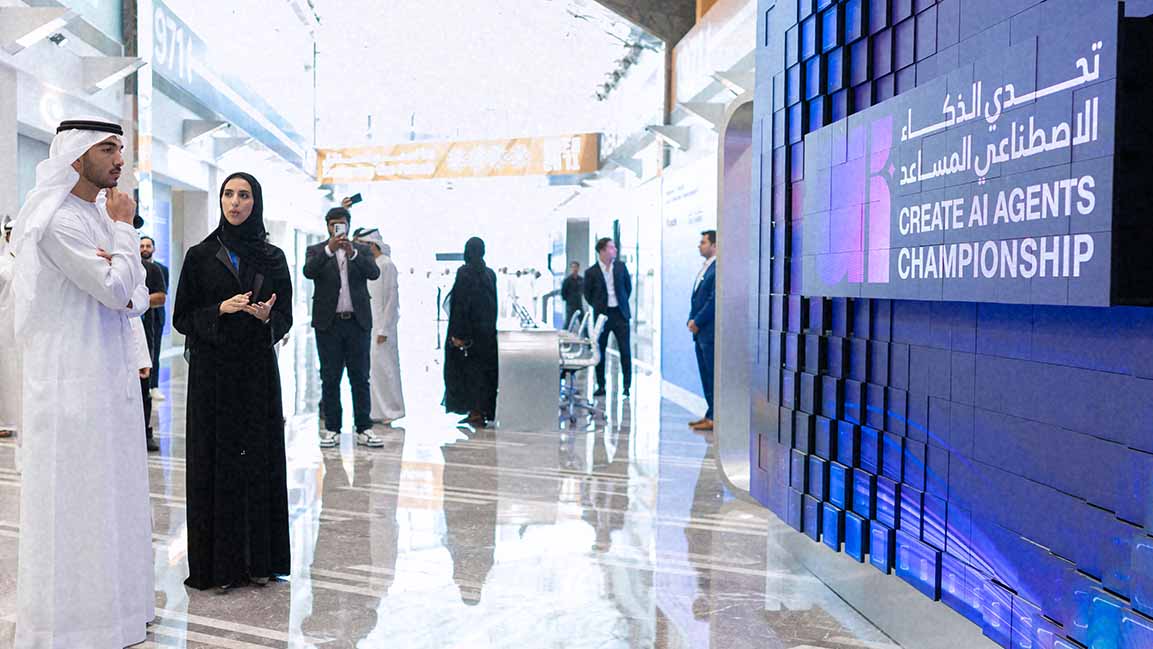
Technology was another central theme, with the debut of ATM Travel Tech as a dedicated co-located event. More than 180 exhibitors from 30 countries took part, with the 850-square-meter Tech & Innovation Hub focusing on artificial intelligence, robotics, fintech, immersive technologies and green technology.
Against this backdrop, airlines, tourism authorities and hospitality operators used the four-day event to announce new partnerships, routes and initiatives across the region.
EMIRATES MOUs
Emirates opened the event by signing seven tourism MoUs covering the Seychelles, Mauritius, Madagascar, Sharjah, Malaysia, Finland and Western Norway. The agreements focus on joint marketing, travel packages and familiarization programs designed to attract visitors through Emirates’ network of nearly 140 destinations.
The airline renewed partnerships with the Seychelles, Mauritius and Sharjah, while agreements with Madagascar, Malaysia, Finland and Fjord Norway expand its cooperation with additional destinations. The Finland partnership comes ahead of Emirates’ planned launch of year-round flights to Helsinki on October 1.
Emirates also renewed its strategic partnership with Huawei, focusing on digital innovation, marketing and customer experience in China. Separately, the airline signed an agreement with Dubai Duty Free to offer exclusive promotions to passengers traveling through Terminal 3 at Dubai International Airport.
SAUDI’S NEW CARRIER
Saudi Arabia’s aviation sector also saw a new entrant, with the General Authority of Civil Aviation (GACA) granting an Air Operator Certificate to an Air Arabia-led consortium to launch a low-cost carrier based at King Fahd International Airport in Dammam.
The airline, owned by Air Arabia Group, Nesma Group, and KUN Holding, with a majority Saudi ownership, plans to serve 24 domestic and 57 international destinations and carry around 10 million passengers annually by 2030. It is expected to create more than 2,400 direct jobs.
FLYDUBAI EXPANSION
Meanwhile, flydubai is expanding its network as operations recover, now serving more than 125 destinations across 56 countries. The carrier has resumed services to destinations including Aleppo, Benghazi and Bangkok, and will launch daily flights to Pokhara, Nepal, on September 23, its second destination in the country.
The airline currently operates around 2,200 weekly flights and has said it plans to increase frequencies as additional aircraft join its fleet. Its partnership with Emirates also provides access to a combined network of more than 214 destinations across over 100 countries.
RAS AL KHAIMAH RAMPS UP TOURISM PUSH
Ras Al Khaimah is also accelerating its tourism development as it works toward a target of 3.5 million visitors annually by 2030.
Philippa Harrison, CEO of the Ras Al Khaimah Tourism Development Authority (RAKTDA), said visitor arrivals increased in the first half of 2026 compared with the same period last year, despite regional geopolitical uncertainty.
The composition of those arrivals, however, shifted significantly. Domestic travelers accounted for around 90% of visitors in H1 2026, compared with an approximately even split between domestic and international travelers a year earlier. Domestic travel grew 47%, while August became the emirate’s strongest month on record as international demand also began to recover.
“We still had the domestic support that we’ve been enjoying, and we saw international starting to come back,” Harrison said. Key markets including Russia, India and the UK have recovered to around 50% to 60% of previous levels, although she said a full recovery will depend partly on greater geopolitical certainty.
At the same time, the emirate is building out its hospitality and tourism infrastructure. Wynn Al Marjan Island is expected to open in September 2027 with 1,500 rooms.
Ras Al Khaimah International Airport is also developing a new VIP terminal to serve the emirate’s growing premium tourism segment.
She acknowledged that external shocks will remain a challenge for the tourism sector, but said the focus is on building resilience around them.
“There’s always going to be shocks. I think we just have to make sure that we know how to get through them,” Harrison said. “I don’t think we’re too ambitious. I think ambition is what underpins this place.”
Harrison said the next phase will include repositioning Ras Al Khaimah internationally around what she described as “relaxed luxury and nature.”
She added that one of the emirate’s biggest challenges is perception rather than the visitor experience itself. “We don’t have a problem on the ground. We’ve got a perception issue,” she said.
Beyond airlines and connectivity, Dubai’s tourism attractions are also using ATM to expand their international reach.
DUBAI SAFARI PARK
Dubai Safari Park will reopen for its eighth season on October 12 with a new brand platform, “Live More Wild Life,” alongside a new premium Royal Safari Experience for travel trade partners. The park said B2B ticket sales increased 16% year-on-year during its previous season, while B2B revenue rose 26%.
The park is also expanding its presence in India and Russia/CIS markets through new sales and marketing representatives, as it seeks to strengthen relationships with international travel trade partners.

Featured Videos
Today's Top Stories:
More Top Stories:

FROM OUR PARTNERS