
- | 9:00 am
AI can handle the beauty business. Can it protect the human touch?
AI is helping beauty businesses cut costs, improve retention and grow with leaner teams
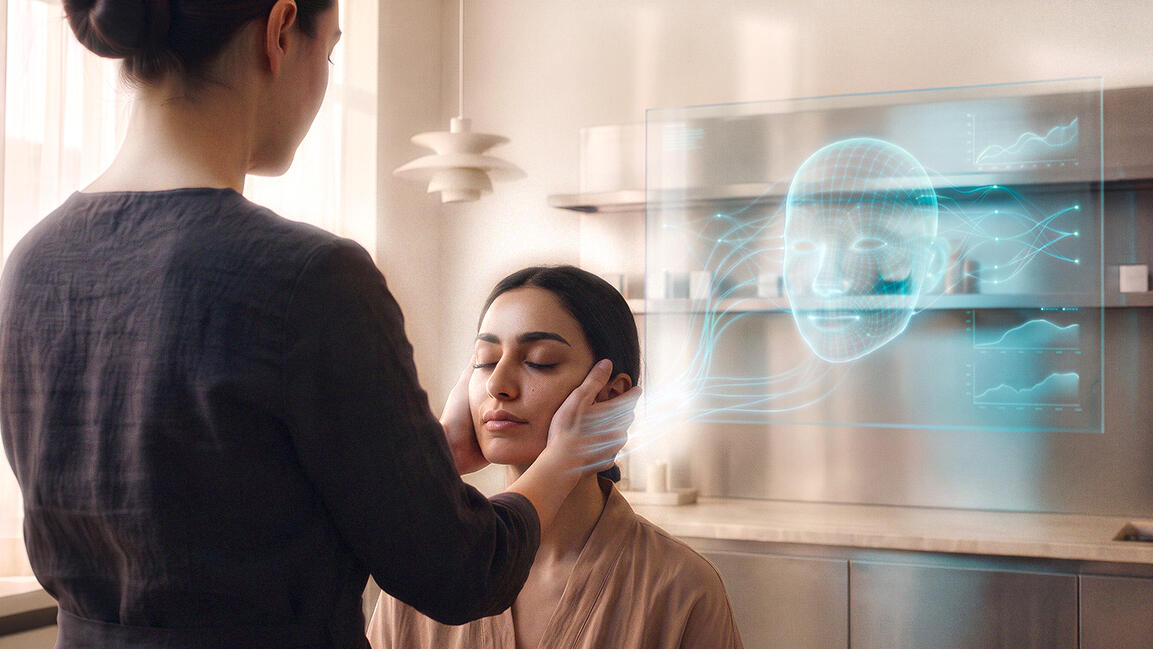


Most people start a beauty brand out of passion, not to deal with inventory issues. Yet, founders often spend hours each week on customer emails, product descriptions, and making reports that no one requested. Now, AI can handle all of these tasks.
But what does that really mean?
PRETTY GOOD ECONOMICS
“Right now, most beauty business owners are drowning in admin,” says Katie Godfrey, Beauty Business Strategist and Founder of KG Professional. Bookings, reminders, follow-ups, stock, marketing, and forecasting all eat up hours that belong to growth, and she expects AI to strip a large share of that away over the next two to three years. “Not eliminate the role, take the weight off it,” she says.
The economic implications are then evident. When a salon owner is no longer spending 15 hours a week on tasks that a system can manage, they gain capacity to focus on seeing more clients, improving client retention, launching new sources of income, or leaving the chair without the business suffering.
Godfrey also mentions the importance of forecasting and financial clarity. “Most beauty businesses have no real idea of their numbers, they’re guessing,” she says. Thanks to AI-powered tools, owners are now able to obtain real-time insights into cash flow, pricing and profitability by service. “That alone will be worth more to the bottom line than any new treatment trend,” she says.
There are also hidden losses during the clinic’s quiet hours. Dr. Maurizio Viel, a plastic surgeon at Cornerstone Clinic in Dubai, believes that the most significant change will be one that affects patients, at least in terms of appearance. The things that change are the inquiries that come in at midnight, the consultation that fails to result in a booking and the follow-up that is not carried out. “In the fields of aesthetics and medicine,” he says, “the most expensive item in the building is an empty chair.” AI could be of help by providing immediate answers to questions, assessing patients, handling bookings and reducing the number of no-shows.
It is in the consultation room that Dr. Viel observes the second effect. Although AI-assisted imaging and simulation allow patients to see a realistic range of possible outcomes before making a decision, Viel is straightforward in stating that the quality and standards are still not up to the required level. “In some cases, these images can create unrealistic expectations, particularly when the doctor is not available to provide them,” he says.
While the tools might help the doctor to decide on a recommended volume, that figure doesn’t always correspond with what the patient desires. The third area is marketing, in which content, campaigns and patient education can now be produced at a much lower cost than before.
LESS BUSY, MORE BEAUTY
Dr. Viel refers to AI as “a very capable back office that never sleeps” for a small clinic or a brand. The front desk is the natural place to begin, involving responding to enquiries on WhatsApp and Instagram in a number of languages, booking and rescheduling appointments, gathering the pre-consultation forms and sending reminders as well as the aftercare follow-ups.
In a city like Dubai, where a patient may message from London at 2am, that responsiveness is worth real money. Content comes next, with articles, social captions and patient guides drafted by AI and a clinician simply reviewing and refining them. Add review management, stock forecasting and reporting, and a surprising amount of administrative drag disappears. “The profitability equation is simple: when overheads fall and conversion rises, you can grow without adding headcount at the same pace,” he says. The larger dividend, in his view, is time. Every hour a surgeon or founder is not chasing paperwork goes to patients, to refining technique or to building the brand.
Godfrey puts the first win in a less glamorous place, the clients who quietly stop coming. “Most salons lose more money to clients quietly drifting away than they ever lose to a bad review,” she says. AI can flag when someone is overdue and trigger a message before they have thought about switching. A second win lies in marketing, where many small businesses stall because they lack the time or confidence to show up online consistently.
AI can draft captions, plan content and respond to enquiries so the owner stops being the bottleneck for their own visibility. The operational side follows, covering stock reordering, appointment reminders, review requests and basic client communication. “None of it is glamorous, all of it is time,” she says.
The same profit logic applies to both accounts: by spending less time on tasks that do not require human intervention, more time is left over for the activities which Godfrey identifies as contributing to revenue, namely retail, retention, price increases and new services; growth then ceases to depend on the owner working longer hours and begins to depend on the business working smarter hours.
THE GREAT SCALE EQUALIZER
Scale used to be something a business bought with headcount, and AI is loosening that link faster than many expected.”A founder-led business can now run patient communications, marketing, analytics and much of its administration with a lean team supported by AI, work that would have required several departments ten years ago,” Dr. Viel says.
The impact on competitors is immediate: since size is no longer a barrier, a small clinic can act, react and communicate in the same refined manner as a large organization.
One limitation still exists: what AI cannot scale are the founder’s judgment, reputation and personal involvement. You can’t hand over the operating theater to an algorithm,” Dr. Viel says.
Godfrey thinks that the industry still does not appreciate just how far this goes. “A single practitioner, having at their disposal the appropriate AI tools, can now truly compete with a clinic five times their size,” she says.
Marketing, administrative work, communication with clients and even certain aspects of the sales process can now be carried out using systems that previously would have needed a receptionist, a dedicated marketing staff member and someone to keep the books. “In the old days,” she says, “scale meant having larger premises, more staff and a larger budget. Nowadays, scale can mean a single person who has the appropriate set of tools at their disposal and who is able to work faster and more efficiently than a business employing ten people.”
THE PEOPLE SIDE OF AI
Few in the industry expect AI to empty the treatment room, though the people in it will be asked to do different things. Godfrey is clear about where the line sits. “I don’t see AI replacing beauty professionals completely. The relationship, the trust, the hands-on skill, none of that transfers,” she says. The skill set around the role is what changes. Once AI takes over booking, reminders and basic admin, therapists and stylists will need to become more consultative, with their value resting further on expertise, advice and the relationship in the chair. “That’s a skill in itself, and it needs training,” she says.
The view from the clinic is similar. “Every technological leap in medicine has changed roles rather than removed the need for people, and AI will be no different,” says Dr. Viel. Demand is already visible for patient experience coordinators who manage AI-driven communication but step in personally at the moments that matter. Clinics will also need people who can interpret imaging and data, curate content that is compelling and medically responsible, and oversee privacy, consent and compliance, which he calls non-negotiable in healthcare.
“The skill set is shifting from doing repetitive tasks to supervising, questioning and editing what the technology produces,” he says. Training is where Dr. Viel puts the weight, since the teams that thrive “will be those that invest in training their people.”
On the business side, Godfrey expects fresh roles to form around managing the technology itself. That means someone who understands the client data, oversees what the AI is doing and makes sure the experience still feels personal and not generic. In a bigger salon or clinic, she says, it could become an actual job title.
However, getting there is harder than it sounds for a small operator. “AI is not a plug-and-play solution, and in a small business, time is the scarcest resource of all,” Dr. Viel says. The tools remain complex, and using them well takes learning that most founders running a clinic and caring for patients have little bandwidth for.
AI systems are also fed a great deal of sensitive information, from patient records to private clinic data, so where that data goes, who can access it and how it is protected must be settled before anything is switched on. He believes most small businesses will “outsource it to specialists who can build it properly, with data protection designed in from the start rather than added as an afterthought which still can be costly.”
SMARTER SHOPPING, HUMAN CARE
The customer journey is being reshaped from the shopper’s side. NielsenIQ’s State of Beauty 2026 report found that global beauty sales grew 10 percent year on year, with e-commerce expanding six times faster than in-store sales. More than half of consumers are now exploring AI-enabled shopping tools, and 49 percent already receive beauty recommendations from generative AI.
“AI and digital commerce are transforming how consumers discover and evaluate products, shifting advantage to brands that show up clearly and consistently across digital ecosystems,” said Tara James Taylor, SVP of the beauty vertical at NIQ.
The region’s own operators make a similar case. “SAPMENA is fast becoming a global epicenter for tech innovation,” said Vismay Sharma, President of L’Oréal’s South Asia Pacific, Middle East and North Africa. L’Oréal sees the zone as an incubator for the future of beauty, a “Silicon Valley” for beauty tech in Sharma’s phrase, and says it is committed to finding and backing the pioneers who will co-lead the change as AI, the creator economy and circularity reshape the industry.
Where the line falls between automation and human care is something both experts answer with the same instinct. “Automate everything before and after the treatment,” says Godfrey. Booking, reminders, confirmations, follow-up messages, retail recommendations drawn from someone’s history and rebooking prompts can all run in the background. “People don’t fall through the cracks the way they do when it relies on someone remembering,” she adds.
Dr. Viel draws the same boundary with a clinical vocabulary. “Automate the logistics; protect the relationship,” he says.
What stays with people is the part clients are paying for. Godfrey puts it at the chair itself, the 60 minutes a client spends with their therapist. “It’s connection, trust, and the reason they keep coming back over a cheaper option down the road,” she says.
“A simulation can show what is possible. Only an experienced surgeon can judge what is right and what is safe, for that particular face or body,” says Dr. Viel.
“In aesthetics, trust is the real product. Technology can support it beautifully, but it cannot replace it,” he adds.
AI REALITY CHECK
Godfrey hears one belief more than any other from beauty entrepreneurs. “AI is for big corporates,” she is told, or “I’ve only got one chair, I don’t need that.” In her view, that mindset is exactly what will leave smaller businesses behind. Dr. Viel rejects the same assumption, since many of the most useful tools are affordable, though he adds that affordable is a different thing from simple for a small clinic today.
Viel’s headline misconception sits elsewhere, in the idea that AI is a shortcut to expertise or to a brand. “It is neither,” he says. Many entrepreneurs expect to switch on a tool and let it think for them, generating content, advice or even treatment suggestions with nobody checking the output.
In beauty, and especially in medical aesthetics, he calls that a serious risk. AI can produce confident text that is inaccurate, generic or non-compliant, and it can make every brand sound the same at a time when clients crave authenticity. His remedy is a change in posture.
“Treat AI as a highly efficient assistant: give it clear direction, review everything it produces, and never let it speak on medical matters without professional oversight,” he says. Done that way, the technology frees up the time to improve the brand.
“Ignoring the technology doesn’t protect the human touch. It just means you’re guessing instead of knowing,” Godfrey says, adding that what matters most is being willing to try something, see what happens, and build from there.
“The businesses that wait for it to feel simple and risk-free will still be waiting while everyone else has already moved,” she adds.