- | 9:00 am
Making every drop count: Inside Egypt’s push to close its widening water gap
Experts explore the country’s efforts to expand water treatment, reform regulations, strengthen international partnerships and raise public awareness.
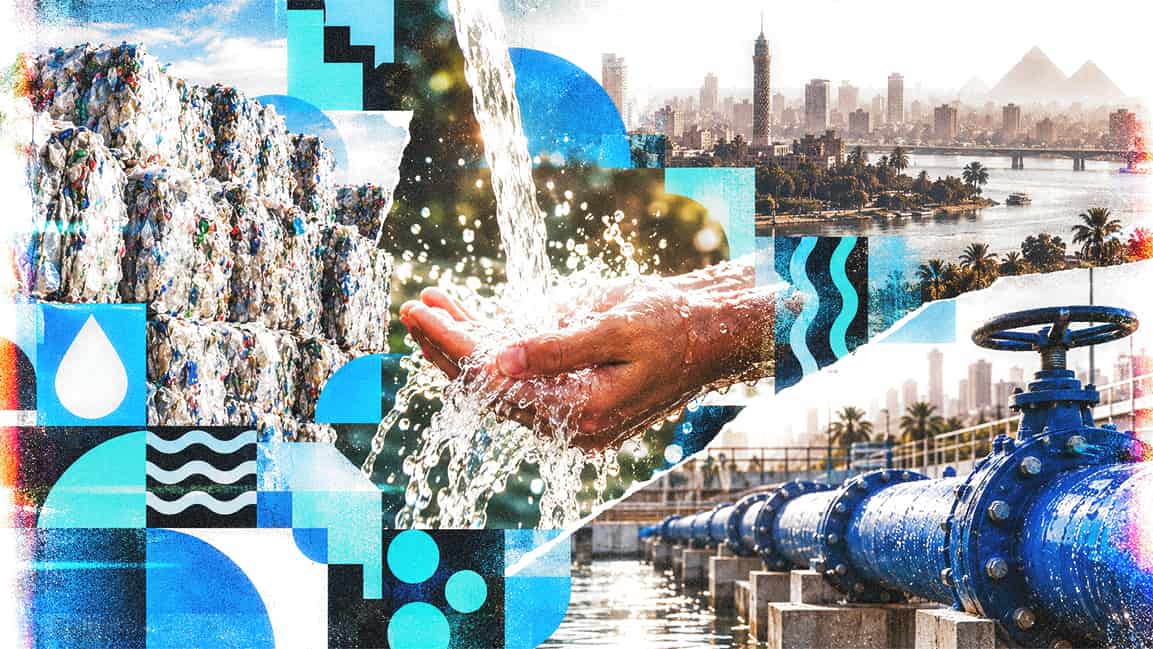


For Egypt, the Nile is the lifeline of a nation that is increasingly threatened by water scarcity. With annual water deficits estimated at 7 billion to 20 billion cubic meters, the country faces a widening gap between its freshwater resources and growing demand.
The stakes are serious: the Nile provides more than 98% of Egypt’s renewable freshwater, while annual per capita water availability has plunged to just 473–560 cubic meters, far below the internationally recognized water poverty threshold of 1,000 cubic meters.
How can the country bridge the supply gap and secure its water future?
To confront this growing crisis, Egypt has invested more than $11.3 billion over the past 12 years in drinking water, sanitation, and recycling infrastructure. The country also reuses an estimated 23.2 billion cubic meters of water annually.
The recently held fifth International Water, Waste & Infrastructure Exhibition and Conference (IWWI 2026) discussed these challenges and highlighted plans to expand desalination and wastewater reuse, increase private-sector investment, localize equipment manufacturing, and adopt smart technologies to reduce water losses and improve efficiency.
REGULATORY REFORM
Among the key targets discussed was increasing Egypt’s seawater desalination capacity to 10 million cubic meters per day by 2050.
Outlining the government’s broader strategy, Ahmed Omran, deputy minister of housing for utilities, said, “The Egyptian state is adopting an integrated vision to develop the drinking water and wastewater sector, based on improving operational and maintenance efficiency, maximizing the benefits of existing investments, enhancing private-sector participation and localizing the manufacture of equipment used in utilities projects.”
Regulatory reform was another key focus. Mohamed Hassan Mostafa, chairman of the Egyptian Water and Wastewater Regulatory Agency (EWRA), highlighted plans to strengthen supervision of service providers, establish clear performance and service-quality indicators, and improve mechanisms for handling consumer complaints.
Alongside expanding capacity, officials stressed the need to improve the efficiency of existing networks and treatment facilities.
Holding Company for Water and Wastewater (HCWW) chairman Mostafa Ahmed El-Shimy highlighted preventive maintenance, reducing drinking water losses, improving energy efficiency, and expanding the use of renewable energy as key operational priorities.
Developing the sector’s technical workforce was also identified as an important part of the strategy, with specialized secondary technical schools expected to help train personnel to operate and maintain water infrastructure.
INTERNATIONAL PARTNERSHIPS
International partnerships, such as Egyptian-German cooperation and financing, are also central to Egypt’s efforts to strengthen its water infrastructure.
Former Prime Minister Ibrahim Mahlab said Egypt could become a regional hub for drinking water and wastewater equipment, citing its strategic location, infrastructure, and engineering expertise.
“It is important to move from importing equipment and technology to local manufacturing and the transfer of technical knowledge, supporting the national economy and strengthening the competitiveness of Egyptian industry,” Mahlab said.
Former Deputy Minister of Housing Sayed Ismail also highlighted the importance of international partnerships and modern operating models. He said, “The sustainability of drinking water and wastewater projects requires adopting modern management and operating models and making use of technological solutions that improve resource efficiency.”
Alongside new investment, officials stressed the need to improve the performance of existing infrastructure through more effective operations and maintenance. Former Minister of Water and Wastewater Utilities Abdel-Qawi Khalifa said: “The next phase requires focusing on maximizing the benefits of investments already made, improving the efficiency of existing assets, and developing operations and maintenance systems to ensure service sustainability.”
Representatives from German water technology companies Hermann Sewerin, Roediger Vacuum, and Reline Europe also discussed opportunities for knowledge transfer and strengthening local technical capabilities through international cooperation.
DESALINATION AND WASTEWATER REUSE
Egypt is expanding desalination and wastewater reuse to ease pressure on its water resources. In 2026, government figures put operational seawater desalination capacity at approximately 2.1 million cubic meters per day.
Alongside desalination, experts discussed how treated wastewater can be redirected towards uses that do not require drinking-quality water, including irrigating non-fruit-bearing trees.
“There is no doubt that desalination and recycling are the paths the state is taking right now. This is the solution to bridge this gap; we have no other solution,” said Dr. Shimaa Abdelrahman, senior planning and development engineer at Alexandria Water Company.
However, expanding these alternatives requires more than treatment capacity. Water companies must also ensure that reused water meets the quality standards required for its intended purpose and that treatment and disposal practices comply with environmental regulations.
While large-scale desalination projects can add new supplies, Alexandria Water Company is also looking at water that is already being extracted and treated but is lost during operations.
“We consider Alexandria Water to be the final point in water extraction and production, so we are looking for every single drop of water and trying to save it,” Dr. Abdelrahman said.
The company developed a low-cost ultrafiltration process using locally manufactured materials. The technology reportedly achieved a recovery rate of 70%-80%, along with approximately 90% turbidity removal. Dr. Abdelrahman said the project could recover between 40,000 and 50,000 cubic meters of water per day.
Dr. Abdelrahman said the technology could also produce water suitable for drinking after the appropriate treatment and verification.
The company is now looking to move beyond research and into industrial deployment. Abdelrahman said the company hopes to work with industrial partners over the next five years to manufacture and scale up the technology.
Water conservation also depends on reducing losses between treatment plants and consumers. Leaks, bursts, and network failures can waste treated water and increase maintenance and operating costs.
Dr. Maisa Salah El-Din, general manager of research and development at Alexandria Water Company, said the organization’s research and development work includes improving the detection of network problems so that teams can intervene before failures escalate.
“Furthermore, we currently care about the water footprint: reducing any losses, bursts, or failures in the networks, so that I can detect them, take proactive action, and maintain the networks in a way that secures customer trust.”
Digital monitoring and software-linked data networks could help utilities identify patterns.
“When I have a data network, and this data network is linked to programming, the decision-maker can anticipate faults and start taking proactive action.”
THE FUNDING CHALLENGE
Moving research into practical applications requires financing, industrial partners, and streamlined regulations. Researchers identified funding as a key constraint, particularly when scaling technologies beyond initial trials.
Dr. El-Din said project-specific investment, climate finance, and carbon markets could help fund water projects. Verified emissions reductions could generate tradable carbon credits, creating an additional revenue stream, subject to eligibility and verification requirements.
Some water companies affiliated with the Holding Company for Water and Wastewater can cover their operating costs and finance upgrades independently, Dr. El-Din said. But the ability to fund new technology internally is not necessarily shared across the sector.
For Dr. Abdelrahman, the challenge is also to ensure that public support for scientific research translates into practical applications.
“Assistance from the state includes trying to help apply scientific research. Every time you help me, it gives me an output that supports me in the industry; I take its outputs and continue with them in the industry.”
However, funding is not the only barrier. Dr. Abdelrahman cited permit requirements and lengthy approval procedures, including security clearances where applicable, as potential sources of delay. More streamlined processes could help researchers and industrial partners move promising technologies into practical use.
PUBLIC AWARENESS
Expanding water infrastructure is only part of Egypt’s response to water scarcity. Encouraging households and institutions to conserve water is another challenge, particularly when reliable access to running water is limited. The campaign targets 450 schools across Alexandria, reaching approximately 1.1 million students through age-appropriate activities, from puppet shows to interactive games and workshops.
“We try, as much as possible, to reach out to the people to explain what the role of water companies is in delivering clean cups of water, and on the other hand, how we can preserve this and protect this blessing that God has given us,” Tayel said.
To measure impact, the company tracks water consumption before and after campaigns. It also promotes water-saving devices that Tayel said can reduce consumption by approximately 35% and rewards schools and students whose water bills show a decline.
“We try to work on this through two fronts: the behavioral change front and the metering/measurement front. We measure the consumption of the places we target before and after awareness campaigns,” he added.
Beyond schools, Alexandria Water Company has trained 900 teachers and partnered with the Marine Scouts and Guides to develop community ambassadors. With UNICEF support, it has also distributed water-saving devices and introduced virtual-reality experiences that allow students to explore treatment plants remotely.
Digital platforms help extend the campaigns’ reach. Tayel said the company uses social media, including TikTok, Facebook, and YouTube, to reach wider audiences at a lower cost than physical campaigns. Its TikTok account has more than 60,000 followers, he said.
“Not everyone is interested in the water company or even water issues. Especially since there is something called the ‘habit rule’—as long as water keeps flowing from the tap, you don’t care about it; people only care about things when they become scarce,” he said.
Water utilities need to encourage daily conservation habits before water scarcity turns into a crisis. While public awareness alone cannot replace investment in infrastructure or better treatment methods, it does help ensure that water saved by new technologies is not wasted through unnecessary use.