- | 9:00 am
What does an AI watermark mean for Arabic culture?
As AI gets better at reproducing Arabic culture, the difference between cultural fluency and cultural cliché becomes harder to see.
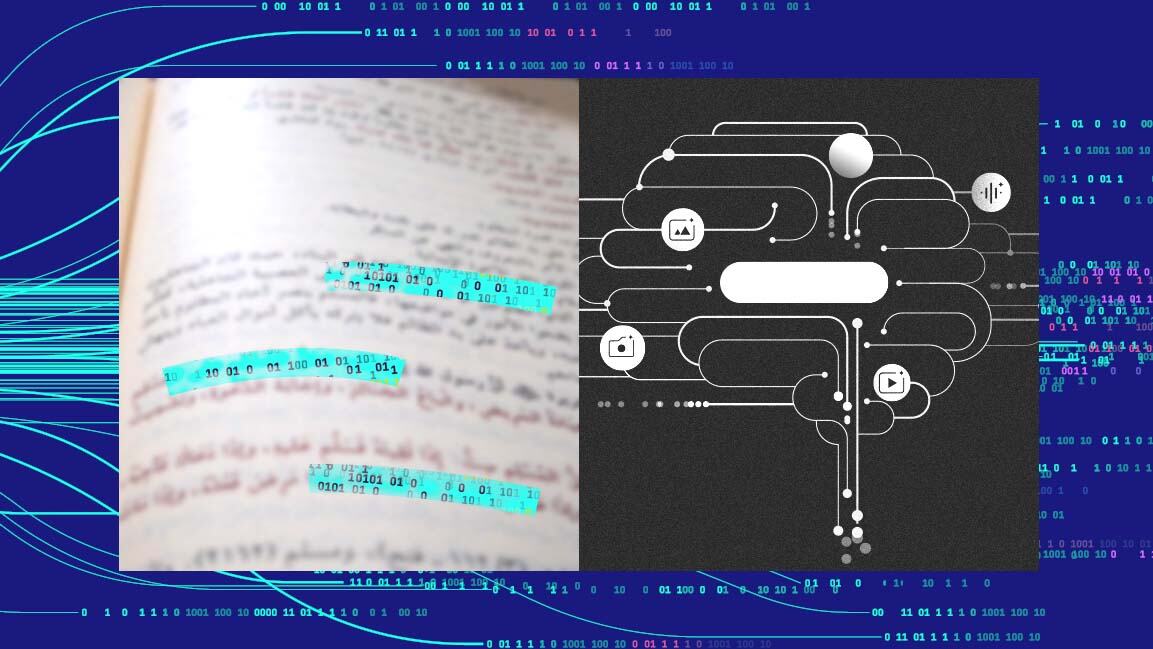


There is nothing visibly different about the Arabic content we scroll past on our screens. The language flows well, the grammar is correct, and the tone is appropriate. To readers, it looks like any other writing. Yet hidden in its structure might be a mark that readers cannot detect.
Anthropic is developing imperceptible watermarking for AI-generated text, while supported generated files can carry digitally signed provenance metadata.
The broader direction is clear: as synthetic content becomes harder to distinguish from human work, AI companies are building mechanisms to identify its source.
The timing is significant. The EU AI Act’s transparency provisions entered into force in August 2026, requiring certain AI-generated or manipulated content to be identifiable through machine-readable markings.
But in the Gulf, where the Arabic content industry is quickly adopting generative AI, the idea of provenance brings up a deeper question. What happens when the content being machine-made is not simply text, but culture?
THE PROBLEM WITH TREATING ARABIC AS ONE LANGUAGE
A Saudi study identified more than 53 Arabic-language models as of the first quarter of 2025, with Saudi Arabia leading among countries in developing these models. Abu Dhabi’s TII has developed Falcon-H1 Arabic, with benchmarks focused on Arabic language and cultural understanding, while Qatar’s Fanar 2.0 combines Arabic language modeling with culturally grounded image and video generation.
The infrastructure for producing Arabic content is therefore arriving as the technology for identifying synthetic content is emerging. Meanwhile, PwC’s research has found that GCC companies are rapidly adopting generative AI across functions, including marketing, sales, and customer service.
The creative implications are obvious. A campaign that once required a copywriter, photographer, art director, stylist, designer, translator, and production crew can increasingly begin with a prompt.
And the prompt can be Arabic. Arabic has more than 400 million speakers, yet accounts for only around 0.5% of global web content, according to researchers behind Qatar’s Fanar project.
Muhammed Shabreen, CTO at CNTXT AI, says that this imbalance creates a fundamental problem before a model even generates anything.
“While Arabic has more than 422 million speakers, it accounts for only around 0.5% of global web content,” he says. “So from the get-go, you’re working with a restricted data set.”
But for Shabreen, the bigger problem is not simply quantity. It is the kind of Arabic that gets recorded.
“Much of that content is Modern Standard Arabic (MSA), which is a formal register that almost nobody uses conversationally. The result of this is that the dialects people actually speak, rarely make it into training data.”
Saudi, Emirati, Kuwaiti, Egyptian and Levantine Arabic can differ in vocabulary, pronunciation, rhythm, idiom and social register. The same sentence can be technically correct and still sound conspicuously wrong to a native speaker from a particular place.
Shabreen offers a simple example. “‘Twenty’ is ishruna in MSA and ishreen in Gulf Arabic. A model trained on generic Arabic will tend to pick one and apply it everywhere.”
More data alone, he says, will not necessarily solve the problem. At CNTXT AI, the response has been to build separate models for dialects, including Emirati, Saudi, and Kuwaiti Arabic, with dialect-specific handling of numbers, place names, and pronunciation.
“That level of cultural accuracy cannot be achieved through better prompting alone,” he says.
But Dr. Nizar Habash, Professor at NYU Abu Dhabi, says there is another problem with the premise. “There is no single, homogeneous ‘Arab culture,’ just as there is no single Arabic if we include its dialectal, historical, and standard varieties,” he says. “To essentialize or stereotype Arab culture is itself a form of violence against its natural diversity.”
Arabic speakers have always mixed and accommodated between dialects. Concepts such as “White Arabic” describe some of the ways speakers navigate that linguistic diversity.
A model trained on a statistical approximation of “Arabic” is not learning one culture. It is learning distributions of language, images, behaviors and associations that may themselves contain contradictions. And those contradictions can become cultural hallucinations.
WHEN ‘ARAB’ BECOMES AN AESTHETIC
Consider typography. Arabic script is not simply Latin text with a different alphabet. It carries centuries of calligraphic practice, typographic conventions, and regional preferences. The choice of typeface, the density of a composition and the relationship between Arabic and English can completely change its cultural register.
A generative model can learn these correlations. A model can learn that certain calligraphy signals heritage, that geometric forms suggest Islamic design, or that particular architecture and attire. It does not necessarily need to understand why something is culturally significant.
It needs to learn that it is. This is where cultural simulation becomes interesting. A model can reproduce the statistical appearance of a culture without possessing a relationship to that culture. And as the models improve, the approximation becomes harder to spot.
The most interesting AI-generated Arabic content may not be obviously wrong. It may be almost perfectly right in all the ways that are easiest to see, and subtly wrong in the ways that matter most to people who actually know the culture.
Shabreen describes this gap between technical performance and cultural fluency. “A perfect technical score and an entirely unacceptable result are entirely compatible,” he says. “Technical metrics can tell you whether the right words were produced in the right order, but they cannot tell you whether those words sound like they came from the right person, place or cultural context.”
A native speaker can catch Fusha in a casual Gulf advertisement, a Gulf voice paired with an Egyptian expression, or an English brand name pronounced in a way that sounds unnatural locally. “None of those necessarily register as technical errors,” he says.
That is why, he says, native speakers cannot simply be brought in at the end as proofreaders.“ They need the authority to reject an output and shape the system itself. Cultural accuracy has to be part of evaluation, not an afterthought.”
THE TRANSLATION PROBLEM
The issue becomes even clearer when an idea moves between English and Arabic. Saad Shakhshir, CEO and co-founder of ImpactX Partners, says that bilingual work exposes something that literal translation tends to conceal: language is not merely a container for information.
“Language is an incredible human creation, and certain meanings, feelings, and emotions are expressed in some languages that just cannot be translated or captured in another,” he says.
Because language is rooted in culture, it carries traditions, mannerisms, and behaviors that may not exist in the same form elsewhere. “Literal translation from English to Arabic most definitely does not work in most cases.”
Shakhshir uses AI for initial translations himself, but says the model has to be instructed not to translate literally, and the result still requires review and manual editing. “From a first draft, I get a second, and even then, it is still not correct. In most cases, I need to make manual edits because it just doesn’t sound right.”
That may be one of the most important forms of AI slop in the region. Not incorrect Arabic, but unlived Arabic.
THE WATERMARK CANNOT ANSWER THAT QUESTION
This is where provenance enters the story. A watermark can indicate that a piece of text was generated by Claude. It cannot tell you whether the text is good or if the writer understands Arabic.
Dr. Habash says, “I would separate provenance from authenticity.”
Anthropic’s watermarking work and C2PA (Coalition for Content Provenance and Authenticity) Content Credentials can help establish whether AI was involved, but they do not establish cultural accuracy.
“Provenance can therefore give us a trace of who created something, what generated it, and who subsequently edited it. But provenance has nothing to do with truth in itself,” adds Dr. Habash.
Watermarking is essentially a statistical signal embedded through generation. It can be difficult for readers to see, but it is detectable by a system that knows the watermarking scheme. Detection becomes less reliable with short passages, highly constrained text, editing, or substantial rewriting.
Even when it works, however, the mark answers a narrower question.
“A watermark cannot distinguish between factual, useful Arabic and fluent Arabic that adds little knowledge or is simply wrong,” Dr. Habash says.
That distinction matters as Arabic content expands online. The rapid increase in Arabic text does not necessarily mean a corresponding increase in Arabic knowledge. A watermark can help identify how much content was machine-generated. It cannot tell us whether that content is accurate, original, well-sourced, or culturally valuable.
That requires another kind of judgment.
Imagine two campaigns. The first is entirely human-made but produced by an international agency whose understanding of Gulf culture comes largely from research, mood boards, and previous campaigns. The second is largely generated with AI but directed, edited, and culturally reviewed by a Saudi creative director who intimately understands the language and social context.
The watermark answers which campaign involved AI. But it cannot distinguish between which one understands the culture.
That is the central paradox of provenance. AI involvement and cultural authenticity are not opposites.
WHO ACTUALLY MADE THE WORK?
Shakhshir pushes this argument further. “To me, the work output by AI is not the work of AI; it is the work of the human driving and directing the AI.”
He compares generative systems with older creative technologies. “Renders, for example, before AI and LLMs were generated using software. We do not say that Adobe Photoshop or 3DMax generated the render, it is the human who drove the tool that created the render.”
The tools are simply becoming more capable. “So, in this case, the provenance is the human who used the tool to create the work.”
It is a provocative position because it reframes AI authorship as a question of accountability. If the human remains the author, then “I just prompted it” becomes a weak creative defense.
The user becomes the editor, art director, fact-checker, and final cultural authority.
Shakhshir describes his own workflow in those terms. He gives AI his ideas and content, asks it to draft, then repeatedly reviews, revises and removes the stylistic traces he associates with AI slop before manually editing the result until it feels like something he could confidently share.
“I see my work in everything that my AI tools generate for me. It is my work, and I am proud of it.” He describes the relationship as a “team effort”, but adds: “I am the senior in the relationship, and the AI is the junior.”
Dr. Habash complicates that idea. If a human writes the prompt, AI generates a first draft, another human rewrites it and a designer changes the image, a watermark cannot capture every contribution. The original mark may not even survive. For that, he says, we still need more conventional forms of attribution: bylines, credits, version histories, and records of who contributed what.
A watermark might tell us that AI participated. It cannot, by itself, tell us who should receive credit for the final work.
THE PROVENANCE OF THE CULTURAL KNOWLEDGE
This may ultimately be the most important distinction. There is provenance for the output. And then there is provenance for the knowledge. The first asks: Did AI make this? The second asks: Where did the cultural understanding that produced this come from?
The first can potentially be answered with a watermark. The second is vastly harder. It requires knowing what data went into a model, how it was selected and labeled, which languages were represented, which dialects were excluded, and what assumptions were built into the evaluation process.
It also requires recognizing that “human-made” is not synonymous with “culturally authentic.”
“Human-made content can be culturally inauthentic,” Shabreen says. “A campaign created entirely by people can still rely on stereotypes or misunderstand the audience it is trying to reach.”
And even within AI systems, there are humans everywhere. “People choose the data, label it and decide what counts as Arabic.”
Dr. Habash takes the argument one step further. “A living culture, by definition, will change,” he says.
Cultures have always absorbed new influences, rejected others, and renegotiated what they consider authentic.
“If there is enough feedback from people, certain narratives, images, or uses of language may begin to resonate. We may find patterns in the noise that we like, adopt them, and eventually make them part of the culture. Others will simply disappear.”
The more interesting challenge is that generative systems are becoming extraordinarily good at reproducing the surface grammar of identity. Arabic typography, Gulf architecture, traditional attire, Islamic geometry, the desert landscapes, and luxury.
But scale introduces a strange cultural paradox.
A master might have drawn a perfect piece of Arabic calligraphy. Or generated in seconds. A skilled marketer might have crafted a beautifully conceptualized Arabic campaign. Or produced by a model.
Increasingly, the eye may not be enough. That is why the invisible mark matters. Not because it can tell us what is authentic. It cannot. But because it signals the beginning of a broader shift: the internet is starting to care about provenance.
And in a region racing to put its language, history and culture online, provenance may become more than a technical property. It may become a creative one.
The next great design challenge for Arabic AI will be about deciding what counts as culturally meaningful and making visible the human judgment that gives it meaning.