
- | 9:00 am
The next workplace challenge? Women caught between work and elder care
As elder care demands grow across the Arab region, experts warn that without better workplace support, businesses risk losing experienced female talent.
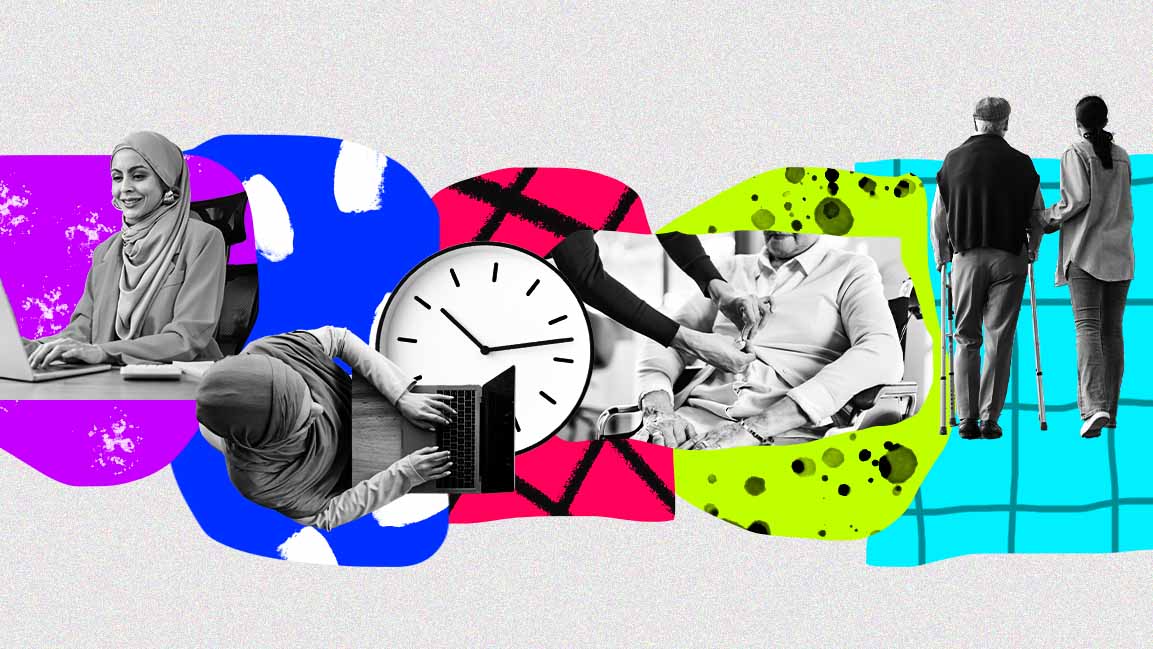


At first, Rana Ayub thought she could help care for her parents, whose health had begun to decline, and still hold on to her job as a senior associate at Big 4.
“It was a well-paying job, and I didn’t want to quit,” Ayub, 54, says, adding she’s always considered herself “very career oriented.” So she tried working late nights to keep up with the office demands, but she frequently had to take days off to take her parents to the doctor for check-ups and tests, and she used up all her leave and benefits.
Ultimately, though, her mother’s heart disease progressed, and her father was diagnosed with Parkinson’s. She realized that the cost of hiring home attendants for two ailing elders exceeded her income. “They really needed me,” Ayub says. In 2023, she left her job to take care of her parents full-time.
She is not alone in this. There are now hundreds who can empathize with the stress of managing work duties, parenting, household tasks, and caregiving for a loved one, all while trying to thrive in their careers.
There are no official figures on the number of employed women currently providing care for family members who need help with daily activities. Still, this group is expected to rise steadily.
The Arab region is now going through two big changes at once, which mostly affect working women: the population is getting older and needs care, while many are still raising young children.
There are times when a child needs more support, a parent’s health takes a turn for the worse, or work pressures intensify. The problem is often framed as a social issue. But its impact is not only on working caregivers but also on employers and the broader economy, as these duties could affect women’s participation in the workforce and result in a shrinking workforce.
A MAJOR WORKFORCE CHALLENGE
This is one of the biggest workforce challenges we are not talking about enough, says Rania Masri el Khatib, CEO of The Giving Movement. “Women have always been the primary caregivers, and while that is slowly changing, the reality across much of the Middle East is that the responsibility for aging parents still falls overwhelmingly on daughters, wives, and daughters-in-law.”
“Many of us are now entering what is often called the ‘sandwich generation— supporting teenage or young adult children while caring for elderly parents whose needs are becoming increasingly complex,” adds el Khatib.
And the data is clear. The number of working caregivers will continue to grow. One of the primary reasons the number of caregivers will continue to rise is the aging baby boomer population. The number of older persons (65-plus) in the Arab region is projected to reach nearly 50 million by 2030 and more than 102 million by 2050.
“The demographic shift is real,” says Reenita Das, a healthcare strategist and founder and managing director of Nxt Horizon. “The 65-plus population will multiply 2.5 times by 2050. Women in MENA already spend 4.7 times more hours on unpaid care than men—roughly 24 hours weekly. With 73.3% of women outside the workforce citing care as the main reason, more working mothers and daughters will face tough trade-offs.”
Research also shows that caregiving can have a strong effect on a person’s mental health and finances.
As women juggle raising children and caring for aging parents, Julie Nguyen, Founder & CEO of Crunchmoms and a leader in women’s career advancement, says, “this dual caregiving responsibility is increasing emotional and financial pressure on working families. Without better support, more people will face burnout, reduce their hours, or struggle to stay and grow in the workforce.”
According to Nancy Nese Ozbek, General Manager at Sharaf Group Mall Division, caregiving can directly affect attendance, focus, and long-term employment as managing work and family care at the same time “can be physically and emotionally exhausting.”
WOMEN STEPPING BACK
In the region, although lower than in Western countries, the cost of caregiving is high, and services are very limited, especially in elderly homes. In such a scenario, many are forced to choose between absorbing these costs or taking on the task of caregiving themselves.
“I witnessed this firsthand with a senior leader whose parent was diagnosed with dementia. Eldercare homes remain scarce and unpopular, partly because placing an aging parent in one is seen as a cultural failure. Employers must offer flexible work, caregiving leave, and subsidized care to retain women,” says Samar Alshorafa, founding CEO of She is Arab. “Perhaps, it’s time we reexamined both the scarcity and the stigma around elderly homes across the Arab World.”
Sharing her experience when her mother needed care, Nancy Nese Ozbek, General Manager at Sharaf Group Mall Division, says, “My sisters and I shared most of the responsibility. We managed without asking our employers for special treatment, but it was still difficult. For many women, this pressure can eventually lead to reducing work or leaving employment.”
Care services meet only 10% of demand, so leaving work often feels like the only option, says Das. “Nearly 2 million women aged 55-plus have already exited the workforce in the region.”
This strain shows up in many ways. Working women are more likely to lose their jobs due to disrupted work schedules, and they also experience higher rates of depression, anxiety, and loneliness.
El Khatib says the pressure is even greater for women in senior leadership. “They are not only responsible for their families, but also for their teams, their organizations, and, in many cases, their shareholders. The emotional load is immense, particularly when caring for a parent living with dementia or another degenerative illness.”
“It affects every aspect of life — health, mental wellbeing, marriage, friendships, travel, and the ability to be fully present both at work and at home,” she adds.
HOW EMPLOYERS CAN STEP UP
Caring for elderly family members places a heavy burden on many families—and that has a direct impact on the workforce. At a time when women are being pulled in two directions by their caregiving duties and the inflexible structure of work, experts say that addressing employees’ caregiving needs can have a measurable impact. Employers failing to recognize this reality risk losing experienced talent, particularly women at the peak of their careers.
“Many are asking for greater flexibility in where and when they work, reducing their hours, or reassessing what success and priorities look like during this stage of life,” says Nguyen.
For founders and business owners, she says, that may mean reducing client work or shifting to part-time. “For women in corporate careers, the experience depends heavily on the culture and support of their workplace. Because elder care remains deeply personal and often invisible, many employees carry the responsibility quietly until balancing work and caregiving becomes unsustainable.”
In the UAE, over half of working mothers felt pressure to step back, adds Das. “Not from lack of ambition, but inflexible systems. Productivity dips too; exhausted caregivers are distracted and burning out.”
“Without flexibility, women may reduce their hours, turn down opportunities, or leave their jobs. Businesses may then lose experienced, loyal, and reliable employees,” says Ozbek, adding that companies can offer flexible working hours, remote work where possible, temporary reduced hours, and emergency family leave. “Even small changes can help an employee remain in the job instead of resigning.”
Flexible work options, caregiver-friendly policies, supportive managers, and an open culture where employees can talk about their responsibilities can make a real difference at work, ensuring employees don’t feel they have to choose between their careers and their families.
Most women rely on the workplace for the resources they need to build financial health, such as income, benefits, and protections. Since employers already manage the systems that help workers handle financial shocks, they are well-positioned to address this issue.
“Medical insurance for the elderly can be prohibitively expensive, the cost of care continues to rise, and with education, housing, and the overall cost of living, dual-income households have become the norm,” el Khatib says, underscoring the financial pressures. “Many families cannot afford to stop working.”
Ironically, she adds, the financial burden of caregiving makes employment more essential at the very moment caregiving makes working more difficult,
The International Labor Organization estimates that care investment could create 13 million jobs across MENA by 2035, with every dollar returning $3 in GDP growth, says Das. “Employers can offer on-site nurseries, flexible hours, remote work, and paid care leave—Saudi Arabia already did this, boosting female participation from 19.7% to 36.3% with programs like Qurrah and Wusool.”
“Employers who adopt care-tech and progressive policies won’t just retain talent—they’ll build a more productive, loyal workforce,” Das adds.
SUPPORT FROM THE BROADER COMMUNITY
But the responsibility doesn’t rest solely with employers. It’s teamwork among employers, government, insurers, and the broader community.
Importantly, we should be careful not to frame aging solely through the lens of caregiving, says Shaden Abdellatif, Founder of The Nadi, a multi-generational social club in Dubai.
“Growing older does not automatically mean becoming dependent. Many older adults remain active, healthy, experienced, and deeply engaged in their communities for decades. The conversation should shift away from viewing older people as a burden and instead look at how we create more opportunities for their continued wellbeing and independence.”
Abdellatif adds that this demographic transition should encourage governments, employers, and communities to invest in preventative, community-based initiatives that support active aging long before people require formal care.” By creating more inclusive environments where older adults can continue to contribute, connect, and thrive, we can improve quality of life while also reducing pressure on families, healthcare systems, and future care services.”
This demographic shift calls for broader public support, adds el Khatib. “Whether through better insurance coverage for older adults, respite care services, caregiver training, tax incentives, or policies that formally recognize and support family caregivers, we need to start building the infrastructure for an aging society.”
As the need for elder care grows, Nguyen says we also “need to ask whether the infrastructure and support systems are keeping pace with the realities of an aging population.”
Emphasizing that supporting caregivers is a strategic investment in the future of the workforce and the region, el Khatib says, “We have rightly spent years focusing on helping women enter and remain in the workforce after motherhood. The next frontier is ensuring they can continue to thrive when careers peak, parents age…”
“Supporting women through this transition is not simply about equity—it is about retaining experienced talent, strengthening families, and building a more resilient economy.”