UAE’s $5 billion-kilometre journey to explore seven asteroids set for 2028
The spacecraft will travel five billion kilometers to explore seven asteroids, with half of the mission's work allocated to private companies as the UAE expands its space industry.


The UAE is on track to launch its most ambitious space mission in the first quarter of 2028, sending a spacecraft on an eight-year journey to explore seven asteroids. The mission is expected to travel five billion kilometers while advancing the country’s space industry and creating new economic opportunities.
The Emirates Mission to the Asteroid Belt (EMA) has entered its assembly, integration and testing phase following the completion of key design reviews in 2025.
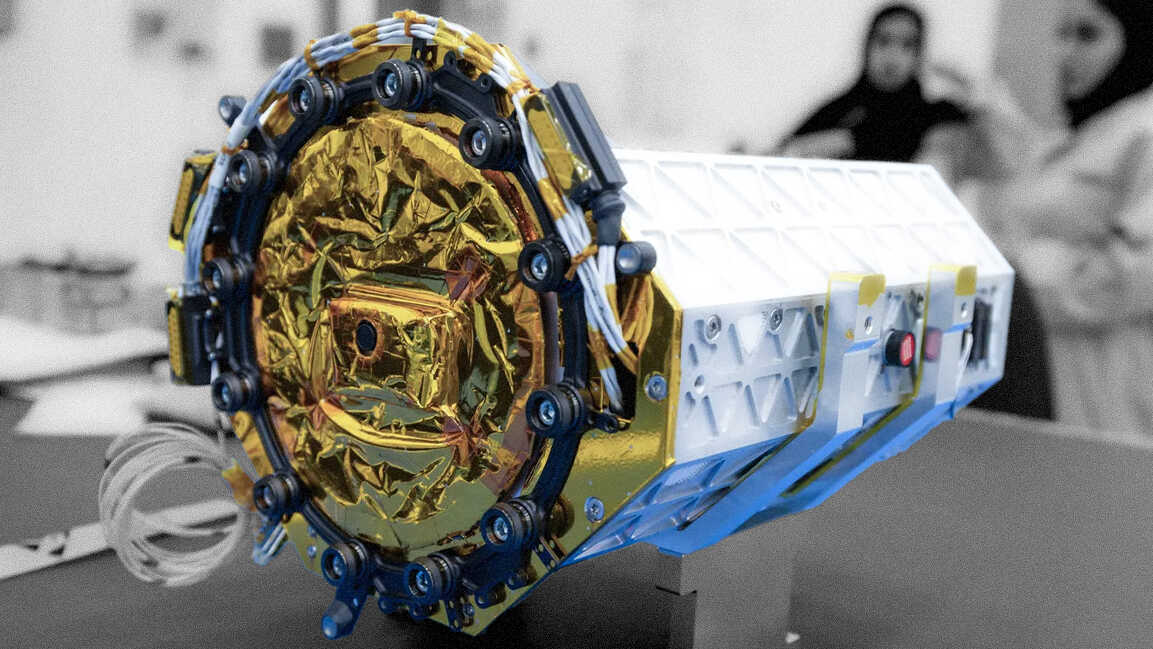
Mohsen Al Awadhi, director of the Space Missions Department at the UAE Space Agency, said the project has made significant progress, including the development of a lander which has been designed, assembled and tested entirely in the UAE in less than two years.
The lander has passed the required technical and environmental tests to verify its flight readiness. Developed with a key contribution from Abu Dhabi’s Technology Innovation Institute (TII), the mission will approach the surface of asteroid 269 Justitia, its final destination, to capture detailed images.
It is now being prepared for transfer to the University of Colorado Boulder’s Laboratory for Atmospheric and Space Physics in the US, where it will be integrated with the MBR Explorer spacecraft and undergo further testing.
Engineers are currently testing the explorer’s subsystems ahead of final readiness assessments and transportation to Japan for launch.
The MBR Explorer is expected to encounter its first asteroid, 10253 Westerwald, in February 2030, beginning a series of observations aimed at understanding how the Solar System formed and evolved.
Asteroids preserve materials dating back billions of years, offering clues about how planets formed and how water and organic compounds may have reached Earth.
By studying seven asteroids, scientists hope to compare their composition and origins. Scientists are particularly interested in the asteroid known as 269 Justitia, which is believed to have originated in the Kuiper Belt beyond Neptune before migrating into the main asteroid belt.
The spacecraft will study Justitia from orbit for approximately seven months before releasing the UAE-built lander to approach its surface.
Four scientific instruments will examine asteroid terrain, temperatures and mineral composition, while searching for indications of water and organic compounds. The findings will be shared with the international scientific community.
But reaching these distant targets will present significant engineering challenges.
Al Awadhi described EMA as the most complex mission in the UAE’s space program to date, citing its distance, multiple asteroid encounters and demanding operating conditions.
The spacecraft must withstand extreme temperature changes while using gravity-assist maneuvers around Venus, Earth and Mars to navigate its journey.
Increasing distances from Earth will also create communication delays and reduce available solar energy, requiring advanced power management, thermal control and autonomous systems.
Beyond scientific exploration, the mission is designed to strengthen the UAE’s domestic space industry and create opportunities for private companies.
Half of the project’s work has been allocated to private-sector businesses, allowing companies to develop advanced technologies, build technical expertise and compete in international markets.
Approximately 150 Emirati professionals are participating in the mission alongside international partners, gaining experience in spacecraft engineering, navigation, autonomous landing systems and operations.
National partners include TII, Khalifa University, New York University Abu Dhabi, the Mohammed bin Rashid Space Centre, HEX20 and the National Space Science and Technology Center at UAE University.
International partners include NASA, the Japan Aerospace Exploration Agency (JAXA), the Italian Space Agency, Mitsubishi Heavy Industries and the University of Colorado Boulder’s Laboratory for Atmospheric and Space Physics.
According to Al Awadhi, these partnerships give Emirati engineers and scientists direct experience across the mission’s development, testing and operations.
The project supports the UAE’s National Space Strategy 2031, which aims to develop a competitive and sustainable space sector while increasing its contribution to the national economy.
Building on the experience gained from the Hope Probe, which reached Mars in 2021, EMA is expected to further develop the country’s deep-space capabilities.
Al Awadhi said the mission’s success would be measured not only by its scientific discoveries but also by the expertise, technologies and competitive companies it helps create.

Featured Videos
Today's Top Stories:
More Top Stories:


FROM OUR PARTNERS