
The gold rush might have a new frontier. But can lab-grown gold disrupt the market?
An experimental breakthrough in turning mercury into gold is raising questions about the future of mining, bullion trading, and investment.
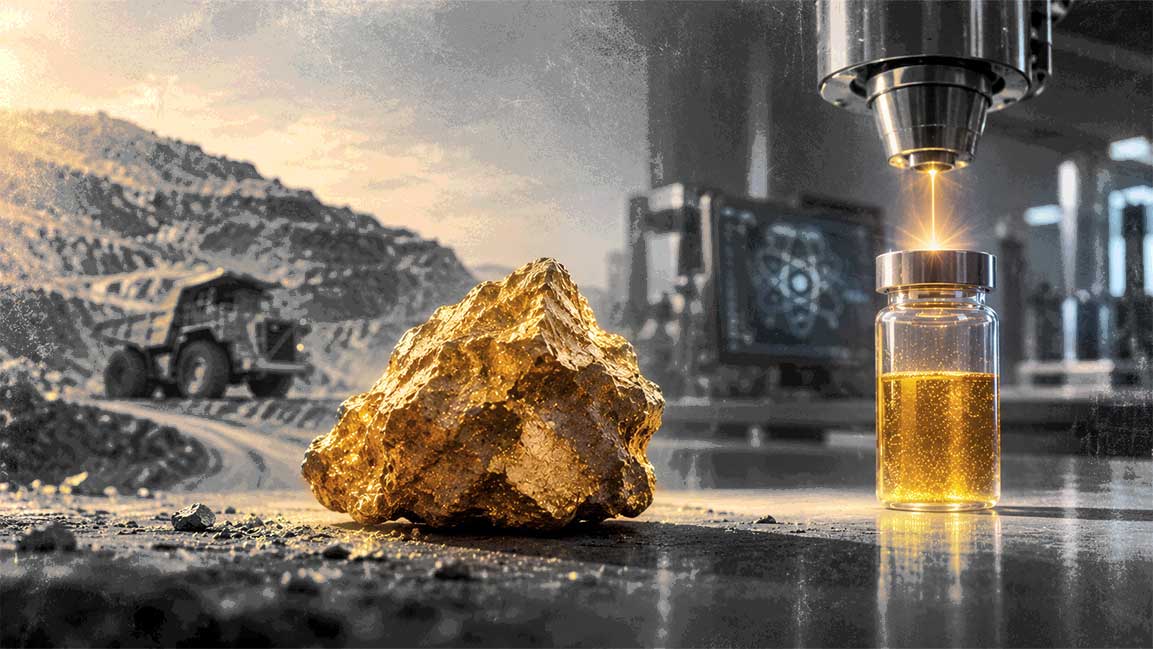


For centuries, alchemists have dreamed of turning mercury into gold. Now, scientists may be bringing that ambition closer to reality. In October 2026, San Francisco-based fusion startup Marathon Fusion announced that it had successfully converted mercury into gold using neutrons generated through nuclear fusion. The announcement has prompted a fresh debate about whether technology could eventually challenge the economics of gold mining and reshape an industry built around the metal’s scarcity.
The question carries significance for the Middle East. Gold is not simply another commodity in the region; it is an investment asset, a cultural tradition, a retail staple, and a major component of international trade. Dubai’s gold trade alone rose 60% to approximately AED 1 trillion in 2025, underlining the emirate’s position as a global bullion and jewelry hub. While producing gold in a laboratory sounds like a potential turning point, the commercial implications are far less straightforward.
“The announcement represents an important scientific development. However, a considerable gap remains between successfully producing gold in an experiment and establishing a commercially viable alternative to mining,” says Vijay Valecha, chief investment officer, Century Financial.
According to Nagham Hassan, a market analyst at eToro, unlike lab-grown diamonds, which already have a substantial commercial market, gold is fundamentally different because consumer expectations and the economics of diamond production are changing. Producing it artificially requires nuclear transmutation, not recreating the natural conditions under which a precious material forms.
For the global gold industry, the question is no longer just whether scientists can make gold. It is whether they can produce enough of it, at a competitive cost, and with the regulatory acceptance needed to enter a market that trades thousands of tonnes annually.
WHY LAB-GROWN GOLD DIFFERS FROM LAB-GROWN DIAMONDS
Comparing lab-grown gold with lab-grown diamonds is natural, but the underlying science and commercial opportunities are very different.
Lab-grown diamonds have been around since the 1950s. They are manufactured using processes that recreate the conditions needed to form diamond crystals. Because diamonds consist of carbon, manufacturers can produce stones with essentially the same chemical and physical properties as mined diamonds.
Gold presents an entirely different challenge because it is a chemical element. It cannot be manufactured simply by reproducing geological conditions or rearranging atoms through conventional industrial processes. Its production requires changing the nucleus of another element, such as mercury, through a nuclear reaction.
“Gold is different because it is a chemical element. Producing it artificially requires changing another element, such as mercury, into gold through a nuclear reaction. This makes lab-grown gold far more complex and expensive to produce,” Valecha says.
Lab-grown diamonds have competed with mined diamonds by offering consumers a less expensive alternative. Artificially produced gold, however, would be chemically identical to naturally mined gold.
“Reactor gold is the same gold-197 as mined gold, so unlike lab diamonds there is no separate, cheaper product to pull buyers across,” Hassan says.
This means there is currently no established lab-grown gold market to value, price, or invest in. Whether the technology eventually becomes commercially attractive will depend on the cost of producing gold relative to extracting it from the ground.
FIVE TONNES VS. A MARKET OF THOUSANDS
The potential production figures indicate why the technology has attracted attention, but they also highlight the scale of the challenge.
According to the World Gold Council, global gold supply reached approximately 5,002 tonnes in 2025. Mine production accounted for around 3,672 tonnes, while recycled gold contributed approximately 1,404 tonnes.
Marathon Fusion estimates that a future commercial fusion plant could potentially produce five tonnes of gold annually for every gigawatt of electricity-generating capacity (GWe). This is equivalent to approximately two tonnes per gigawatt of thermal power (GWth).
Valecha says this would amount to just 0.1% of global gold supply in 2025.
The potential grows when considering a hypothetical network of 100 facilities. If each produced five tonnes annually, the resulting 500 tonnes would represent approximately 10% of total 2025 gold supply and around 13.6%of mine production.
“While this would eventually matter, it would require substantial investment, commercial fusion technology, and widespread adoption,” Valecha says.
However, this is an ambitious theoretical scenario, not a demonstrated production forecast. It assumes that fusion technology becomes commercially operational, that the facilities can consistently deliver their projected output, and that the process can be scaled economically.
Hassan is equally cautious about the potential effect on global prices.
Even if one large fusion plant produces five tonnes annually, she points out that this would remain a small amount compared with more than 3,600 tonnes of mined gold in 2025.
It would take many such facilities to shift global supply by even a relatively small fraction.
Demand is another important consideration. Hassan notes that investors and central banks bought more than 3,000 tonnes of gold last year. Against that level of demand, a few additional tonnes would be unlikely to make a meaningful difference.
THE BIGGEST OBSTACLE FOR LAB-GROWN GOLD
The scientific achievement may be significant, but the commercial hurdles are substantial. Producing gold in a controlled laboratory experiment is very different from establishing an industrial process that can supply the global bullion market.
The first challenge is the infrastructure itself. Marathon Fusion’s proposed technology depends on commercial nuclear fusion facilities. However, commercial fusion power plants are not yet operational at scale. The company is still developing its reactor, meaning the production estimates are based on a future technological capability rather than an existing industrial operation.
The second challenge is raw-material availability.
Hassan explains that only around one-tenth of naturally occurring mercury is suitable for the proposed process. The company is still working on how to separate the required isotope, mercury-198, from naturally occurring mercury.
This introduces another layer of technological complexity before production can even begin.
Then there is the question of radioactive byproducts.
According to the company’s own modeling, the process generates radioactive material that would need to be stored for approximately 14 to 18 years while the relevant radioactive isotopes decay. Only after that period could the resulting material potentially become suitable for commercial use.
This creates a significant delay between manufacturing gold and bringing it to market.
“Nobody can put a date on it, because the barriers come in sequence,” Hassan says.
She says the technology must clear several hurdles in order: a commercial fusion plant must first become available, the appropriate mercury isotope must be separated, and the resulting gold must then undergo the necessary storage period.
Even if a commercial plant were switched on during the 2030s, she estimates that its gold might not become available for bullion sales until the late 2040s.
Valecha also believes the process is unlikely to become a commercially viable investment soon.
He identifies economics as the most significant obstacle.
Unlike diamond manufacturing, artificial gold requires sophisticated nuclear equipment, substantial energy, and complex isotope separation. The technology must also overcome the challenge of handling radioactive byproducts.
Scaling the process would require substantial investment in fusion infrastructure, alongside the development of reliable production systems and access to suitable mercury isotopes.
Valecha assesses that commercial adoption remains a long-term possibility, potentially a decade or more away, rather than an immediate threat to the gold market.
CAN THE GOLD MARKET ABSORB A NEW SOURCE?
For Hassan, the region’s established gold market is not necessarily an obstacle to new production technologies.
“The region’s gold market is not what would hold lab-grown gold back; the problem is there is no lab-grown gold to bring to it,” she says.
Dubai has already demonstrated its willingness to accommodate new sources of precious materials. The Dubai MultiCommodities Centre (DMCC) established a dedicated lab-grown diamond vertical in 2026, reflecting the growing commercial relevance of alternative diamond production. That development suggests the market can accommodate new categories when they have a viable supply chain and commercial proposition.
However, gold presents a different regulatory challenge.
For bullion to be accepted by banks and international exchanges, it generally needs to come from accredited GoodDelivery refineries that meet established standards, including responsible-sourcing requirements.
Hassan points out that no established refinery or exchange framework currently covers lab-grown gold.
This raises questions about how artificially produced bullion would be certified, and whether international trading institutions would accept it.
The issue is particularly relevant because the proposed production process involves radioactive materials. Even if the resulting gold is chemically identical to mined gold, the production history and potential contamination risks would need to be addressed before it could enter established bullion supply chains.
Certification is therefore not simply an administrative detail. It could determine whether institutional buyers, refiners, banks, and exchanges accept the material.
RELATIONSHIP WITH BULLION
Another important question is whether lab-grown gold could change the relationship between financial investors and physical gold buyers.
Gold exchange-traded funds have already made it easier to invest in gold without purchasing, storing, or securing physical bullion. Investors can gain exposure to price movements through financial products, while avoiding some of the logistical considerations associated with physical ownership.
However, this has not eliminated demand for physical gold.
Valecha explains that buyers continue to value physical ownership for several reasons, including jewelry, cultural importance, and gold’s traditional role as a store of wealth.
The latest figures also suggest that financial investment and physical ownership can grow alongside each other.
According to the World Gold Council data cited by Valecha, global bar and coin demand reached 784 tonnes in the first half of 2026, representing a 21% year-over-year increase.
Meanwhile, physically backed gold ETFs recorded a record $31 billion in inflows during the third quarter of 2026. Global holdings increased by 211 tonnes to reach a record 4,256 tonnes by September.
These figures show that investors continue to seek gold exposure through different channels, rather than abandoning physical bullion in favor of financial products.
For Valecha, this distinction matters when assessing the potential impact of lab-grown gold.
Unlike ETFs, which provide financial exposure to gold prices, artificially produced gold could eventually add physical metal to the market.
That could influence supply and, potentially, pricing. But its impact would depend on whether production becomes affordable, whether the purity of the material can be verified, and whether the market accepts it as legitimate bullion.
In markets such as the Middle East, where physical gold has considerable cultural and investment significance, acceptance could matter most.
Valecha believes the technology may eventually introduce some competition, but does not expect a major impact on physical gold demand or prices in the foreseeable future.
“Until then, lab-grown gold is unlikely to have much impact on gold prices or demand, especially in markets like the Middle East where gold has strong cultural and investment significance,” he says.
INVESTMENT OUTLOOK
Despite the hype, experts believe the new metal won’t fundamentally change the investment outlook for precious metals at this stage.
For Hassan, the market’s existing supply-and-demand dynamics remain much more important than the possibility of artificially produced gold.
She argues that investors and central banks are already buying gold in substantial quantities, so a relatively small increase in supply is unlikely to meaningfully affect prices.
Valecha shares that view, pointing to three factors that continue to determine gold’s investment outlook: central-bank purchases, interest-rate expectations, and geopolitical uncertainty.
These macroeconomic forces are likely to remain far more influential than a technology that has yet to demonstrate commercial production.
However, he believes if fusion technology becomes commercially viable and producing gold becomes an economically attractive byproduct of electricity generation, the industry could eventually gain a new source of supply.
For investors, the milestones to watch are therefore relatively clear: independent verification of Marathon Fusion’s results, disclosure of actual production quantities and costs, successful isotope separation, the development of commercial fusion facilities, and evidence that production can be scaled economically.
Until then, the technology remains an emerging scientific development rather than a new investment category.