Can the Gulf make desalination’s waste worth recovering?
Recovering water and minerals from brine could reduce desalination’s environmental impact, but costs and energy demands remain challenging.
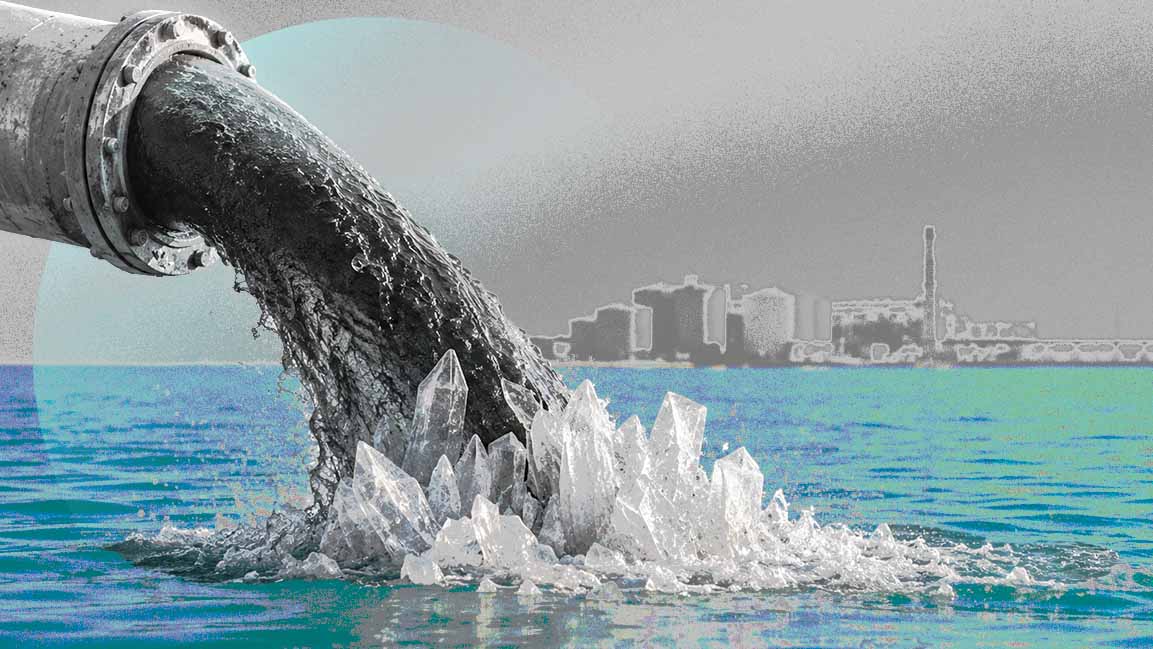


For every liter of freshwater produced through desalination, it leaves something behind. Salt, minerals, and other substances stay in a concentrated stream called brine. Most of this brine returns to the sea.
In the Gulf, desalination is essential to everyday life. But while it provides much-needed freshwater, it also produces waste that can harm the marine environment.
The scale of this problem is significant.
A 2019 study published in Science of the Total Environment estimated that desalination plants worldwide generated around 142 million cubic meters of brine daily. Saudi Arabia, the UAE, Kuwait, and Qatar accounted for approximately 55% of that total.
As the region builds more desalination plants, it faces a tough question. Can it continue producing more freshwater without causing bigger environmental problems?
Researchers and industry leaders are looking for ways to recover more water from brine, extract valuable minerals, and reduce waste discharged back into the sea. But making these ideas work will take more than just new technology.
“The Gulf has become exceptionally good at turning seawater into freshwater. The next challenge is what we do with what is left behind,” says Omar Al Busaidy, President – UAE and Oman at Future Pipe Industries (FPI).
THE ENVIRONMENTAL COST OF FRESHWATER
Brine contains higher concentrations of salt than seawater. Depending on the desalination process, it can also be warmer and contain residual treatment chemicals. When discharged into the sea, its higher density can cause it to sink, potentially affecting marine life near the seabed.
Prof. Phil Hart, Chief Researcher at the Renewable and Sustainable Energy Research Center at the Technology Innovation Institute (TII), says the effects can be particularly harmful to seagrasses and organisms living near discharge points.
However, he warns that not every discharge has the same effect. When brine is released through well-designed outlets, it mixes slowly with surrounding seawater, limiting immediate impacts. The longer-term concern is what happens when those effects accumulate.
“The challenge is cumulative: many localized effects in many locations add up to a wider environmental problem, or could eventually, as we install more desalination plants,” Hart says.
Sachin Kodolikar, Chief Operations Officer at Metito Utilities, says the region’s marine conditions make desalination infrastructure design especially important.
“The Gulf is particularly sensitive. It is a shallow sea, only 35 meters deep on average, with salinity averaging about 45 grams per liter and limited water exchange,” Kodolikar says.
Decisions about where plants draw seawater, how they discharge brine, and whether they use systems to improve dilution can influence their environmental impact. These choices are also easier to address before construction begins.
“Where the intake and outfall sit, whether diffusers are used, the plant’s recovery rate and the final route for the brine, whether discharge, injection or reuse, are all easier to settle before construction than after,” Kodolikar adds.
Al Busaidy says brine management cannot be separated from how desalination plants are designed and operated. The infrastructure used to transport seawater, freshwater, and waste also influences the system’s efficiency and environmental performance.
That becomes increasingly important as new technologies attempt to recover more resources from water that would otherwise be discarded.
CAN DESALINATION WASTE BECOME A VALUABLE RESOURCE?
Brine is usually seen as waste. But concentrated seawater has magnesium, calcium, potassium, and other materials used in manufacturing. It also has smaller amounts of lithium.
Hart sees mineral extraction, often called brine mining, as a promising way to reduce liquid discharge.
“In a perfect world, desalination plants would not release brine at all, and the long-term goal for the industry is so-called Zero Liquid Discharge (ZLD),” he says.
Zero liquid discharge aims to recover water from the remaining waste until the dissolved salts can be separated into solids. Depending on their composition and quality, these solids could be sold or require disposal.
The potential goes beyond cleaner water production.
Hart believes desalination plants could eventually serve as mineral production sites, supplying materials to domestic industries rather than relying entirely on imported resources.
Al Busaidy says that commercial success depends on several factors, including mineral concentrations, extraction costs, energy requirements, and whether nearby industries can use the recovered materials.
“The interesting shift is moving from asking, ‘How cheaply can we dispose of brine?’ to ‘What value can we recover from it?’” he says.
He sees more immediate potential in recovering magnesium and industrial salts than in focusing exclusively on rarer, higher-value materials.
Kodolikar also sees commercial potential in mineral recovery but cautions that the economics remain uncertain.
“In some cases, the energy and processing costs can outweigh the value of what is recovered,” he says.
Extracting a valuable mineral in tiny quantities may cost more than the revenue it generates. Recovering a less expensive material at a larger scale could make better business sense.
MORE FRESHWATER DOESN’T NECESSARILY MEAN LESS WASTE
Experts say increasing the amount of freshwater recovered from seawater can reduce the volume of brine, but the remaining waste becomes even saltier. That means improving water recovery alone cannot eliminate the disposal problem.
“Recovering more fresh water from the same seawater reduces the volume of brine, but it also makes that brine more concentrated,” Hart says.
Eventually, removing dissolved minerals becomes necessary if operators want to avoid releasing highly concentrated liquid waste.
A 2024 review published in Nature Reviews Clean Technology examined technologies designed to reduce or eliminate liquid waste. These include membrane-based concentration, evaporation, and processes that separate dissolved salts into solid materials.
Kodolikar cites research estimating that brine disposal alone can account for 5% to 33% of total desalination costs. Additional treatment and recovery systems can increase both the initial investment and operating expenses.
“The biggest challenge is making these solutions viable at the scale the region needs,” he says.
Al Busaidy says combining different technologies is likely to be more practical than relying on a single breakthrough.
Kodolikar agrees that there is no universal solution, explaining that the choice of technology depends on each plant’s conditions and requirements.
“No single approach suits every site, so the most promising path combines technologies according to the feedwater, the scale of the plant and the intended use of what is recovered,” he says.
Infrastructure is important too. As brine gets more concentrated, it can cause more corrosion and mineral buildup in pipes and equipment.
FPI, which supplies composite piping systems for desalination and water infrastructure, has worked on projects including Shuqaiq 3 in Saudi Arabia and Dubai’s Hassyan seawater reverse osmosis complex.
Al Busaidy believes that having infrastructure built to withstand harsh water conditions will be crucial as desalination systems become more complex.
THE BIGGEST BARRIER MAY BE ECONOMICS
Scientists have demonstrated various methods for recovering minerals and reducing brine discharge. Making those processes financially viable at industrial scale is considerably harder.
The closer a plant moves toward zero liquid discharge, the more energy it generally needs to recover the remaining water and separate the salts.
That increases operating costs. Installing additional treatment equipment also requires substantial upfront investment.
Hart says the economics become more attractive when desalination plants target minerals with established local demand.
“You also need a local market for the minerals if you are to avoid large transport costs,” he says, suggesting starting with selected minerals and expanding recovery as additional commercial opportunities emerge.
Such an approach could help operators manage investment costs while testing whether customers will consistently purchase the recovered products.
Al Busaidy also thinks it’s worth aiming for minimum liquid discharge, which cuts down waste a lot, even if it doesn’t eliminate it. He argues that just because a solution is technically possible doesn’t mean it’s always the best choice for the economy or the environment.
So, is eliminating every drop of liquid waste worth the additional energy and expense?
The answer can vary from plant to plant. Factors such as local electricity prices, environmental regulations, mineral demand, and infrastructure all affect what is practical.
Some facilities might get better results by focusing on recovering more freshwater and a few valuable minerals rather than trying to achieve zero liquid discharge.
THE GULF HAS THE SCALE. NOW IT NEEDS TO PROVE THE MODEL
Hart says research institutions, including TII, have already demonstrated core mineral-recovery technologies in laboratory settings. Larger pilot projects are now needed to understand how these systems perform under industrial conditions.
That means testing costs, energy consumption, equipment durability, and mineral quality over extended operating periods.
Al Busaidy believes the Gulf could benefit from bringing desalination operators, researchers, manufacturers, and industrial customers into closer collaboration.
“A regional brine testbed, with shared data on brine composition across plants, would be a practical first step,” Kodolikar says.
Instead of designing a desalination plant solely to produce freshwater, developers could consider how its waste streams might supply nearby industries.
The industry still needs commercial demonstrations showing that recovered materials can meet customer requirements at competitive prices. Operators must also establish whether the environmental gains justify the additional energy and investment.
As desalination capacity grows, those decisions will become harder to postpone.