- | 9:00 am
What the future of work looks like in 2025, according to an ancient technology
The future of work will see shifts toward flexibility, lifelong learning, and a wellness-focused culture.



How does the future of work look in 2025? As workers and employers continue wrestling between remote and return to office, and the speed of innovation outpaces many industries and workplace structures, this is the year when new models will anchor into the zeitgeist (minus the post-pandemic prefix that we can hopefully stop attaching to everything, bird flu warnings notwithstanding).
As a professional astrologer (along with my twin) who advise CEOs, founders, and businesses on strategy and planning, and publish an in-depth yearly guide, we look to mundane astrology (a branch of astrology that studies the cosmic effects on world events, politics, and governments) for historical cycles that may be repeating for the first time in decades, even centuries.
With more than 60% of Gen Z and millennials using astrology as a serious tool for navigating their careers, more professionals than ever are looking to the stars for insight and foresight. Here’s what we found.
Hybrid, fractional, remote
The trend wants to skew toward the part-time model of hybrid workplaces and fractional executives. But…will it? The arm-wrestling match will wage on, with some bosses trying to corral people back to the office against their will—only to discover they’re paying a steep “talent tax” by doing so. With data from companies like Pinterest showing massive leaps in remote workers’ engagement levels, 2025 will demand a compromise that doesn’t ask workers to sacrifice the lifestyle upgrade they gained during the pandemic.
How might that look? To woo workers back into a corporate compromise, offices could experiment with new forms of flexibility, such as creating on-site perks that ease personal life stressors like cooking and childcare. Imagine: a private chef preps a week of healthy family dinners—dietary restrictions and preferences included—and it’s waiting as you leave the office. Or, how about an “apartment style” corner office with your own bathroom, shower, and kitchen? Hey, maybe that’s a solution for all those unoccupied luxury high-rise co-ops…?
Diverse skill sets become an asset
Portfolio-based work—a career that combines multiple titles or roles across disparate sectors—is another exciting trend that speaks to the diversity of skills many workers bring. Why yes, you can be an accountant and a food photographer or part of both the marketing and the business development teams. If you’ve got range, there’s no need to shoehorn yourself into a box this year.
Reskilling, upskilling, and continuing education trend
With technology and AI rapidly advancing, people must continually update their tools to stay competitive in fast-changing industries. A spring and summer phase that encourages individual growth and self-sufficiency, drives a trend toward continuous skill-building and refreshing. Savvy companies will invest in the ongoing training of workers, funding their continued learning via micro-certifications, short courses, tuition matching, and digital boot camps. Paid education may become a benefit that bigger companies use to entice staff to stay long-term.
New ways to create “culture”
Workers floating in and out of roles or coming into the office can present challenges around teamwork. New strategies will emerge to help companies unify their staff and create camaraderie, while also respecting that the office is no longer the source of social bonding that it was during the early Google and startup era.
Periodic offsites and team-building retreats could become essential ingredients to creating culture where the Zoom square fails (add a line item to your department budget for travel!).
Beyond basic bonding experiences, these perks can foster a desirable corporate culture and inspire workers to be part of the company’s mission—especially if hosted in locations like a boutique hotel’s idyllic property or a city’s buzziest neighborhood.
How about some outdoor space, too?
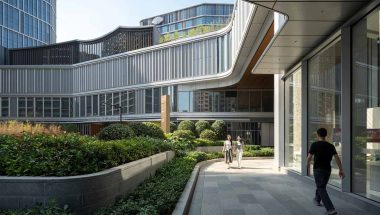
As we progress into the second half of the decade, the future of work will be burgeoning with offices with terraces, rooftops, and outdoor meeting spaces as must-have amenities for recruiting and retaining top talent. Forget about the flatscreens and foosball machines of yore. Greenspaces, air-purifying plants, and natural light are the new luxury perks.
The new “corner office” could have open-air access with Wi-Fi, a barista, and even a pool! Communal options are also a perk. We can expect to see food trucks, fitness classes, and other “experiences” become part of the modern worker’s lifestyle. Biophilic design, where architecture and nature intertwine, will increase in popularity.
Home sweet office
In the second half of 2025, workplaces may reimagine their physical spaces to create a sense of belonging and comfort. Offices will feature communal spaces that feel like home, with comfortable furniture, wellness rooms, and even family-friendly zones. This trend could foster a more nurturing atmosphere, making the workplace feel like an extension of your WFH sanctuary.
Companies may also organize more “family days” and community service activities, nurturing a workplace culture rooted in compassion and shared values. The future of work in 2025 could see more kid-friendly offices that offer on-site care, education, and experiences, especially during holidays.
Coworking for focus and productivity
The ADHD technique of “body doubling” could become a popular strategy for remote workers to adopt in 2025—especially in this era of distraction. Body doubling involves working alongside another person to support each other in staying focused and productive, even if your tasks are independent. Whether IRL or virtually, this can stave off isolation and replace the built-in accountability of an office environment. Remote teams might even set up an office in the metaverse, using dashboard and app-based programs like Teamflow HQ, which allow customized decor that looks and feels like home.
Ethical AI and transparent data practices
Privacy policies? Check. The future of work in 2025 emphasizes transparency and ethics, particularly surrounding data and technology. In the workplace, this could lead to innovative practices around ethical AI use and data privacy, with companies hammering out clear policies on data collection, employee surveillance, and AI usage for the team. This will become crucial in the summer and fall especially.
Wanted: Emotionally mature leaders
Hard skills won’t be the only key assets to bring to the table in the Age of Aquarius. A high EQ and emotional maturity will also be a marker for success and leadership in the future of work. Companies may increase investments in interpersonal training for their teams.
There are now five generations sharing office space. Gen Alpha, first born in 2010, is not far behind. The vastly divergent communication styles, comfort level with technology, and values are already creating clashes. Executives may lean into personality tests, gamified icebreakers, and other common-interest activities to mitigate volatility and create cohesion.
Overall, we’ve exited a 16-year cycle steeped in hierarchy, control, and sharp divisions in rank—one that last took place from 1762-78 and won’t surface again in our lifetimes.
Next, the cosmos indicates the resurgence of a “we the people” era that will span the next 19 years and mirrors a cycle from 1778-98 that last occurred at the advent of the United States and America’s first Industrial Revolution.
Autocratic leaders (including, ahem, elected ones) will find new ways to hold on to their power, including through alliances with tech oligarchs. But technology and greater decentralization will also work in the employee’s favor, as the future of work moves deeper into a knowledge economy and younger generations pile into the workforce.
Serendipitously nestled in the middle of the decade, 2025 is indeed the fulcrum—The Year of the Divine Pendulum, as we’ve named it—that will reveal how society will leap into a fast-paced, innovation-driven second half of the 2020s.