- | 9:00 am
Is AI race testing the GCC’s climate priorities?
As the region attempts to catch up in the AI race, the need for energy-intensive infrastructure increases and electricity demand rises — and that friction is becoming harder to ignore.
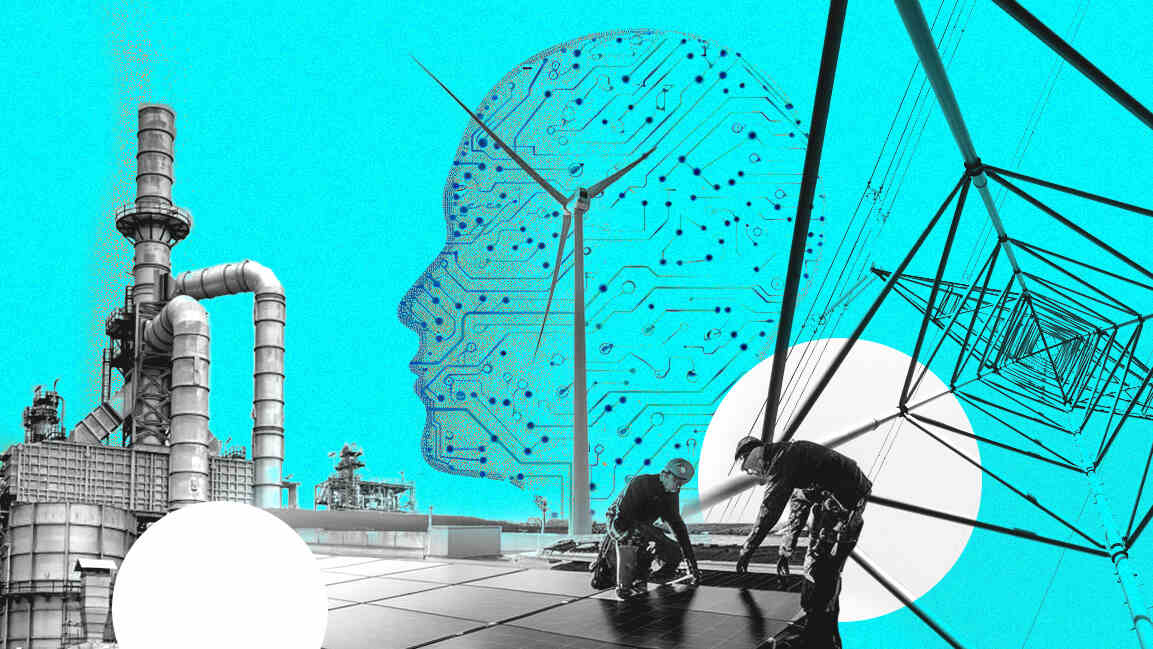


The Gulf states have been hailed for their agenda-setting climate policies. And also for competing in the AI race. But the region may now be approaching a strategic crossroads: as governments accelerate AI investments, there’s a growing concern that sustainability measures could lose momentum.
The tension is sharpened by two parallel imperatives — ambitious clean-energy targets and a rapidly expanding data-center buildout — the massive infrastructure needed for the AI boom that is driving up energy demand.
DECARBONIZATION AND AI-DRIVEN DIGITAL EXPANSION
A few years ago, governments in the region began announcing new environmental policies and setting ambitious goals for an energy transition and zero emissions by 2030 and beyond. Saudi Arabia plans to generate half of its electricity from renewable sources by 2030. The UAE aims for 44% clean energy in its energy mix by 2050, while Oman aims for 20% renewables in power generation by 2030.
Power producers began scaling up renewable energy, and governments made strides through mechanisms such as voluntary carbon offset markets, sustainability tax incentives, and regulatory caps to drive decarbonization.
But that transition, perhaps, is now colliding with the explosive growth of data centers.
For much of the clean-energy boom in the GCC, little changed in the power generation methods.
Fossil fuels still dominate the energy mix, even as solar capacity expands and nuclear energy gains a limited foothold. Clean energy today accounts for about 15% of power generation across the GCC, underscoring the region’s reliance on hydrocarbons even as it pursues a low-carbon transition.
The sector’s surging power needs cannot yet be reliably met by renewables alone — particularly as data-center capacity in the Middle East is projected to nearly triple, from 1 GW in 2025 to 3.3 GW by 2030. The UAE data center capacity is expected to surge 165% by 2028.
The result is a growing tension between the region’s decarbonization ambitions and the energy intensity of its AI-driven digital expansion.
“The growth of AI and digital infrastructure is undoubtedly increasing energy demand across the GCC, particularly as more data centers are being developed within the region to meet cybersecurity, data sovereignty, and economic requirements,” says Fadi Al-Shihabi, Partner, Head of Sustainability Solutions, KPMG Middle East.
However, this does not necessarily place sustainability ambitions at risk, he adds. Rather, it highlights the need for a broader and more adaptive energy strategy. “The conversation is evolving from a traditional ‘energy transition’ model to one focused on expanding overall energy capacity while continuing to invest in cleaner sources.”
The challenge for the region, he says, will be ensuring that renewable energy deployment, grid modernization, and infrastructure investment “move quickly enough to support both economic growth and the rapid expansion of AI technologies.”
Sustainability remains a core priority, adds Al-Shihabi, but “it now sits alongside equally important considerations around energy resilience and long-term supply security.”
DELIVERING ON CLEAN ENERGY COMMITMENTS
Large-scale AI data centers require significant energy. The key issue is how quickly demand is increasing.
In 2025, data centers in the UAE used 3 TWh of electricity, about 2% of the country’s total demand of 173 TWh. Each year, data centers are expected to use more than 6% of the UAE’s electricity. According to an Emirates NBD report, data centers’ energy use will more than double from 5.6 to 12.6 TWh by 2028.
In Saudi Arabia, S&P Global projects the data center sector’s megawatt load will grow by 29% from 2024 through 2030.
The pace of AI growth and data center expansion has created unprecedented pressure on energy systems, making implementation more complex than initially anticipated, Al-Shihabi says. “This is increasing the focus on deploying alternative and renewable energy at a much larger scale, while also continuing to rely on conventional fuel-based power generation to meet immediate and rapidly growing demand requirements.”
As demand for data centers grows, the choice of energy sources is becoming increasingly important, and concerns about energy supply are rising. Many big tech companies, aiming to address these concerns, have pledged to develop alternative energy sources to run their data centers.
But do hyperscalers follow through on their clean energy promises?
“There is measurable progress,” says Safak Yucel, Associate Professor and Associate Director at the Business of Sustainability Initiative at Georgetown University’s McDonough School of Business in Dubai.
Yucel adds, “Hyperscalers building in the GCC should be held to the same commitments they make globally, and the region’s regulatory frameworks are increasingly positioned to demand exactly that.”
ENERGY AND WATER EFFICIENCY
As data centers grow rapidly, the GCC has invested over $42.5 billion to develop nearly 62.1 GW of renewable energy projects. The countries have set ambitious energy transition and zero-emissions goals for 2030 and beyond, including a target of 165 GW of renewable energy capacity.
However, a recent report says the GCC will need to invest about $60 billion between 2025 and 2030 to add another 102 GW of renewable energy capacity.
The GCC, Yucel says, with its abundant solar resources, “is better positioned than most to power AI growth without compromising its climate ambitions.”
Governments and businesses are recognizing that energy security must be addressed alongside sustainability objectives, adds Al-Shihabi.
“This has led to more forward-looking planning that balances clean energy investment with infrastructure expansion, reliability, and resource optimization. The overall approach is becoming less about choosing between sustainability and security.”
At the same time, data center water use is closely linked to energy use, as the region relies heavily on power-intensive desalination, and saving water reduces the massive amounts of electricity needed to produce it. A medium-sized data center can use up to 110 million gallons of water per year for cooling, which is comparable to the yearly water use of about 1,000 households.
However, in the region, Rami Ghandour, CEO of Metito Utilities, says, “while governments are building more capacity, the focus is also equally on efficiency, minimizing loss of non-revenue water, reusing what is treated, and managing networks with far greater precision.”
“We can see this in Saudi Arabia, the world’s largest producer of desalinated water, where the National Water Strategy targets treated water reuse of 70% by 2030, supported by investments exceeding $6 billion in distribution, treatment, and wastewater infrastructure.”
The UAE’s Water Security Strategy 2036 targets a 21% reduction in total water demand and 95% reuse of treated water, he adds.
PROBLEM AND A SOLUTION
Change is happening slowly. Meanwhile, many tout AI’s ability to make energy systems more efficient and boost sustainability, positioning it as both a problem and a solution.
The IEA says that while data centers might threaten energy security, using AI wisely could change the energy sector over the next 10 years. If used well, this technology could reduce costs, make companies more competitive, and lower emissions.
Yucel says, “The dramatic efficiency improvements in AI models, which now require less compute and therefore less electricity per query, show that technology companies are delivering real gains, not just pledges. The question is whether infrastructure investment keeps pace.”
In the UAE, where the data center sector is expected to grow by 10% over the next five years, the Ministry of Energy and Infrastructure, Khazna Data Centers, and Agility have started a pilot project. They are using control technology from Seattle-based AI firm Phaidra, which claims to have helped reduce capital costs for data center cooling and cut energy use by up to 40%, to improve energy efficiency in data centers and district cooling systems.
At the same time, sustainability efforts are in progress. Khazna, which controls 70% of the UAE’s operational data center capacity, is using solar power and biofuels to lower its environmental impact.
PRACTICAL AND FLEXIBLE APPROACH
Climate change is an infrastructure and business risk that is not going away.
While doubts remain about renewable energy commitments and how far these sustainability promises will advance in the region, analysts say that, despite GCC countries’ long-term sustainability and clean energy goals, there is growing recognition that energy systems must also be reliable and capable of supporting AI growth.
“As a result, policymakers are taking a more practical and flexible approach, balancing clean energy targets with immediate energy security needs,” says Al-Shihabi.
For example, to meet increasing demand from data centers, clean energy capacity in the UAE is expected to exceed 22 gigawatts by 2031. In 2025, at the Emirates Energy Forum in Abu Dhabi, Suhail Al Mazrouei, the country’s energy and infrastructure minister, said that by 2031, additional clean energy capacity would account for “35% of the baseload.”
In many markets, Al-Shihabi says, the immediate priority has become ensuring sufficient and reliable power supply while renewable capacity continues to scale.
“The GCC’s strong investment in clean energy projects positions the region well to support these commitments over time, but meeting rapidly rising demand will require continued collaboration between governments, utilities, and technology companies to accelerate infrastructure development and diversify energy sources,” Al-Shihabi adds.