- | 10:00 am
Adeline Pelage is using biscuits to tackle a larger challenge: Keeping Africa’s agricultural value in Africa
What began as a biscuit business has become a broader effort to connect farmers, manufacturers, and consumers while keeping more value closer to home
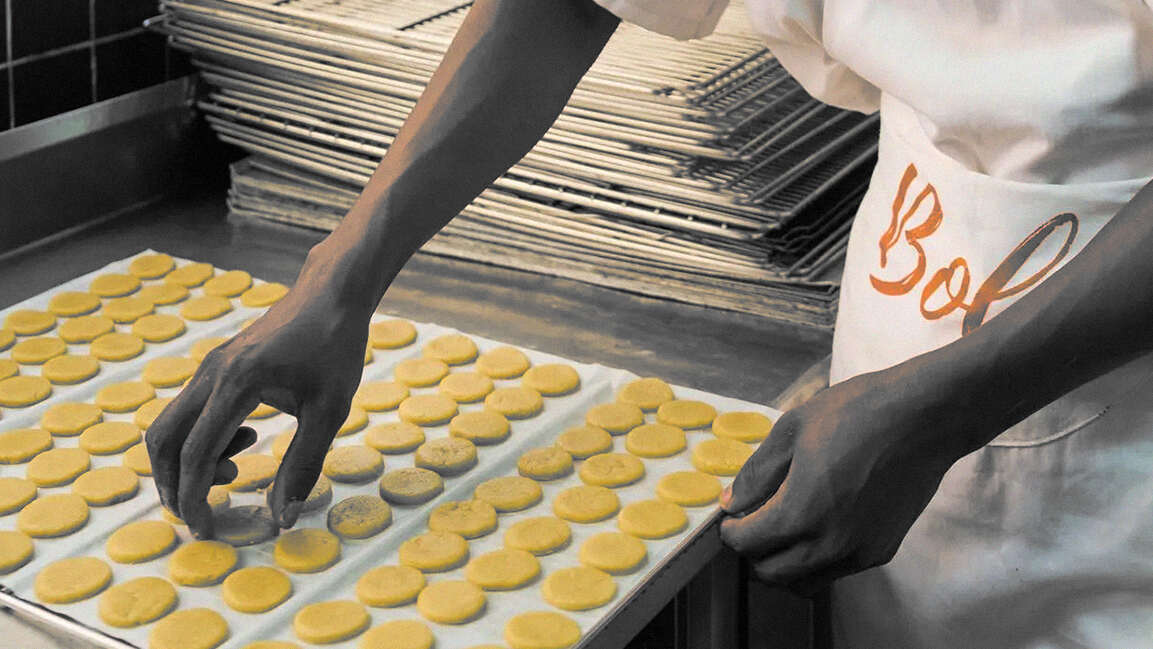


A biscuit is not the first product that comes to mind when discussing economic development. For Adeline Pelage, co-founder and CEO of Biscuiterie Bobo, it is a practical starting point. Named this year among the Cartier Women’s Initiative’s 30 fellows, a program now in its 20th year that backs women-impact entrepreneurs across nine regional awards and one thematic award, supporting them with the financial, social, and human capital to scale their businesses and sharpen their leadership, Pelage is doing exactly that from an unlikely place: the snack aisle.
Founded in Cameroon, Biscuiterie Bobo was built on a simple premise: if Africans consume biscuits every day, more of them should be made in Africa using locally sourced ingredients.
The company works with crops such as sweet potato and cassava, sources most of its raw materials locally, and partners with more than 100 smallholder farmers. In doing so, it is tackling a challenge that extends far beyond the snack aisle. Across much of the continent, agricultural production remains disconnected from higher-value processing and manufacturing.
That disconnect has become an increasingly important economic question as governments seek to create jobs, strengthen industrial capacity, and reduce reliance on imports. Food processing has emerged as a sector of growing interest because it sits at the intersection of agriculture, manufacturing, and consumer demand, offering a pathway to capture more value from local production.
Pelage, a former investment banker, entered the industry with the conviction that local manufacturing can play a larger role in that process. Under her leadership, Biscuiterie Bobo has built a supply chain that links farmers, processors, and consumers while developing products tailored to local tastes. The company’s growth reflects a broader movement across Africa, where entrepreneurs are looking beyond raw commodity production and focusing on businesses that can create value closer to home while strengthening ties between agriculture and industry.
BUILDING MORE THAN BISCUITS
Building a biscuit company was about more than producing a popular snack. It was an attempt to strengthen local industry and create economic opportunities across the value chain. Returning to Cameroon after a career in investment banking, Adeline Pelage noticed that supermarket shelves were dominated by imported brands, despite Cameroon’s agricultural potential.
“Biscuits are never just biscuits,” she says. “Behind every packet, there’s agriculture, industry, logistics, distribution, an entire value chain.” The observation raised a broader question about where value was being created. While consumers regularly purchased biscuits, much of the economic activity associated with their production occurred outside the country. For Pelage, that represented a missed opportunity for local businesses, farmers and manufacturers.
“We were eating biscuits, but we weren’t producing them,” she says.
The realization prompted her to move from finance into manufacturing. “At that moment, I thought, either I keep analyzing balance sheets, or I start building one.”
What appealed to her was the product’s simplicity and the scale of the opportunity behind it. Biscuits are a staple purchase for many households, creating a market large enough to support local production while generating demand across agriculture, processing, packaging and distribution.
That thinking eventually led to the creation of Biscuiterie Bobo. “They are simple enough to scale, and powerful enough to transform a system,” she says.
The decision to manufacture locally was also a response to a broader economic challenge. Dependence on imported snacks, Pelage argues, carries costs that extend far beyond the products themselves. For consumers, imported goods can mean higher prices and products that are not always aligned with local tastes and preferences. The larger impact is felt across the domestic economy.
“For producers, it means being invisible,” she says.
Without a strong local processing industry, farmers often have limited opportunities to move beyond selling raw commodities. That, she believes, prevents agricultural producers from capturing more value from what they grow and limits the development of related industries.
“You can grow crops, but if there is no local industry to absorb them, you remain stuck at the lowest end of the value chain,” she says.
The result is a cycle in which countries import finished products while missing opportunities to create jobs, build manufacturing capacity, and strengthen local supply chains.
“We import value instead of creating it,” she says.
In her view, the consequences extend beyond trade balances or consumer choice. “The cost is not just economic, it’s systemic,” she says. “It limits job creation, weakens local industries, and disconnects agriculture from value creation.”
THE SUPPLY CHAIN ADVANTAGE
Creating a locally made product meant far more than replacing imported brands with domestic alternatives. From the outset, the goal was to build products that reflected local ingredients, tastes and consumption habits rather than simply adapting imported concepts for the local market.
“It was fundamental,” says Pelage.
The company’s use of ingredients such as sweet potato and cassava sits at the heart of that approach. Those choices influence not only where raw materials are sourced but also the character of the final product.
“We didn’t want to create ‘African-looking’ products,” she says. “We wanted to create products that are truly rooted in local realities, ingredients, tastes, and consumption habits.”
For Pelage, authenticity begins with what goes into the product. As consumers become more discerning, she believes brands need to move beyond packaging and marketing to create products that genuinely reflect local preferences and cultures.
“Using sweet potato or cassava changes everything, not just the supply chain, but the product itself,” she says. “That’s how you build something people don’t just buy, but recognize.”
That emphasis on local ingredients naturally shaped the company’s sourcing approach. Building a supply chain in which more than 80% of raw materials are sourced locally has required a long-term commitment rather than a simple procurement strategy. The process has involved working closely with smallholder farmers to create relationships that support consistency, quality, and reliable supply.
“Patience, and a lot of conversations,” says Pelage.
She views sourcing as a collaborative effort that extends beyond purchasing crops. Establishing trust and creating predictable demand have been key to helping farmers plan production and invest in quality improvements over time.
“Working with smallholder farmers is not just procurement, it’s alignment,” she says. “You build trust, you create predictable demand, you work on quality together.”
The approach can take longer than relying on imported ingredients, but Pelage believes the benefits extend beyond the business itself. A stronger local supply chain can create opportunities for farmers, strengthen domestic agriculture and keep more economic value within the country.
“It’s slower than importing, but it’s much more meaningful,” she says.
THE VALUE OF PROCESSING
Working with more than 100 smallholder farmers has had an impact beyond securing a reliable supply of raw materials. According to Pelage, it has also changed how many farmers think about surplus production and income generation.
“In many cases, surplus often meant losses,” she says. “Now, surplus becomes an opportunity.”
Excess harvests can be difficult to sell before they spoil, limiting farmers’ ability to benefit from strong growing seasons. By transforming crops into flour and other ingredients for production, farmers can extend the shelf life of their harvests and access markets that might otherwise be unavailable.
“When crops are transformed into flour, they last longer, sell better, and generate more income,” says Pelage.
The shift has encouraged a different way of thinking about agriculture. Rather than focusing solely on selling fresh produce immediately after harvest, farmers can begin viewing their crops as part of a broader value chain that creates opportunities beyond the farm gate.
“They start thinking differently,” she says. “Not just ‘how much can I sell today,’ but ‘how much value can I create.’”
That focus on creating value extends beyond agriculture. As Biscuiterie Bobo has grown, the company has also sought to create employment opportunities within the communities it serves, particularly for women.
“We operate in an environment where many women don’t have access to stable, respectful jobs,” says Pelage.
She says creating those opportunities was a deliberate priority from the beginning. Today, women account for 60% of the workforce, a figure that reflects both intentional hiring efforts and the nature of the business itself.
“From the beginning, we wanted to create that space,” she says.
At the same time, women have been drawn to the company organically, particularly across production and operational roles. The outcome, Pelage says, has been shaped by both strategy and circumstance.
“Interestingly, the business also attracts women naturally, especially in production and operations,” she says. “So it’s both a decision and a reality.”
For Pelage, inclusion is not a standalone initiative but part of building a business that reflects the communities around it and expands access to stable employment.
A BIGGER DEFINITION OF SUCCESS
Much of the conversation around Africa’s food industry focuses on production. The bigger opportunity, according to Pelage, lies in strengthening the connections between producers and consumers.
“Everyone talks about production,” she says. “The real opportunity is connection.”
The continent has significant agricultural capacity and a large consumer market, yet the systems linking farmers, processors, manufacturers, distributors and consumers remain underdeveloped. In Pelage’s view, the challenge is not a lack of supply or demand but the gaps between them.
“Africa produces. Africa consumes. But the link between the two is still weak,” she says.
Closing that gap represents one of the defining opportunities for the next generation of food businesses on the continent. Companies that can build efficient supply chains, improve market access and better connect agricultural output with consumer demand stand to unlock value across the food ecosystem while creating more resilient local industries.
“Whoever builds that bridge, at scale, will win,” she says.
That belief also shapes how Pelage measures success at Biscuiterie Bobo. While profitability remains essential, she views business performance as only one part of the equation. Long-term success, she says, depends on creating value across the broader ecosystem that supports the company.
“Success is when everything aligns.”
For Pelage, that means improving outcomes for farmers, building products that can compete on quality and maintaining a financially sustainable business. She is particularly focused on ensuring customers choose Biscuiterie Bobo for the product itself, rather than solely because it is locally made.
“When a farmer earns more. When a customer chooses BOBO because it’s better, not just because it’s local. When the business is profitable.” Her definition of success also reflects her own journey from investment banking to food manufacturing. While the industries may appear very different, she sees both as exercises in building and managing complex systems.
“And personally?” she says. “Success is also when I can switch from financial models to baking trays, without losing the plot.”
The vision is ultimately larger than the product itself: creating more value from local agriculture and keeping that value within local economies.