- | 9:00 am
Is higher education redesigning learning to stay relevant in the AI economy?
Experts say redesigning how universities approach the rapidly evolving AI-first job market is a current challenge, and there is no clear reference standard to follow at the moment.
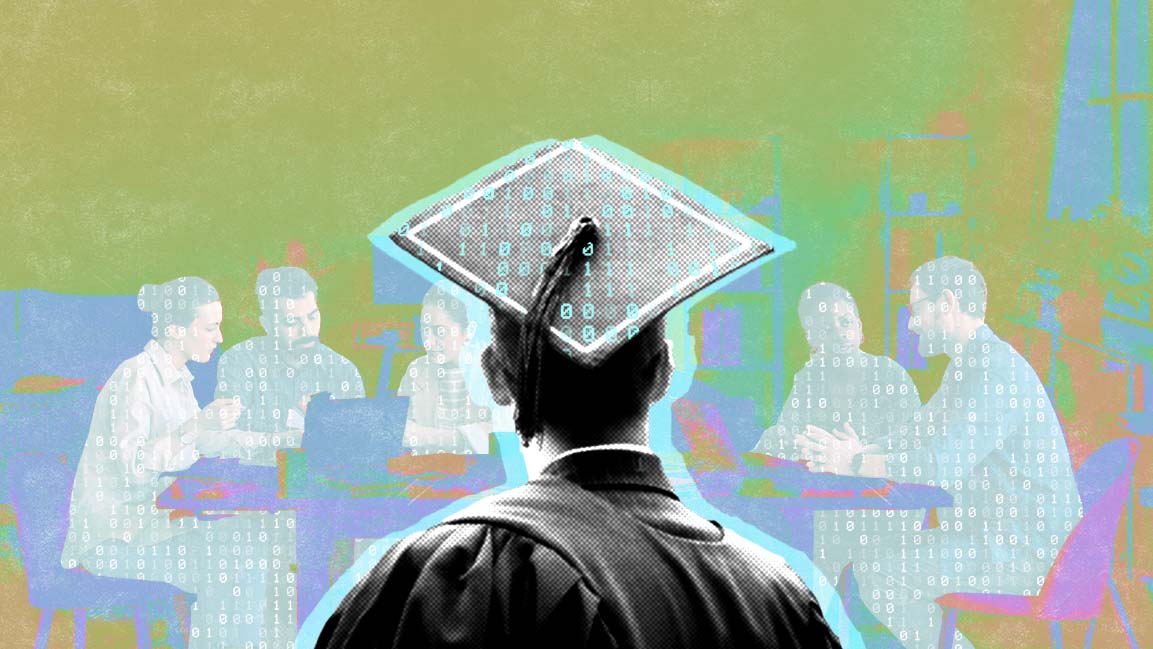


In June, a segment of America’s recent college grads showed they are not very fond of commencement speakers hyping up AI, which they see as a threat to their career prospects.
At graduation ceremonies, students jeered at speakers who praised AI. High-profile guests like Eric Schmidt, former Google CEO, faced this backlash at the University of Arizona.
Meanwhile, incoming college students worldwide are already wondering if their degrees will be valuable, given predictions about AI.
In the Middle East, the job market over the past few years has not been kind to graduates. The uncertainty about AI’s impact has made it harder for them to determine what they need to know to be successful.
Is higher education helping students handle this uncertainty? Are they changing how they teach to prepare students for the AI economy?
MOVING BEYOND KNOWLEDGE DELIVERY
Bernard Ghanem, Professor and Chair of the Center of Excellence for Generative AI at KAUST, says that because powerful AI tools are now widely available, universities need to do more than just deliver knowledge. They should help students build the skills needed for jobs in an AI-driven world.
“This specifically includes AI literacy, lifelong learning, real-world innovation, and adaptability. Universities or other educational institutions that quickly make this pivot will reap short- and longer-term benefits,” says Ghanem.
But colleges in the region “aren’t fast enough” in redesigning learning to stay relevant in a volatile job market, says Nirmal S. Chhabria, Professor of the Practice & Academic Director EMBA, Georgetown Dubai.
“Most curricula lag market realities by 2-3 years,” says Chhabria, adding that true redesign requires dismantling siloed departments and embracing continuous curriculum evolution. “The future belongs to schools willing to blur classroom and boardroom boundaries, where students solve actual business challenges rather than just focusing on theoretical ones.”
While the need to redesign how universities approach the rapidly evolving AI-first job market is a current challenge for educational institutions worldwide, there is no clear reference standard to follow, says Ghanem.
“However, this challenge is an opportunity for innovation and evolution. In fact, there are many ongoing efforts in the region and in the kingdom to exploit this opportunity.”
Several educational institutions, he says, including KAUST, are developing and implementing AI-first strategies to govern the effective and proper use of AI for learning and evaluation across various educational levels.
“For example, AI-specific programs and degrees are being offered in many universities, and AI literacy is being encouraged or, in some cases, mandated within curricula. Moreover, some universities are partnering with industry to encourage more industry-relevant learning with real-world course projects integrated within classwork.”
A WELL-ROUNDED EDUCATION AND CRITICAL THINKING
Having AI expertise is a lucrative specialty, but students still need a well-rounded education that emphasizes human-centric soft skills more than ever.
“As AI becomes better at processing information, the qualities that make us human become more valuable,” says Dino Varkey, CEO, GEMS Education, adding that creativity, empathy, communication, ethical judgment, leadership, and collaboration are increasingly the skills that will differentiate people in the workplace.
Emphasizing the need to balance technical skills with human-centric competencies, Prof. Nathalie Martial-Braz, Vice-Chancellor, Sorbonne University Abu Dhabi, says AI expertise divorced from judgment and ethical reasoning becomes dangerous. “The most sought-after professionals combine technical depth with humanistic breadth. Soft skills aren’t nostalgic luxuries; they are operative necessities. A data scientist without understanding human impact, or a legal technologist without ethical frameworks, creates unintended harm.”
The most successful individuals, adds Varkey, will be those “who can harness AI effectively while applying uniquely human insight, values, and decision-making.”
Chhabria, who hires people in private equity, startups, and now in academia, points out that technical AI skills can become outdated in just 12 to 18 months, while judgment, persuasion, and adaptability grow more valuable over time.
“AI handles computation; humans navigate ambiguity, stakeholder complexity, and ethical trade-offs. The workers who’ll thrive aren’t just going to be AI specialists—they’re thoughtful generalists who understand business, psychology, and systems thinking alongside technology.”
While critical thinking remains a university’s fundamental mission in the age of AI, Martial-Braz resists ranking skills in isolation. “Critical thinking toward what end? If we teach only knowledge, we lose the battle; if we teach how to think, students master adaptation, create tomorrow’s innovations, and remain vigilant against the biases of innovation. Critical evaluation of source credibility, algorithmic bias, and contested truth is urgent.”
She adds that the pedagogical imperative is “cultivating integrated analytical thinking combined with ethical awareness and adaptive capacity.”
Learning technical AI skills is valuable in the current job market, especially since AI tools are not perfect and still make mistakes—factual errors, hallucinations, and misalignment, says Ghanem. “Those with AI technical expertise will know why these mistakes persist and may have insights on how to fix them. It is imperative that these tools be used while also knowing their evolving limitations and accessible mitigation strategies. An AI tool is not a calculator, so its output should always be critically assessed by the user. Therefore, AI literacy, critical thinking, and proper experiential evaluation of AI usage should be skills instilled in students during their education journey.”
But as AI tools become more accurate and accessible to more people, Ghanem adds that educational institutions should place greater emphasis on human-centric skills, including critical thinking, creativity, and innovation; real-world evaluation through experience; and collaboration and communication skills.
He says, “Universities should focus on teaching AI literacy to all students and AI technical fluency to those interested, with lifelong learning skills being instilled early on, so ‘no student is left behind’ in the rapidly evolving job market.”
“Discernment is paramount—the ability to ask which problems matter, not just to solve problems efficiently,” says Chhabria. “AI excels at execution; humans must excel at question-framing. I push my students to challenge assumptions, interrogate data, and think systemically. In an AI economy, the rarest skill is knowing when not to use AI and understanding the consequences others miss. That’s discernment.”
COMPETENCY TRACKER AND REAL-WORLD ASSESSMENTS
In order for this approach to be successful, though, faculty need to provide students with authentic assessments, and students need a record of their expertise that will help them get hired.
“Competency frameworks and authentic assessment complement, rather than replace, traditional transcripts. Evidence of demonstrated capability is compelling to employers. However, meaningful competency tracking requires transparency about learning pathways, not just outputs,” says Martial-Braz.
For example, Sorbonne University Abu Dhabi is exploring hybrid models: structured evidence of real achievements alongside documented processes. “This requires robust frameworks, not checklist reduction. Employers need both what students can do and how they learned to do it,” adds Martial-Braz.
While college transcripts will remain an important source of information and evaluation for employers assessing incoming candidates, a solid technical background related to the field of employment is still an important factor, usually inferred from transcript grades.
However, it may no longer be the predominant factor in securing a job in the future, Ghanem says, since there is now greater emphasis on what an employee can do rather than only what they know. “With many candidates having a similar technical background, it will be imperative for students to show skills that distinguish them from others. Such distinction can be evidenced by practical experience deployed in real-world settings that align with the job market’s needs.”
Universities can help by offering more courses that focus on creative, project-based work that students can add to their resumes. They should also offer a wider range of elective courses so students can develop diverse skills and remain competitive in a fast-changing job market.
Encouraging students to participate in lifelong learning efforts through online training courses or MOOCs, as well as competitive activities such as hackathons and technical competitions, would also be useful. “In this aspect, it becomes essential that universities continuously engage with industrial partners representing various market sectors to understand their evolving needs and to modify course content, learning objectives, and offerings when deemed possible, appropriate, and timely,” adds Ghanem.
A HOLISTIC DEEP DIVE
Universities teach durable skills like problem framing, systems thinking, and communication. But inconsistent instruction makes these skills harder to master—and harder for graduates to demonstrate.
Experts say universities and colleges must be prepared to conduct a holistic deep dive into what learning objectives and skills need to be achieved, how teaching is conducted, and how learning is assessed.
“This strategic redesign needs to be implemented quickly and in an agile manner so that it can be adapted and modified as the job market evolves,” says Ghanem. “The timeliness of this process requires all stakeholders – universities as well as the public and private sectors– to be involved and nationwide coordination to be ensured for optimal and quick outcomes.”
The bigger question, says Varkey, is whether education is keeping pace with how work is changing. The future will reward adaptability more than credentials alone. “Schools and universities need to move beyond knowledge transfer and focus on developing problem-solvers, innovators, entrepreneurs, and lifelong learners. In an AI-driven economy, success will belong to those who can continuously learn, unlearn, and reinvent themselves as industries evolve.”
As it turns out, there is a straightforward way for higher education to make graduates more future-proof: focusing on teaching students durable skills that will see them through the future; tying assessments to outcomes; and tracking competencies rather than courses.
The future is not a choice between technical and human skills, says Varkey. It requires both. “The most successful individuals will be those who can harness AI effectively while applying uniquely human insight, values, and decision-making.”