- | 9:00 am
The UAE through the lens: telling the story of the changing urban landscape
Using photo archives, digital maps, and books, some photographers and cultural historians are documenting buildings that often go unnoticed.
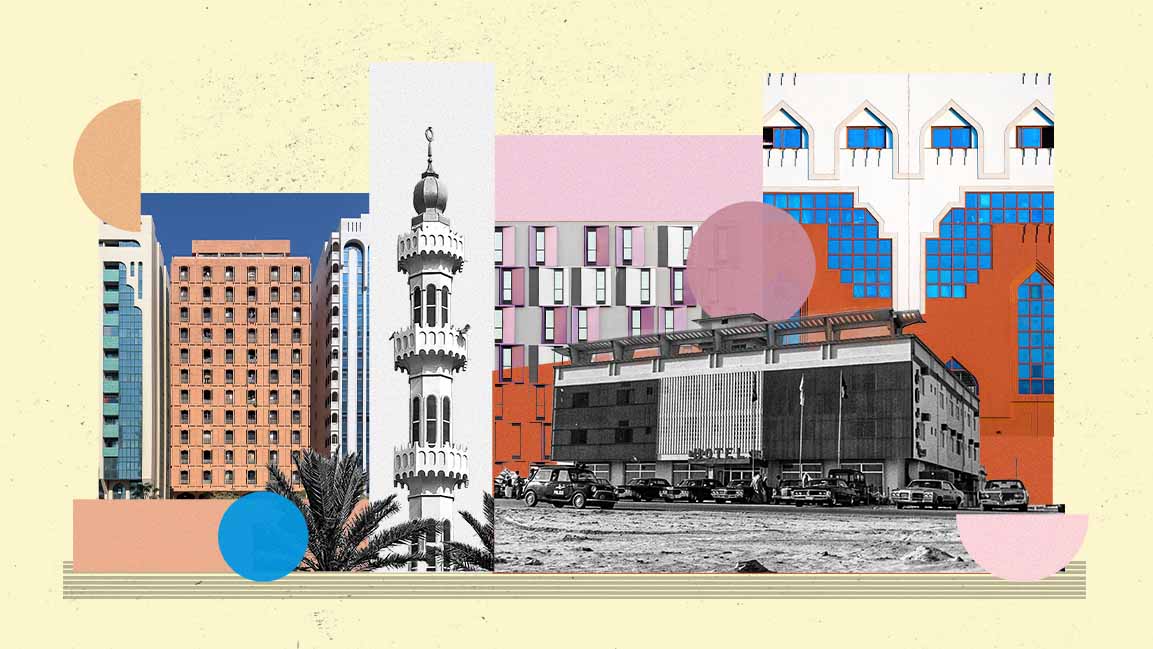


Across the UAE, skylines rarely stay the same for long. Residential towers, cultural districts, and transport infrastructure continue to shape how cities look and function.
As this happens, older parts often fade from sight. Housing blocks, municipal buildings, neighborhood mosques, and early shopping centers usually don’t get the same attention as new landmarks. Still, these buildings tell the story of the country’s shift from coastal towns to fast-growing cities.
Many date back to the 1970s and 1980s, a period of rapid expansion when governments invested heavily in housing, civic buildings, and commercial infrastructure.
With so much change happening, a few photographers and cultural historians are working to capture this heritage before it’s lost. They use photo archives, digital maps, and books to document buildings that usually get ignored.
DOCUMENTING ABU DHABI’S EVERYDAY BUILDINGS
In Abu Dhabi, international attention often focuses on headline projects and new developments. Yet much of the city is made up of everyday buildings that shape how residents experience it.
Architect turned photographer Jon Wallis hopes to redirect attention through his project, Everyday Icons. Wallis moved to Abu Dhabi in 2014 and worked as an architect on projects like the new cruise terminal at Mina Zayed and the restoration of Qasr Al Hosn. In 2020, he stepped away from architectural practice to focus on photography. The idea for Everyday Icons began with a building he passed on his daily commute, whose distinctive architectural details inspired him to photograph it.
“It made me think about the lack of attention paid to the majority of buildings in a city where icons and landmarks are the main attractions,” he says.
As he continued photographing similar buildings across the city, the project grew. What began as a series of social media posts gradually expanded into a larger archive, later supported by a website and interactive map that allows viewers to locate the buildings.
Wallis has documented 99 buildings across Abu Dhabi city, as well as in Al Dhannah, Al Bahyah, Al Ain, and Delma Island. Many are residential blocks, small commercial buildings, or civic structures that have blended into the city’s background.
“Most architecture in any city exists without much attention being paid to it,” he says. “But this doesn’t make it insignificant. For those who live and work every day in a city, it’s the ordinary everyday architecture that forms their city’s identity.”
Everyday Icons follows Abu Dhabi’s growth, from early housing and government buildings to becoming the UAE’s capital. “As the city expanded rapidly, architecture was a visible sign of growth and ambition. Each layer represents a different moment in the city’s development,” Wallis adds.
SHARJAH’S BUILDINGS AS A RECORD OF SOCIAL CHANGE
A similar focus on earlier urban development appears in Sharjah. Writer and curator Sultan Sooud Al Qassemi explores Sharjah’s architectural history in his book Building Sharjah, co-edited by Todd Reisz, which highlights buildings that shaped the city in the late 20th century.
The project started from a childhood memory.
“One of the main structures that drew me to document the modern architectural heritage of Sharjah was the Mothercat building on Al Wahda Street,” Al Qassemi says. The Lebanese construction company’s regional office featured a black cat on its façade, which had long caught his attention. “One day, out of nowhere, the building wasn’t standing anymore, and it gave me a great sense of sadness.”
That moment eventually led Al Qassemi to document the city’s changing landscape in his book Building Sharjah, recording buildings that were once widely recognized but later demolished or forgotten as the city developed. Some of this work can also be seen on Instagram.
The project also challenges the idea that only grand buildings deserve historical attention. Many of the buildings featured in the book were built for practical reasons, such as housing, civic buildings, and government offices that helped the emirate grow quickly.
“These ‘non-landmarks’ played an important role in the modern history of the UAE,” he explains, pointing to developments such as the 1000 Villas housing project in Al Ghubaiba, built to house a growing workforce during Sharjah’s early expansion.
“Their unique design features allowed houses to be constructed swiftly, accommodating the influx of teachers and other white-collar workers to the emirate,” Al Qassemi says. Such developments offer insight into the demographic and social changes that took place during the country’s early decades of growth.
Even when buildings cannot be preserved, documentation can maintain a record of their presence. “Not every building can be preserved, but we can try to maintain their memory to give people an understanding of their past and how their cities came to be,” he adds.
Al Qassemi hopes that younger residents who have never seen many of these buildings in person will still discover them through archives and find inspiration for their work.
SEEING DUBAI THROUGH ITS FAÇADES
Some researchers study architecture through archives and history, while others focus on visual documentation. Dubai-based photographer and designer Hussain AlMoosawi has spent years photographing building façades across the UAE as part of his ongoing project, Façade to Façade. You can see some of his work on his website and Instagram.
AlMoosawi’s interest in documenting urban types started when he lived in Melbourne. He photographed overlooked parts of the city, like construction hoardings and everyday streetscapes. After returning to the UAE in 2013, he kept documenting urban features, including modernist buildings built after the UAE’s unification.
“Initially, I focused on photographing ‘hero buildings,’” AlMoosawi says, citing the Burj Rashid (Dubai World Trade Center) – once the tallest building in the Middle East – as an example. But he soon realized there were only a limited number of such landmarks.
Now he photographs buildings that might look ordinary alone but show patterns when seen together, reflecting the character of a street, neighborhood, or city.
Over time, these patterns and place character became central to his work and shaped his project. He’s especially interested in 1970s–80s modernist architecture, a time when builders moved from traditional materials like coral stone and palm fronds to the new international style.
“That transition was shaped by regional influences and architects from the Arab world and Indian subcontinent,” he explains. Today, it expresses a distinctly modernist Arab identity linked to the UAE’s nation-building era.
Like Wallis and Al Qassemi, AlMoosawi views this work as a way to preserve the UAE’s modern architectural heritage, especially the transitional period that reflects the ambitions of a young nation.
By documenting both famous landmarks and lesser-known buildings, the project builds a visual archive of structures often lost before their significance is recognized. He hopes to create a data-driven, interactive archive in which geolocation and curated navigation tools will enable researchers and the public to explore and contribute.
Through photography, research, and publishing, these projects capture the country’s urban growth, help preserve shared memories, and ensure future generations can connect with buildings that might no longer be standing.