- | 9:00 am
The airline industry is ready for a creative reboot
Bernadette Berger, the director of innovation at Alaska Airlines, on how to make air travel feel a little more human.
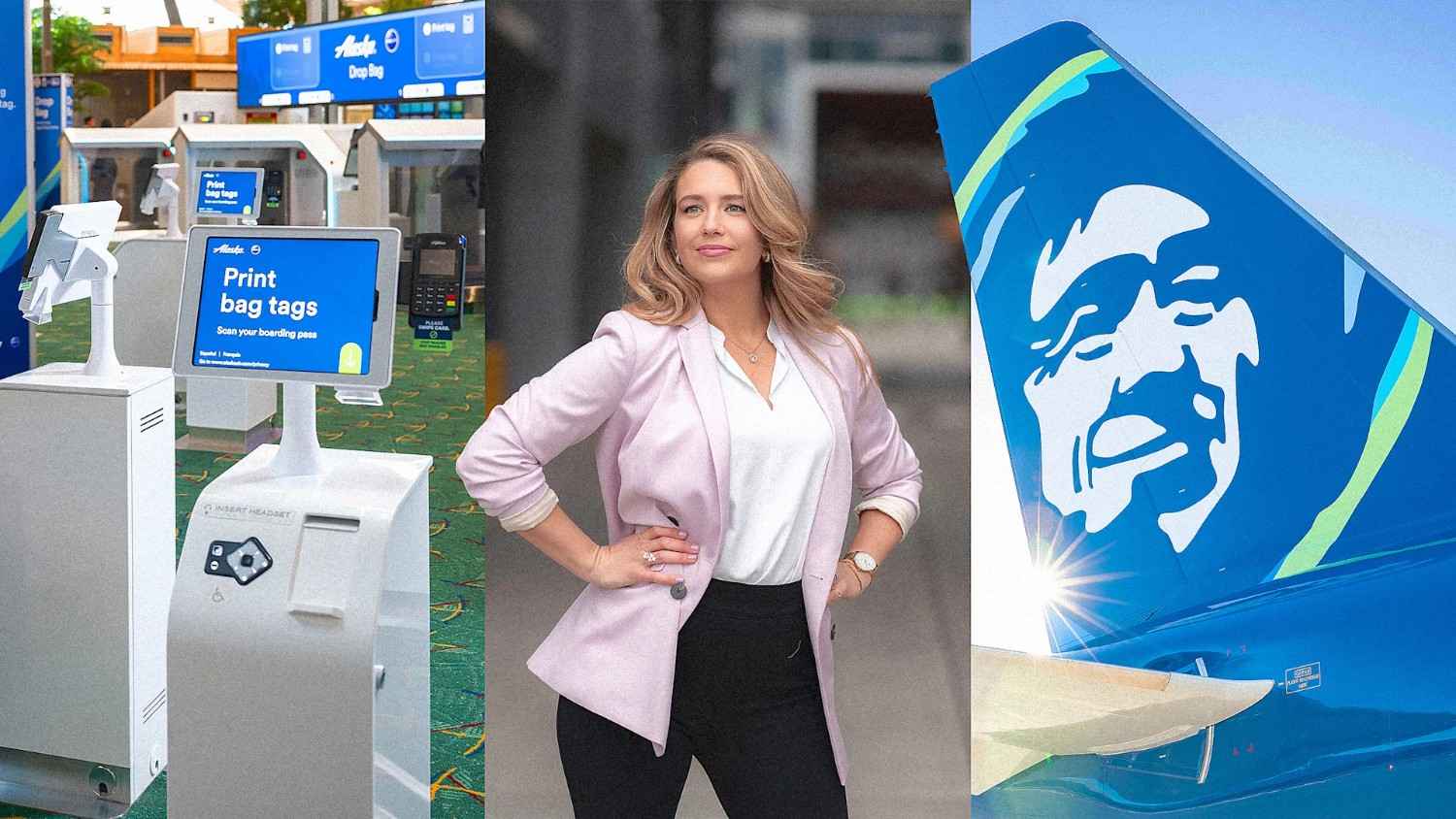


Bernadette Berger is the director of innovation at Alaska Airlines, where she leads transformative initiatives that reimagine the travel experience for guests and employees. With a background in industrial design and a career path that spans dance instruction, stage performance, UX, and more than a decade spent designing aircraft interiors at Teague, Berger brings a unique blend of creativity, human-centered thinking, and technical insight to the aviation industry.
Berger is on a mission to humanize travel. In my conversation with her, we discuss how design can foster dignity and independence in travel, and she shares how her team is using emerging technologies—like AI and automation—to solve aviation’s hardest problems, not just for today but for years ahead.
Have you always been a creative person?
Yes! This is actually my fourth career—I’ve had a jungle gym of a career instead of a ladder. My first career was as a dance teacher. I taught kids and adults how to dance, choreographed recitals, and did competitions. I learned a lot about teaching creative skills and mastery to people of all ages.
Then I thought, maybe I’d be a performer. So I was an actress for many years—musicals, eight shows a week, the whole thing. I learned to sing, act, and develop a very specific creative skill. But I remember one lighting tech rehearsal—I was standing there, waiting, and thought: I’m spending all this time fulfilling someone else’s creative vision. I think I could do this better. I want to be the one coming up with the creative ideas.
So I went back to school and fell into industrial design and spent many years designing airplanes. Now, working at an airline, I’m in a different role—but I’ve carried all those lessons with me.
![[Photo: courtesy Alaska Airlines]](https://images.fastcompany.com/image/upload/f_webp,q_auto,c_fit,w_1024,h_1024/wp-cms-2/2025/08/02-91382355-bernadette-berger.jpg)
[Photo: courtesy Alaska Airlines]
How did you find your way into the airline industry?
I studied industrial design at the University of Washington. At the time, industrial design was just starting to sneak into digital interfaces. It was the early days of what later became the entire UX design practice. I found myself leaning toward projects that had both physical and digital components—or some sort of spatial element with a digital layer.
That interest led to me connecting with the design consultancy Teague. For over a decade at Teague, I got to design aircraft interior architecture, which involves anything you touch, see, or interact with inside the airplane. I also got a chance to learn many other design skills: lighting design, audio design, haptics, materiality—all the ways I’d classify as experience design.
That’s what got me into travel. But the thing that’s kept me in travel is this: I think travel can be the best tool for fighting hate. It can be amazing for fighting discrimination, racism, xenophobia. It’s really hard to hate another group of people when you’ve experienced their culture—what they eat, how they move through their city, their town, their village—how they relate to one another. I love working in the travel space because it’s about connecting people.
Does that perspective influence your design?
100%. One of the jobs of a designer is to make sure you’re not designing for yourself—that you’re really walking a mile in the shoes of the end users you’re designing for. There’s no better way to learn how to design a travel experience for someone who doesn’t speak English than to go to a country where you don’t speak the primary language.
There’s no better way to learn how to design a better way to move bags around an airport than to go load bags for a full shift in the rain. You learn really fast when you experience those challenges yourself versus hearing about it secondhand or observing someone doing it. It changes the conversations you have, the ideas you think of, and the way you launch solutions.
![[Photo: courtesy Alaska Airlines]](https://images.fastcompany.com/image/upload/f_webp,q_auto,c_fit,w_1024,h_1024/wp-cms-2/2025/08/05-91382355-bernadette-berger.jpg)
[Photo: courtesy Alaska Airlines]
How has the airline industry adapted to experiential design and service design?
The ones that are adopting a user-centric approach wholeheartedly are the ones that are winning. It’s easy to see when decisions are made purely on what’s best for business without considering what’s best for humans. At Alaska and Hawaiian Airlines, care and customer care are central tenets of our business. Great customer care comes from our frontline employees.
If we’re not creating great tools and experiences for our flight attendants, pilots, and customer service agents, they won’t be able to be their best for our guests. There’s as much focus on creating a well-designed employee experience as there is on the guest experience because they’re so related to each other.
![[Photo: courtesy Alaska Airlines]](https://images.fastcompany.com/image/upload/f_webp,q_auto,c_fit,w_1024,h_1024/wp-cms-2/2025/08/03-91382355-bernadette-berger.jpg)
[Photo: courtesy Alaska Airlines]
What about designing for better interactions between airline staff and airport staff?
Absolutely. Guests are constantly handed off from airline staff to TSA and back. If you’re on an international flight, you may show your passport three times. We’re working closely with TSA to allow identity verification using your face or phone. Imagine not needing to dig out your wallet at bag drop, TSA, or the gate. This year, there will be 13 moments in the travel journey where you can use your face or phone instead.
What role does your team play in shaping travel experiences at Alaska Airlines?
As an airline, we look at how people are boarding in Asia, how guests take short flights in Europe, or how travel is booked in South America. We often examine our own industry, but as the innovation group, we also get to look outside of aviation. We’re trying to make the flight booking path as easy as buying something on Amazon. We want the day-of-travel experience to be as seamless and interactive as planning your day at Legoland or Disneyland. We study personalization from places like Sephora—their app, stores, and online experience.
We look both inside and outside our industry because the same traveler buying sunscreen on Amazon is coming to our airport with high expectations for personalization, seamlessness, real-time information, and self-service. Even though other companies don’t have the same constraints we do in flying people across the world, our bar still has to be just as high.
It sounds like senior executives are really invested in this. Did you have a lot of work to do to prove that this innovation group works?
Yes. Working on moonshot ideas is not for the faint of heart. It’s for people who get excited about what might be, and who aren’t held back by fear of what might go wrong.
Our job is to prioritize the really gnarly challenges that we face as an airline and then ask over and over: What would need to be true for this challenge to go away? What tasks can we do that are fast and inexpensive so we can learn more, whether it’s that a technology isn’t ready yet or that a process could be automated, or that we should communicate differently with guests?
We constantly ask ourselves: Are there different ways to tackle this problem? What are the hard-and-fast rules, and where can we think differently to get different results?
![[Photo: courtesy Alaska Airlines]](https://images.fastcompany.com/image/upload/f_webp,q_auto,c_fit,w_1024,h_1024/wp-cms-2/2025/08/07-91382355-bernadette-berger.jpg)
[Photo: courtesy Alaska Airlines]
What are some of the challenges that design has helped the airline industry overcome?
Design has helped more people travel. Historically, aviation was expensive and not accessible to everyone. But design has changed that. Now, more people can travel safely, independently, and with dignity.
Think about booking a trip—an airline, a hotel, a car, fun activities. Design helps deliver not just information, but the right, relevant information for each person. It helps guests who are blind, deaf, traveling with a service animal—it helps them enjoy travel with the same independence and dignity as anyone else. There’s still more work to do, but one of the major successes of design in this industry is making travel more accessible to more people.
How are you using AI in your work? Do you think AI can improve design’s contribution to the travel industry?
AI is a big part of our innovation strategy and really, almost every department’s strategy. It’s well integrated across the airline to elevate how we work. Right now, we’re using AI where it excels: looking at lots of data sources and synthesizing them for humans. AI is great at pattern recognition, prediction, detecting things, and using rules to make quick decisions.
We use AI for complex scheduling, improving safety, rerouting aircraft around storms, and in computer vision. It’s already being applied in machine learning and automation. But the next level I’m excited about is AI as your best team member where it helps humans make nuanced decisions, use intuition, and observe when automated processes are going wrong. That’s where we’ll start to see jobs improve in quality.
We’re currently using automation on the ramp to help move bags from plane to plane more effectively—especially with tight connections. AI can track bags, planes, and people, and find the best routes for bag transfers. That frees up human ramp agents to focus on the complex problem-solving they’re experts in.
You work with both creative and noncreative people. How do you motivate them—especially people who don’t consider themselves creative?
I have a spicy take. I believe, deep in my soul, we are all creative. Creativity is a form of problem-solving—a trial-and-error process. My heart breaks when people say, “I’m not creative.” I want to say, “Who told you that?” Because almost everyone I work with is a great problem solver. They may use analytical tools, but they’re still making creative choices.
How do I motivate people? A lot of it is looking at problems from a different perspective. Asking, What if? What would need to be true for this to work? When you invite people into that way of thinking, they can contribute using their own methods—sketches, words, process flows, or whatever it may be.
The killer of creativity is fear—fear of embarrassment, fear of failure. Most of what we try doesn’t work out, but we learn so much from the process. That’s the point. To me, that’s creativity.
What advice do you have for aspiring designers—especially students?
I used to teach at the University of Washington, my alma mater. I loved seeing lightbulbs go off when students finally got something. I’d assign them to go somewhere and experience a challenge firsthand. Want to design for a user group? Be that user for a day. Don’t just observe them.
If you’re ambitious and want to be a senior designer or creative director, spend time around those people. Watch how they carry themselves. Learn from their presence. One of my mentors walked into a room with confidence—heels clicking, bag down, commanding attention. You can’t learn that on Teams.
So my advice is to get in front of people in real life. Experience what they experience. Sit with coworkers. Build bonds. Learn from mentors—how to be and how not to be. That all requires showing up in person. Working from home is efficient—and I love the flexibility with my kids. But creative teams need bonds. You need trust to have honest conversations about work without it feeling personal. You have to apologize when you mess up—be transparent. When I show vulnerability, my team can too. Vulnerability is a requirement for trust.

Featured Videos
Today's Top Stories:
More Top Stories:




FROM OUR PARTNERS