- | 9:00 am
What it means to be “Made in UAE” in beauty
UAE beauty has an edge in fragrance, climate-aware formulas, and diverse consumers. Its credibility depends on local R&D, testing, and manufacturing.
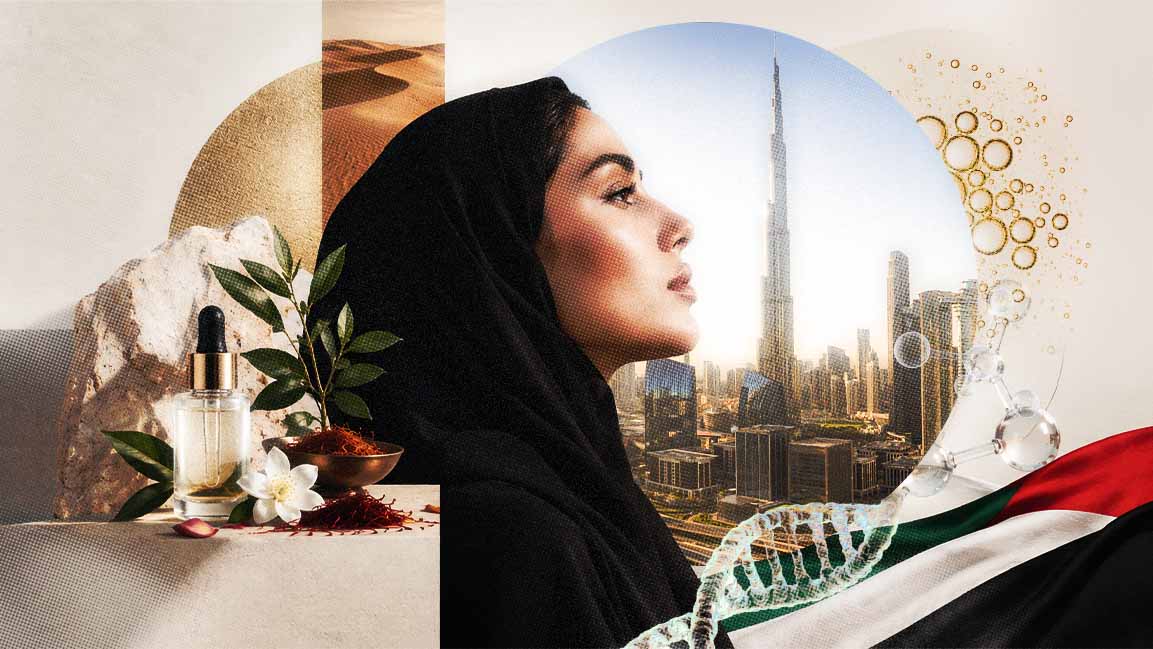


France and South Korea have made country of origin mean something specific in beauty. France’s reputation draws on perfumery, pharmacy, and long-established houses, while Korea’s grew through fast-moving formulation, specialized manufacturing, and a coordinated export ecosystem. In both cases, a label alone tells the consumer what to expect before they have tried a single product.
Now, the UAE is considering whether it can do the same. The country is weighing whether its unique climate, diverse consumers, and drive for innovation will work in its favor or make the path harder. Its fragrance heritage and fast-growing exports give it a head start, but a strong regional market does not automatically translate into global credibility.
Brands, formulators, and manufacturers across the region are asking what it would take for “Made in UAE” to signal quality, science, and desirability, and not simply the place where a product was filled or packed.
THE PROVENANCE PREMIUM
What does it take for a beauty product made in the UAE to reach the same level of recognition as products from established beauty markets? Faiza Hussain, Director of The Skin Shrink and Head of Research and Product Innovation at NEX Skincare, says these markets earned their reputations because consumers expect something special. “France built up its standing through perfumery and dermocosmetics, which were driven by the pharmacy sector,” she explains.
In contrast, South Korea has created a unique approach to product formulation. The country is known for rapid innovation, advanced product textures, and a government that supports the cosmetics and personal care industries as key exports by encouraging innovation through regulation.
The UAE will only gain real credibility when ”Made in UAE” means more than just filling or packing a product. According to her, it should show that the expertise, testing, and innovation all come from within the country.
For this to happen, manufacturing, formulation, and product validation should all be carried out in that country, not just assembly.
Hussain says there are two main opportunities. The first is in the fragrance industry. The UAE is now among the world’s top ten perfume exporters by value, and its fragrance exports have grown nearly sevenfold in the past decade.
The other possibility is what she calls climate-adaptive beauty, a field that is not yet well developed but has potential. Since the country experiences intense outdoor heat, high levels of ultraviolet radiation, humidity, and many air-conditioned indoor spaces, it is difficult to formulate products for this environment.
Others see the main issue as consistency rather than category. At its origin, Kathryn Jones, founder of KJ Serums, believed the key was consistency rather than marketing. “Made in France and Made in Korea earned their reputations after decades of brands maintaining the same standards, until consumers stopped questioning them,” she says.
The UAE, Jones says, has what it takes to progress faster than most people expect: “genuine scientific credibility, serious investment in manufacturing and an increasing number of brands created by founders who actually understand the product, not merely the marketing.” However, she says the missing piece is not quality, but “time and a shared story which UAE brands tell jointly rather than individually.”
Ece Baltaci Mallak, Founder of SADE, agrees that reputation is built slowly. “France and Korea didn’t earn that reputation through marketing. They earned it through decades of formulation expertise, strict regulation and a local consumer who is hard to impress,” she says. The UAE, she notes, already has the third part: “the consumer here is one of the most educated and demanding in the world.” What is still missing, she adds, is “depth behind the label: local R&D, testing infrastructure and talent in cosmetic chemistry.”
In her view, the first wave of equity will come from “designed in the UAE,” meaning “the point of view, the edit and the understanding of the customer.” “Made in the UAE,” she says, “follows when the ecosystem catches up.”
For Máire “Mo” Morris, Founder and CEO of Morris Global Consulting, the UAE can build up its own equity, but “the quality, formulation, manufacturing standards and brand experience have to match or exceed global benchmarks first consistently.”
BEAUTY UNDER PRESSURE
The case for a distinctive UAE beauty proposition, in Jones’s view, starts with the weather and ends with whether the product can actually back it up. “The UAE’s real advantage is that it’s one of the hardest climates in the world to formulate for,” she says, with extreme heat, humidity, and constant air conditioning creating stress-test conditions “that most global brands never have to consider.”
That, she argues, is a strong story, but only if the performance supports it. “Price competing alone won’t build a lasting brand. The proposition has to earn the premium.”
The UAE’s most underrated beauty asset, Morris argues, is its consumer base. “We have an incredibly international consumer base, sophisticated beauty customers, significant luxury consumption and exposure to trends from Europe, Asia, the US and the wider Middle East,” she says. “That creates an extraordinary testing ground for brands.”
Internationally, however, performance and quality still have to stand up against the best products globally. Price, she adds, is less of a lever at the premium end, but “the value proposition has to make sense.”
Mallak agrees that the customer is the story and that price is the wrong fight. Competing on it, she says, “is a race you lose against brands with ten times your scale.” The UAE’s real proposition, in her view, is the woman buying: “multicultural, well travelled,” living in extreme heat with access to every brand in the world, so “she edits ruthlessly.” A brand that wins her, Mallak says, “has already passed a very hard test,” which makes for a credible story to take abroad, but only if the product performs. “Provenance opens the door,” she says. “Performance is what gets the second purchase.”
The UAE’s distinctive beauty proposition, Hussain says, is not price. “Fragrance is a top category in the region and is setting trends globally,” she notes, pointing to a market that has already demonstrated it can compete commercially but arguing that price alone is “a door, not a home.”
The real proposition, in Hussain’s view, combines three things: “a fragrance-native culture, climate-adapted performance and one of the most diverse consumer bases on earth living in a single city.”
Layering, perfume oils, bakhoor, and hair fragrance were daily rituals in the Gulf long before they became global trends, and the advantage comes when brands pair that heritage with genuinely advanced science, carrying ingredients “in modern delivery systems and technologies with storytelling rooted in heritage and innovation.”
THE R&D IMPERATIVE
Science, formulation, and product innovation are non-negotiable. “Beautiful branding might secure the first purchase, but formulation and performance determine whether you have a sustainable business,” Morris says.
Consumers today are more informed and quick to speak up when products disappoint. For UAE beauty brands aiming for international credibility, “investment in R&D, formulation, testing, manufacturing standards and genuine product innovation needs to sit alongside the investment we’re already seeing in branding and marketing.”
Hussain also sees science as key to building international credibility. She says, “Heritage opens the door, but science keeps you in the room.” This involves backing up claims with evidence, testing product stability under real-world conditions, and preparing for regulations in markets like Europe, where stricter fragrance-allergen labeling is required before shipment.
Mallak says that evidence matters most because international consumers “have no reason to give a new origin the benefit of the doubt.” A French or Korean label, she notes, “gets trust on day one,” while a UAE brand has to “earn it product by product.” That means “formulas that do exactly what they say, with honest claims and nothing overstated.”
Innovation, in her view, is not about adding complexity. “It doesn’t mean more steps or more actives,” she says. “It means doing more with less: multifunctional products that hold up in real conditions, in a routine a woman will actually finish.”
Jones says international consumers are skeptical by default of a new market, “so the science has to speak first.”
She says that brands earn real consumer trust when they can explain “why an ingredient or a formulation choice was made and what problem it’s actually solving.” Without this, Jones adds, “a UAE brand is just another pretty package.”
THE BEAUTY EXPORT
The most common mistake Middle Eastern beauty brands make when looking outward, Jones says, is trying to appeal to everyone at once. “A lot of regional brands do very well locally, then dilute what made them special the moment they look outward,” she says.
The second mistake is treating international expansion as a distribution exercise rather than a trust-building one. “You can’t just ship the product overseas; you have to bring the story and the science with it.”
Hussain identifies four mistakes that can prevent regional brands from leaping to global recognition. The first is mistaking virality for brand equity: “the ‘dupe’ economy has been an extraordinary customer acquisition engine, but you can’t build provenance on another house’s DNA.”
The second is using heritage as decoration, with oud or frankincense on the front of the pack at trace levels, which, in her words, is “the fastest way to lose a sophisticated, ingredient-literate consumer.” The third is treating regulation as paperwork.
Due diligence needs to align with regional regulations to support future international expansion.
The fourth mistake is assuming that a region is a single market. “The UAE and Saudi Arabia aren’t interchangeable, and neither are London, New York, Malaysia, and Seoul,” she says. “The work that earned loyalty at home must be done again, market by market.”
Mallak agrees that what worked at home cannot simply be carried over, and adds four pitfalls of her own. The first is “launching too many products too fast,” because “a long range hides a weak point of view.” The second is relying on “founder or influencer visibility instead of building a brand that stands without them.”
The third is assuming the regional story translates as-is. “What reads as luxury here can read as generic elsewhere,” she says, “so the brand needs a clear idea that works in any language.” The last is “scaling before the operations, compliance and claims are ready for stricter markets.” As she puts it, “Global retail is unforgiving on those details.”
On climate as a source of innovation, Hussain says that brief is already taking shape. Founders and manufacturers are developing cooling formats including body and hair mists, alcohol-free perfume oils, and gels using low-odor cooling agents, while hybrid formats defined in the region, “fragrance that behaves like skincare and skincare with a real fragrance strategy,” are beginning to be exported.
The biggest mistake regional brands make, Morris says, is assuming success at home automatically translates to success abroad. “A brand entering London, Paris or New York is entering an entirely different competitive environment,” she says. “The consumer, price architecture, regulations, distribution, margins and competitive set all change.” International expansion, in her view, needs its own strategy and on-the-ground partners. “It can’t simply be an extension of what worked at home.”
Morris sees products developed for extreme heat, humidity, intense sun exposure, and heavily air-conditioned environments “have relevance far beyond the UAE.”
Add an exceptionally diverse population with different skin tones, hair types, and beauty routines, and you get “a very interesting environment in which to develop and test products.” The advantage, she argues, is only realised if brands use that diversity intelligently, “rather than treating it simply as a marketing story.”
THE ORIGIN EFFECT
The trust signals, Hussain says, are already visible. “International buyers are flying into the UAE to buy fragrances, global brands are formulating and introducing new formats developed specifically for the consumer here and global groups are investing in Gulf fragrance houses,” she says.
The definitive sign, however, will come when “formulated and tested in the UAE for the UAE” serves as a performance promise, as Korean skincare has become shorthand for “glass skin performance, texture and innovation.” The ultimate measure, she adds, will be “when the global industry starts reverse-engineering our habits, instead of the other way round.”
Mallak sees the same shift, starting with the customer. The clearest sign, she says, is “when a customer in London, Paris or Seoul chooses a product partly because it comes from the UAE, and not in spite of it.” On the industry side, the practical signs will be “international retailers seeking out UAE brands as a category rather than as one-off listings, and global brands opening R&D or formulation centres here to be close to this consumer.”
“When the origin shows up on the front of the pack because it adds value,” she says, “the label has become equity.”
The moment Made in UAE begins communicating “an expected standard of quality, innovation and performance before the consumer even knows the individual brand,” Morris says, it will have become genuine brand equity.
For Jones, the real change comes when Made in UAE becomes “a reason to trust the formulation before you’ve even tried it, the same instinct people have with Made in France or Made in Korea today.”