
- | 8:00 am
Quantum computing is about to get a lot more real
A surge of funding and federal action is giving the once-futuristic technology a more immediate role in everything from business to cybersecurity.
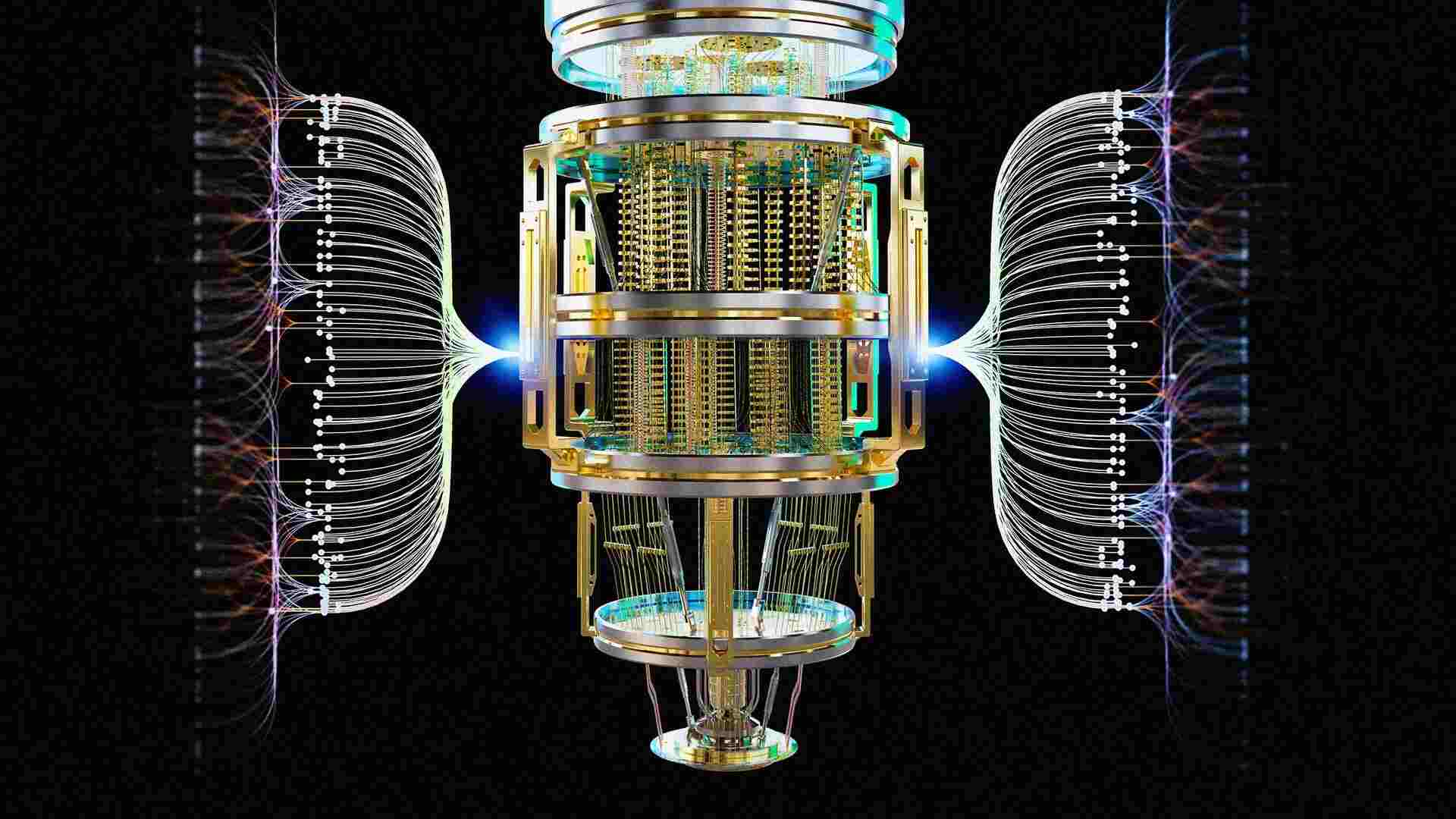


Just as AI has its dreams of “AGI” and “superintelligence,” quantum computing has its own north star: broad, practical quantum advantage over traditional supercomputers.
The quantum industry’s goal is to build a large-scale, fault-tolerant quantum computer powerful enough to solve hard, economically valuable problems in fields such as chemistry, materials science, and drug discovery. Recent progress suggests the technology may be moving closer to that point. The question is whether quantum computers can finally emerge from the lab and demonstrate superiority over conventional machines in practical applications that matter.
Why qubits are so hard to scale
Conventional computers store information as bits, represented as either 0 or 1. Quantum computers use qubits, tiny physical systems that behave according to the strange rules of quantum mechanics. Qubits can exist in multiple states at once, allowing them to represent more complex mathematical information than zeros and ones alone. Through entanglement, the state of one qubit can also be linked to the state of another, allowing quantum systems to encode even more complex relationships.
That promise comes with a major engineering problem. Qubits are highly sensitive to their environment, making it difficult to keep them in a coherent state long enough to perform useful computations. Many quantum systems keep qubits at temperatures just above absolute zero (minus 273.15 degrees Celsius, or minus 459.67 Fahrenheit) to slow their movement and reduce interference from environmental noise.
Some quantum developers, including Google, have focused on systems that use additional qubits for error correction. Researchers believe quantum error correction is possible, but building systems that can detect and correct errors in real time, while scaling to many more qubits, remains one of the field’s central challenges. Solving that problem could make quantum machines accurate and powerful enough for commercially important work.
Money is pouring in
Investors are betting that moment is getting closer. A recent PitchBook report found that venture capital investment in quantum computing reached an “inflection point in 2025,” with $3.9 billion invested across 125 transactions, the highest annual total on record.
Even though quantum computing remains nascent, 2026 has brought a wave of public-market activity. Quantinuum’s June 2026 IPO raised $1.68 billion at a valuation of between $14 billion and $15 billion. Xanadu Quantum Technologies, Infleqtion, and Horizon Quantum went public earlier in the year, while Pasqal, IQM, Terra Quantum, and Seeqc each announced IPO plans. Before this year, a handful of quantum companies, including IonQ, Rigetti Computing, D-Wave Quantum, Quantum Computing Inc., and Arqit Quantum, had gone public through Special Purpose Acquisition Companies.
What’s accelerating quantum now
Capital is only one accelerant. The generative AI boom is also helping quantum developers move faster. Artificial intelligence coding tools are helping scientists accelerate the development of materials and components used in quantum designs, says Heather West, an analyst at IDC. That, in turn, is shortening the timelines on product road maps.
Industry consolidation has also helped, often by bringing different parts of the quantum stack under one roof.
“You’re bringing a lot of that knowledge into one house as opposed to keeping it isolated,” West says. “So you would have a quantum software vendor over here and then you’d have a quantum hardware vendor over there, but they weren’t necessarily underneath the same roof, and therefore it was hard to develop the technology when you have all these subtechnologies that also need to be developed.”
The federal government is also using its own levers to push quantum forward. On June 22, the White House released two executive orders (EOs) concerning quantum computing. One directs federal agencies, including the Energy Department, to collaborate with private companies and academics to deploy a quantum computer capable of conducting scientific research by 2028. The other directs agencies and security experts to prepare for quantum systems that could break standard encryption sooner than expected, with the goal of protecting critical infrastructure from quantum-enabled attacks.
In May, the Commerce Department said it would award $2 billion in grants to nine quantum computing companies in a bid to accelerate the commercial and national security value of quantum machines. In some of those deals, the government will take minority equity stakes in the companies.
Some of the government’s goals may be aspirational, but they still set a marker. They show that Washington takes quantum seriously and sees the technology as mature enough to present both security threats and commercial opportunities within the next few years.
“People sometimes think of quantum just like how they think of [nuclear] fusion–that it’s always like 10 years away, which is not true,” says Abhishek Chopra, CEO of the quantum-inspired software developer BQP. “The way this EO talked about commercialization being a big focus, it already says that we don’t have to wait for one or two things—like the Q-Day, post-quantum cryptography type of things—and judge the field of quantum just on that. There is so much that can be done right now.”
BQP’s algorithms, for example, run on existing graphics processing units (GPUs) and central processing units (CPUs) and can sharply reduce the time needed to run safety modeling and simulations for large aerospace companies, Chopra says. That can shorten development cycles for products such as commercial jets or rockets, sometimes by years. Faster simulation can also give engineers more time for design iterations in aerospace, defense, automotive, chemistry, and biopharma. Microsoft, Fujitsu, and Hitachi are also developing quantum-inspired algorithms for logistics, scheduling, and finance. BQP eventually plans to develop algorithms that incorporate quantum computers as the machines mature.
Quantum ideas are already spreading
Quantum’s influence can be felt beyond quantum computers themselves.
Some companies are developing “digital annealers,” specialized silicon systems that solve optimization problems using ideas borrowed from quantum annealing. Annealing systems use unusual quantum states to quickly search for the best solution among many possibilities.
Several startups, including Extropic, along with academic groups, are building chips that use probabilistic bits, or “p-bits,” instead of qubits. These complementary metal-oxide semiconductor (CMOS) chips mimic some behaviors of quantum annealers while operating at room temperature.
Quantum research is also influencing AI infrastructure. Large AI workloads must be distributed across many GPUs and CPUs, making fast data routing critical. Companies including Nvidia, Broadcom, and Marvell Technology have borrowed photonics techniques used to control qubits to move AI data through light waves with greater speed and power efficiency.
The Q-day problem
Quantum’s rise carries serious risks. The biggest is that quantum computers will likely become powerful enough to crack the public-key encryption systems that protect bank accounts, military secrets, cryptocurrency infrastructure, and much of the modern internet. Cybersecurity experts call that eventuality “Q-day.”
IDC’s West says “Q-day” is a real concern, though its urgency depends on who you ask. CIOs and cybersecurity officers at Fortune 500 companies are aware of the threat, but many view it as a medium- or long-term problem, especially as they wrestle with new data-security risks posed by increasingly powerful AI models such as Anthropic’s Mythos and OpenAI’s GPT 5.6.
The White House and national security agencies are more worried about the possibility that a hostile state actor could use quantum computers to steal secrets or wreak havoc by breaking the encryption that secures financial systems and critical infrastructure.
For real this time?
Whether the main driver is fear, greed, or both, the quantum sector feels different in 2026. That matters because the field has been through waves of hype before.
“I’ve seen all the ups and all the downs, and around 2020 or 2021 all of a sudden we saw this increase in capital investment spending,” West says. “At that point this was supposed to be the next hot new technology that was coming up, and the vendors were saying that in two years we’re going to be able to do all these amazing things with it.”
At the time, the quantum story was still technologically complex and difficult for outsiders to understand. The breakthroughs needed to move the field forward, including stabilizing and scaling qubits, kept receding into the future. Investors understandably shifted their attention to technologies with a clearer near-term payoff, especially AI.
This time may be different.
“I think what you’re seeing this year, the number of acquisitions and mergers that you’re seeing, the number of IPOs that have gone through or are still in the process of going through, the government investments, I mean, I think we’re seeing something totally different,” West says. “And I think within the next year to two years, this is just going to take off.”