- | 9:00 am
The Gulf’s next megaproject isn’t a city. It’s reinventing digital infrastructure for extreme heat
For years, digital technology was discussed as if it existed independently of physical constraints. The AI boom is exposing a different reality.
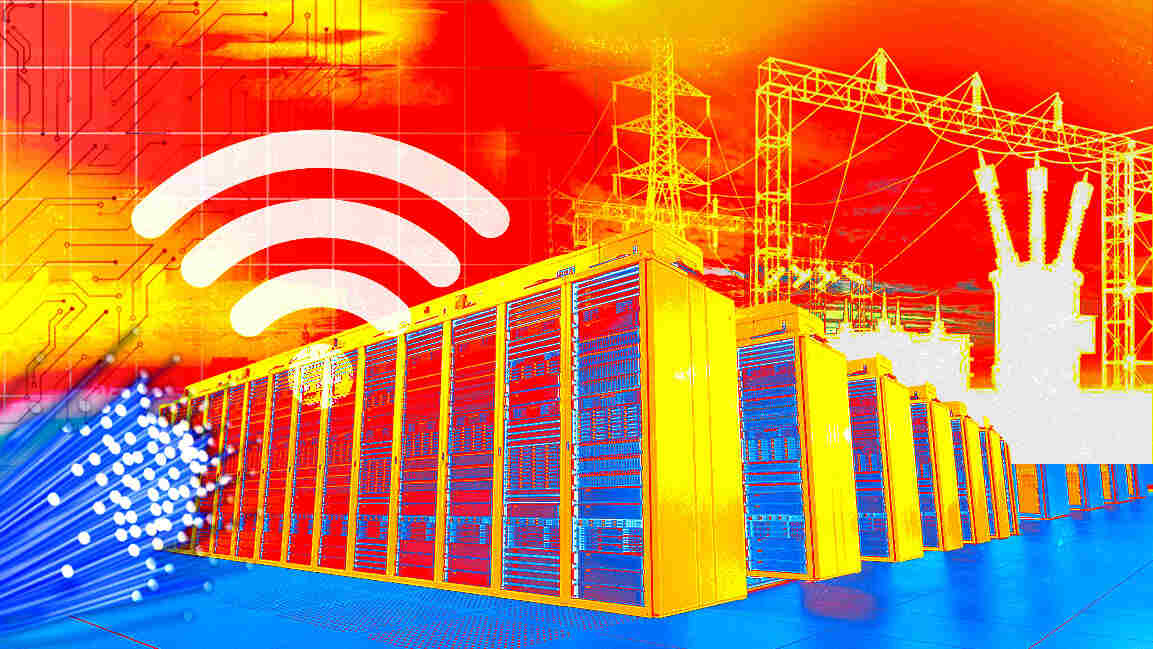


The Gulf has spent decades building airports, ports, financial centers, and megacities. Its next great infrastructure challenge may be less visible: creating the physical foundations of artificial intelligence in one of the world’s harshest operating environments.
As countries race to become AI leaders, success will depend not only on algorithms and chips, but on something more fundamental—electricity, cooling, water, connectivity, and resilience.
But AI depends on physical infrastructure, which has its limits. Data centers require vast amounts of computing power, electricity, cooling, and connectivity. In a region defined by extreme heat, water scarcity, and rising energy demand, building the base of the AI economy is becoming as much an environmental challenge as a technological one.
The urgency is only growing. The International Energy Agency projects that global electricity demand from data centers could more than double by the end of the decade, driven largely by AI. At the same time, Gulf countries are investing aggressively in hyperscale facilities, cloud infrastructure, and sovereign AI capabilities as they position themselves for the next phase of digital growth.
As a result, questions such as how much electricity is available, how cooling works in extreme heat, and how effectively resources are used are now key to staying competitive in the digital world.
THE PHYSICAL REALITY OF AI
For years, digital technology was discussed as if it existed independently of physical constraints. The AI boom is exposing a different reality.
“AI is often discussed as something virtual and weightless, yet every AI interaction depends on very physical infrastructure: storage devices, cooling systems, energy, land, and water,” says B.S. Teh, Executive Vice President and Chief Commercial Officer at Seagate.
“Behind every AI-generated response, recommendation, or insight is an ecosystem of a physical infrastructure stack, from compute to storage to energy to cooling, working together to make it possible.”
That reality is particularly relevant in the Gulf, where environmental conditions directly influence how infrastructure can be designed, powered, and scaled.
AI workloads require significantly more computing power than many traditional digital services. More computing power generates more heat. More heat requires more cooling. More cooling requires additional energy and, depending on the design, substantial water resources.
THE CLIMATE CONSTRAINT
The defining challenge is heat.
AI workloads require densely packed computing equipment operating continuously at high performance. The more computing power deployed, the more heat is generated. The more heat generated, the more energy is needed to remove it.
In cooler climates, operators can sometimes take advantage of lower ambient temperatures to reduce cooling requirements. In the Gulf, where summer temperatures routinely exceed 45 degrees, that option is far more limited.
As a result, cooling is rapidly becoming one of the most important design considerations in the AI era. Operators are increasingly investing in liquid cooling systems, direct-to-chip cooling technologies, and AI-driven optimization tools that can improve efficiency while maintaining performance under extreme conditions.
Water scarcity presents another constraint. Many conventional cooling systems rely heavily on water, creating a difficult challenge for some of the world’s most water-stressed countries.
As digital infrastructure expands across the GCC, operators are exploring closed-loop cooling systems, higher-density architectures, and alternative cooling approaches designed to reduce freshwater consumption while supporting growing computing demand.
THE ENERGY QUESTION
The conversation around AI often focuses on chips and computing power. The more fundamental issue may be electricity.
AI data centers are becoming some of the most energy-intensive facilities in the modern economy. As countries pursue ambitious AI strategies, ensuring a sufficient and reliable power supply is becoming a strategic priority.
This creates a new intersection between digital policy and energy policy. The future competitiveness of AI ecosystems will depend not only on access to advanced computing infrastructure but also on the ability to provide resilient, affordable, and scalable electricity.
For Gulf nations, the challenge extends beyond simply generating more power. It is about building digital infrastructure that can grow sustainably without placing increasing strain on energy and water resources.
RESILIENCE BY DESIGN
Climate resilience extends beyond heat, water, and energy.
Dust remains a persistent operational challenge across much of the region. Airborne particulates can affect cooling performance, increase maintenance requirements, and shorten equipment lifespans. Solar installations can also suffer efficiency losses when panels become coated with sand and debris.
The issue underscores a broader reality: infrastructure rarely fails because of a single factor. It fails when multiple pressures accumulate simultaneously.
A resilient digital ecosystem must be capable of operating through extreme temperatures, environmental disruption, fluctuating demand, resource constraints, and evolving security risks, all while supporting increasingly complex AI workloads.
That reality is changing how organizations think about resilience itself.
“What we’re seeing is a shift from reactive business continuity to proactive business continuity,” says Sahem Azzam, President IMEA & Inner Asia at Orange Business. “I don’t wait for things to happen so I can react. I want to make sure I’m proactive and can anticipate what’s happening.”
That shift requires infrastructure that can adapt quickly to changing conditions.
“Whatever is going on in the region, honestly, nobody can predict at the moment,” Azzam says. “You need to build an agile, vendor-agnostic infrastructure that will help you scale up or scale down quickly.”
The emphasis is increasingly on adaptability.
THE RISE OF HYBRID RESILIENCE
The same pressures reshaping physical infrastructure are also changing how organizations think about data, connectivity, and continuity.
“What we have seen recently has pushed GCC countries to rethink how we look at data sovereignty in the region and whether we should be more flexible about that,” says Azzam.
He describes the shift as “hybrid data sovereignty”—an approach that mirrors the evolution of cloud computing itself. Just as enterprises moved from fully private infrastructure toward hybrid cloud environments, organizations are increasingly seeking a balance between sovereign control and operational flexibility.
“They need faster access and a more agile approach to moving data to ensure business continuity,” he says.
The shift is being driven not only by resilience concerns but also by practical realities.
“There’s a scarcity of resources,” Azzam says. “Organizations need to tap into different markets to enjoy the capabilities of infrastructure and talent while ensuring business continuity.”
The result is a more distributed approach to digital infrastructure; one designed to prioritize flexibility, resilience, and access rather than relying exclusively on centralized environments.
CONNECTIVITY BECOMES CRITICAL INFRASTRUCTURE
As AI expands across industries, the role of connectivity is evolving as well.
For decades, connectivity was viewed primarily as a technology service, but it is increasingly a foundational utility that underpins economic activity.
“Network is becoming another utility,” says Azzam. “Like water or electricity.”
The comparison reflects how deeply digital infrastructure has become embedded in everyday life. From banking and government services to cloud platforms and AI-powered applications, nearly every aspect of the modern economy depends on continuous connectivity.
As organizations adopt hybrid cloud environments, distributed infrastructure models, and AI-driven services, the ability to move data seamlessly and securely across networks is becoming just as important as the infrastructure that stores or processes it.
THE GULF’S ADVANTAGE
There is a paradox at the heart of the Gulf’s digital ambitions.
The same tough environment that makes it hard to run infrastructure may actually help the region get good at building it.
Extreme heat is accelerating innovation in cooling. Resource constraints are encouraging new approaches to resilience, infrastructure design, and operational flexibility.
“This region is one of the first adopters and pioneers in adapting new technologies,” Azzam says. “They are brave in adopting technology and showcasing to the world that we can really implement things and make them happen.”
As AI infrastructure expands globally, many regions may soon face challenges that Gulf operators are already addressing–building a new model for operating digital infrastructure in a climate-constrained world. The lessons learned in the Gulf might help shape how this infrastructure is built everywhere.