- | 10:00 am
What LEAP has learned from five editions of exhibitor data
Annabelle Mander and Basma Dawwas on the preparation, follow-up and year-round strategy that separates LEAP's long-term winners from its one-time attendees
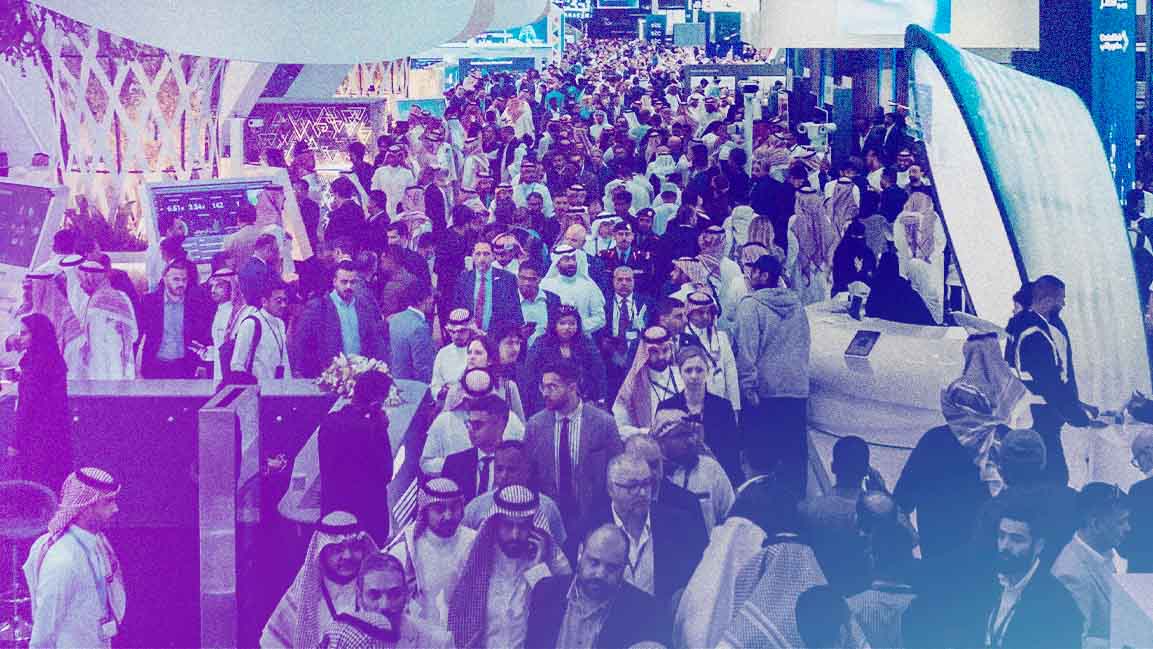


Exhibitors at large technology conferences tend to operate on a fairly intuitive theory that a bigger stand near the entrance will translate into more meetings and, eventually, more revenue. Tahaluf, the company behind LEAP, has spent five editions gathering evidence that this theory is largely wrong. With more than 201,000 visitors and 1,800 exhibitors at the 2025 edition, and roughly 1,900 investors representing an estimated $22 trillion in assets moving through the venue, the companies that actually converted floor time into investment and partnerships were rarely the ones with the largest footprint.
They were the ones who had done the unglamorous preparation weeks in advance, and who treated the event as the middle of a longer process rather than the whole of it.
Annabelle Mander, Executive Vice President at Tahaluf, and Basma Dawwas, Director of LEAP Events at Tahaluf, spoke about what actually separates high-traffic booths from expensive real estate, why hall placement has become a weaker predictor of success than it once was, and why the thirty days after LEAP closes often matter more than the four days it’s open. Fast Company Middle East, LEAP’s official media partner for 2026, spoke with Mander and Dawwas ahead of the show floor opening, as part of its on-ground coverage of the event.
STOP SCROLLING, START STOPPING
The instinct to go bigger, according to Mander, is exactly the wrong one. “The biggest mistake exhibitors make is believing a larger stand automatically creates greater impact. In reality, the highest-performing booths are designed around an experience, not a display,” she says.
That distinction matters because of how little time exhibitors actually have. Visitors decide within seconds whether to stop, which means clarity, not scale, becomes the deciding factor. The strongest performers communicate what they do immediately, build an open, welcoming space, and give people something worth stopping for, whether that’s a live demonstration, an immersive activation, or a hands-on experience that couldn’t be replicated online.
Mander points to a broader shift in what visitors actually want from the event as it enters its fifth edition. “People are no longer coming simply to discover technology, they want to experience it,” she says, citing dedicated spaces like the Tech Arena, where AI-powered healthcare, robotics, brain-computer interfaces and autonomous systems run live in front of visitors, as evidence of that evolution. Her closing point is blunt. “People rarely remember the biggest booth.
They remember the booth that made them stop, participate and start a conversation.”
Dawwas doesn’t dismiss location entirely, but she’s clear about its limits. “Location certainly influences visibility, but it no longer determines success,” she says.
At an event the scale of LEAP, where more than 201,000 visitors and 1,800 exhibitors converged in 2025, people move through the venue with intent rather than wandering, which means the companies generating the strongest commercial outcomes aren’t relying on where they’re positioned. They’re giving people a reason to actively seek them out.
That work, in her account, starts well before the exhibition floor opens. Businesses that announce product launches, secure speaking slots, schedule meetings in advance and build anticipation through their own marketing consistently outperform those simply waiting for foot traffic to arrive. Tahaluf has leaned into that shift structurally too.
New for 2026, LEAP Connect will offer a dedicated platform for curated meetings and networking, enabling companies to connect around shared objectives rather than chance encounters on the floor.
Dawwas sums up the shift in a single line. “Today, relevance beats proximity. The right conversation will always outperform passing foot traffic,” she says.
THE FOLLOW-UP IS THE POINT
Whether the target is an investor, an enterprise customer, or a strategic partner, Mander argues that the same three questions need to be answered almost immediately: what problem is being solved, why it matters, and what outcome the meeting is meant to achieve.
She’s skeptical of the instinct to broaden appeal. “One of the biggest mistakes businesses make is trying to appeal to everyone. In reality, specificity creates better opportunities,” she says. Being explicit about whether a company is seeking investment, partnerships, customers, or market expansion in her account makes it easier for the right people to recognize the value of meeting.
Preparation carries just as much weight as the messaging itself. Across five editions, Mander has seen the strongest results consistently come from companies that start engaging weeks in advance, complete their profiles, actively use the matchmaking platform, and build their schedules before ever arriving on-site. With roughly 1,900 investors representing an estimated $22 trillion in assets attending LEAP 2025, she frames that preparation as a genuine competitive advantage rather than a formality. “The best meetings rarely happen by chance. They’re engineered long before the event begins,” she says.
For Dawwas, the real work starts once the event ends. “The most successful exhibitors understand that LEAP isn’t the finish line, it’s the beginning of the relationship,” she says.
She points to the weeks immediately following LEAP as where the greatest commercial value tends to get created, with leading exhibitors moving quickly to prioritize their strongest conversations, personalize their follow-up, and keep momentum going while discussions are still fresh. Dawwas cites Ejari as a concrete example of what that discipline can produce over time. After first connecting with investors at LEAP 2023, the company secured an initial $400,000 investment, went on to raise further funding, and returns to LEAP 2026 with a Unicorn Booth.
The companies generating the greatest long-term return, in her view, aren’t measuring success by how many business cards they collected. “They measure it by the quality of the relationships they continue building long after the exhibition closes,” she says. Her closing observation clearly frames the stakes. “In many cases, what happens after LEAP determines whether the event becomes a cost, or a catalyst for growth.”
FOUR DAYS IS A MYTH
Mander puts a number on the preparation window, though not a fixed one. “Across five editions, we’ve consistently seen the best results from companies that begin preparing around 10 to 12 weeks before the event,” she says, noting that organizations planning major product launches or large-scale activations often start considerably earlier than that.
She pushes back on a common misconception that success gets built during LEAP’s four days on the floor. Much of it, in her account, is determined well before then, with the strongest exhibitors using those early weeks to define clear objectives, sharpen messaging, schedule meetings, secure speaking opportunities and build momentum before ever arriving in Riyadh.
Mander goes further still, challenging the premise that LEAP is a four-day event at all. “Today, LEAP is a year-round platform that continues creating value long after the exhibition halls close,” she says.
She points to newsletters, white papers, industry reports, and ongoing thought leadership as ways Tahaluf stays connected to its global community between editions, alongside the Rocket Fuel program, which extends well beyond the startup competition itself to offer founders mentorship, connections, and ongoing support. LEAP East in Hong Kong, she adds, has extended that community into Asia, creating year-round opportunities for innovators, investors and partners to connect.
By the time LEAP’s doors open, the most successful exhibitors already have a clear strategy, a full calendar and measurable objectives in place, turning the event into a catalyst rather than a starting point. Mander’s closing line makes the philosophy explicit. “LEAP isn’t something that happens once a year. It’s a global technology community that stays connected all year round,” she says.
As LEAP’s official media partner for 2026, Fast Company Middle East will be on the ground throughout the event, running interviews with exhibitors, investors, and founders, and hosting exclusive sideline meetings alongside its live coverage.