- | 1:00 pm
Why the iPhone Duo should stop trying so hard to be a Kindle
For a reader, it's like comparing chalk with cheese.
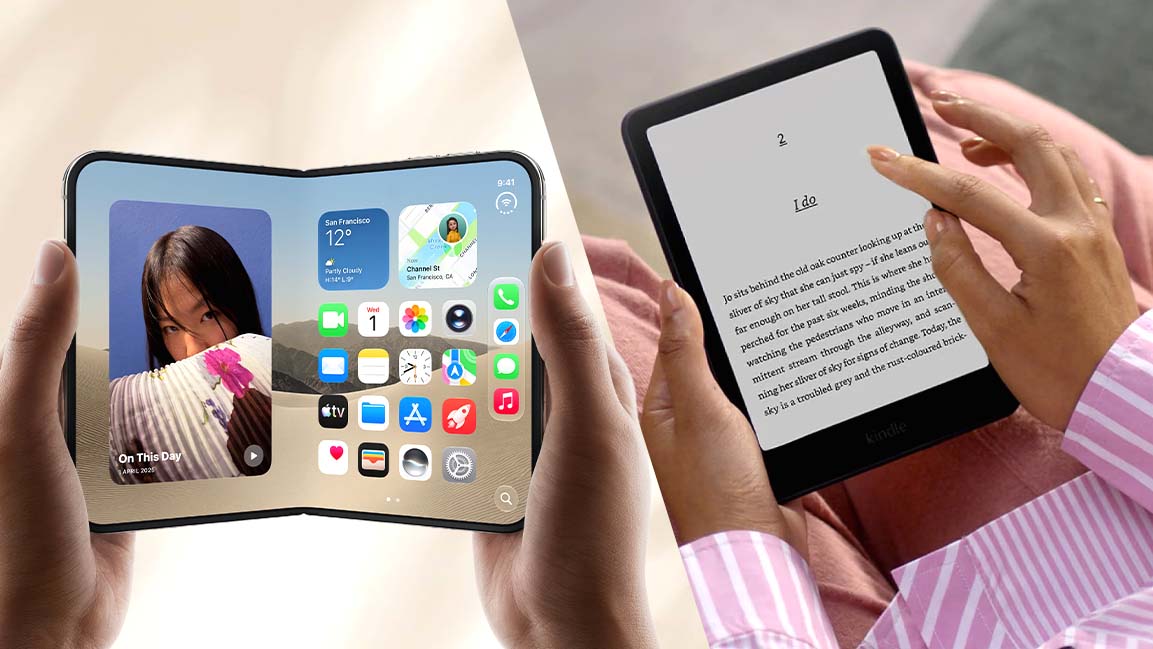


If you’re a reader like me, you’ve probably noticed the iPhone Duo’s uncanny resemblance to a Kindle.
Think of the world switching to reading on a foldable phone, and much won’t add up. It might offer convenience and clarity, but holding attention beyond short articles requires much more.
Which raises the question: why do we expect so much from a phone? A phone serves countless functions, and that’s exactly why it’s so hard to put down. But a single-function device offers what phones can’t: undivided focus.
We’ve all got hundreds of tabs open on our devices and we wonder why we can’t focus anymore.
A phone does it all. Yet there’s something refreshing about owning a device that’s good at just one thing. Think of that digital camera you’ve been eyeing. Just the thought of a device with limited functionality feels like a relief.
Single-function devices push back against the ultra-smart world, because too much of anything wears our attention thin.
More is more, but a book rendered on a screen with a resolution of 1398 by 2034 pixels at 460 ppi would be excessive, even unnecessary. It’s not a Nolan film; it’s a book where the words, even in digital form, must remain stable. So lacklustre is a Kindle’s interface in comparison, and that’s kind of its point.
THE CASE AGAINST THE HYPE
There are many claims about the iPhone Duo that await testing as it hits the market. Whether its price tag is justified by the slew of ‘new and improved’ features, or by the time it took to join the foldable party, is irrelevant. Still, in an attention-deficit economy, the option to download the Kindle app on a bigger phone canvas is not something Apple should be bragging about.
The Duo’s 7.6-inch inner display may be “the largest display of any iPhone,” but size has never been the measure of a reading experience. The best reading device is not the one with the most screen real estate.
Most of the time, products should stick to what they do best. Rather than trying to capture the entire menu of digital life — recording memories, staying connected, maintaining an online presence, and developing a discipline for reading — the iPhone Duo should stay in its lane when it comes to words on paper.
No matter how hard you try to read on an iPhone, there will always be portals vying for attention there. It would be too easy to flip between the page you’re on and the Instagram notification that pops up, so you won’t even notice where your reading trailed off.
WHY LESS IS MORE IN READING
Less is more, and the Kindle knows it.
In the search browser of the Kindle, there’s not much one can do. Critics agree that the device is brilliant at one thing—forcing users to read. So limited is its functionality and the features that you can’t make it a multifunctional device.
The Kindle should never have to compete with an iPad, nor should it aspire to do so. The point of reading a book, especially on a device, is to get transported to another world. For that, zero distractions are imperative, not an option.
The Kindle’s raison d’être is to mimic the experience of reading a real book as closely as possible. In contrast, the iPhone Duo, with a larger display, might come in handy for browsing multiple apps simultaneously or reading more easily. But it can’t corral your attention, even with muted notifications or Airplane mode. The constant options would ruin the reading experience
You can’t multitask your way through a good book.