
- | 1:00 pm
How do you design a self-driving car for the unexpected?
After winning A2RL’s first international race at Imola, Team Kinetiz is using autonomous racing to rethink how cars are designed to navigate unpredictable, real-world conditions.
[Source photo: A2RL]


A self-driving car has to do more than know where it is going. It has to understand what is happening around it, anticipate what could happen next, and make decisions when the situation changes faster than expected.
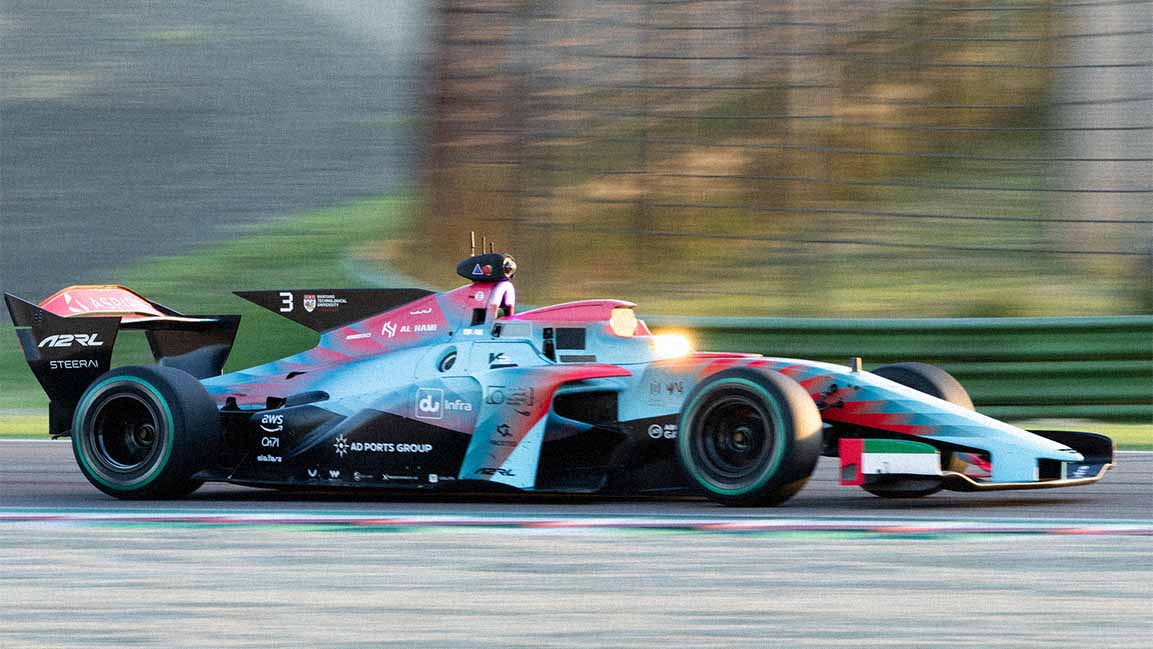
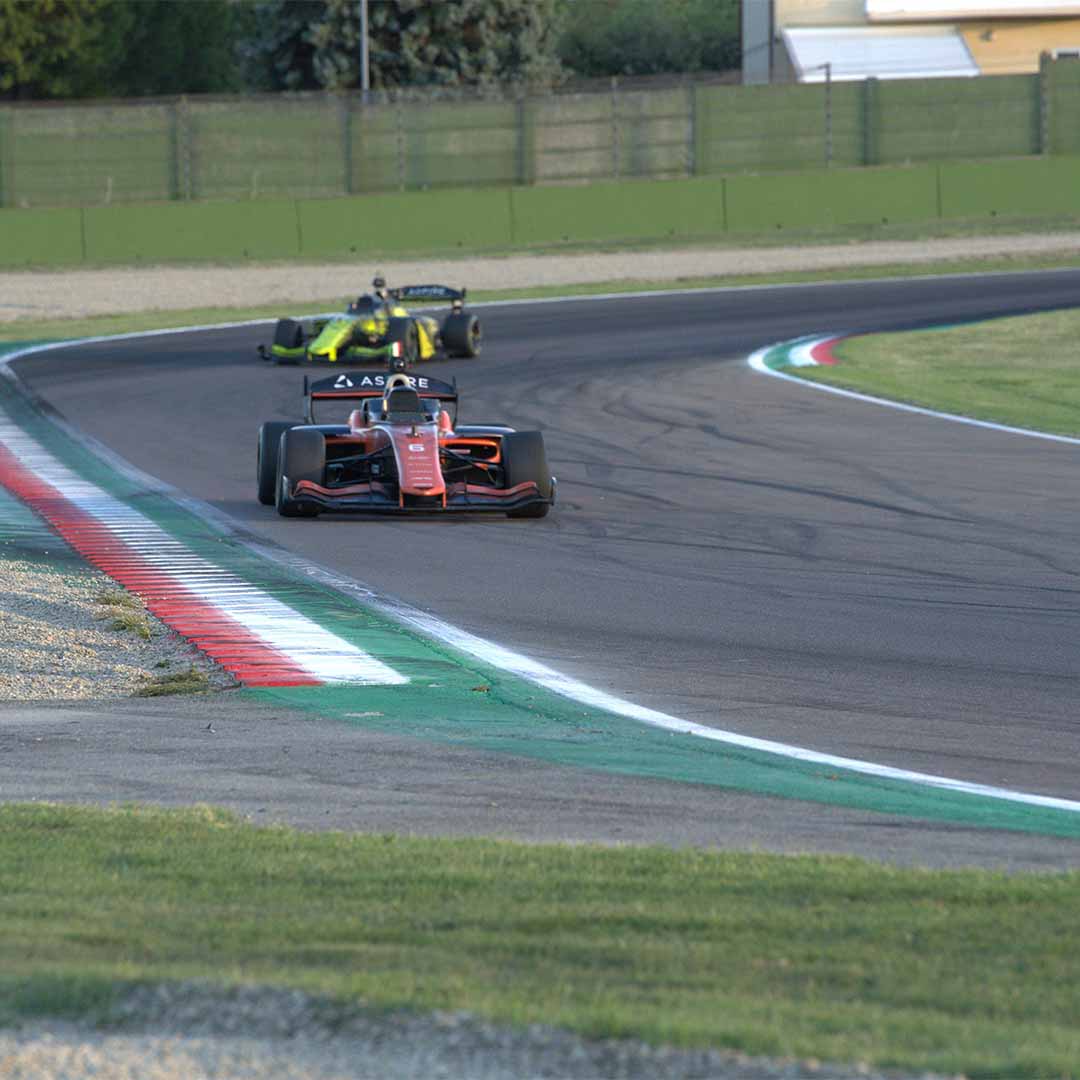
That challenge played out on one of the most demanding circuits in motorsport this September. On September 5, the Abu Dhabi Autonomous Racing League (A2RL) held its first multi-car autonomous race in Europe at Italy’s Imola Circuit, as part of ACI Racing Weekend. Across 12 laps, five fully autonomous race cars competed without drivers behind the wheel.
Team Kinetiz from the UAE emerged as the winner of the League’s inaugural international race. The result marked another step in A2RL’s evolution from a public testbed for artificial intelligence under extreme racing conditions into a competitive international series. After two seasons at Abu Dhabi’s Yas Marina Circuit, Imola was the League’s first race outside the UAE and a step toward its ambition of becoming the first international championship for fully autonomous race cars.
But the most revealing part of the race was not simply who crossed the finish line first. It was how quickly the conditions changed and how the cars responded.
WHEN THE CAR HAS TO MAKE THE DECISION
Unlike conventional motorsport, where performance differences between teams are reflected in the hardware, A2RL gives competitors an unusually similar starting point.
All five teams at Imola competed using identical EAV-25 hardware. The differentiator was therefore the software: perception, planning, control, and real-time decision-making. The field included Kinetiz, Germany’s Constructor Racing, Italy’s PoliMOVE and Unimore, and two-time consecutive champions TUM from Germany.
The race immediately demonstrated how little can be taken for granted in autonomous racing. Unimore, which had started from pole, set the fastest lap at 1 minute 40 seconds before suffering a technical issue that brought its car to a halt. PoliMOVE, which had been following closely and had reached the race’s top speed of 252.3 km/h, was unable to avoid the car that had suddenly slowed.
The collision ended both teams’ races.
Kinetiz moved into the lead and maintained it through to the checkered flag.
The result was a win, but it also offered a real-world demonstration of the problem Kinetiz has been working to solve: what happens when an autonomous vehicle encounters something it did not expect?
DESIGNING FOR THE LONG TAIL
Kinetiz’s interest in A2RL goes beyond racing. Founded by K2 in 2024, the team specializes in autonomous technology and urban mobility, with work spanning autonomous mobility, logistics, and robotics in the UAE. The team’s broader ambition is to develop autonomous systems that can eventually operate safely in everyday environments.
That makes the racetrack a particularly useful design laboratory.
Some of the hardest problems in autonomous technology involve rare or unexpected scenarios that are difficult to verify in controlled environments. A vehicle may perform exactly as intended under known conditions, but real-world environments are full of variables that are difficult to anticipate.
A2RL offers a way to deliberately push autonomous systems into those conditions.
The aim is not simply to make an autonomous car faster. It is to understand how its systems behave when circumstances become unpredictable and use those lessons to build technology that remains robust when it encounters something it has not seen before.
In that sense, designing an autonomous vehicle is increasingly about designing for uncertainty.
Courtesy: A2RL
THE CAR IS ONLY AS SMART AS ITS DECISIONS
Kinetiz’s development priorities have changed as the team has gained experience.
Last year, its focus was on improving race pace and streamlining its research and development workflow, particularly the process of moving safely and quickly from simulation to physical testing. This year, the emphasis shifted toward multi-car interactions.
That meant putting greater attention on perception and planning. An autonomous car operating alone has to understand its environment and follow a trajectory. Put several autonomous vehicles on the same circuit, and the problem becomes considerably more dynamic.
Every vehicle is now both an observer and an actor.
The system has to recognize other cars, interpret their behavior, and determine how to adjust its own actions in response. A decision that was safe a moment earlier can become unsafe as another vehicle changes speed, position, or trajectory. That is a fundamentally different design challenge from simply making a car follow a predefined racing line.
THE HUMAN HASN’T DISAPPEARED
The absence of a driver can make autonomous racing look like a purely technological exercise. In reality, humans remain deeply embedded in the process.
Engineers design the algorithms, define the safety boundaries, and decide how aggressively the vehicle should be tested. Between sessions, they analyze data, identify problems, and use those findings to improve the software.
The human role has shifted rather than disappeared.
Instead of controlling the car directly, engineers are designing the systems that control it—and deciding the conditions under which those systems can be trusted.
That distinction becomes particularly important as autonomous technology moves beyond racetracks.
The question is no longer whether a machine can drive itself. It is whether the people designing it can anticipate enough of the possible ways things might go wrong to make autonomous driving safe in uncontrolled environments.
THE REAL WORLD STILL HAS THE FINAL SAY
Simulation is a critical part of that process. High-fidelity simulation allows teams to test software repeatedly and expose autonomous systems to scenarios that would be difficult, expensive, or unsafe to recreate in the real world. But simulation has its limits.
Kinetiz points to variables such as tire-to-track interaction, throttle response, sensor noise, and external disturbances as factors that cannot be perfectly replicated in a virtual environment.
The physical track exposes those gaps.
For autonomous teams, real-world testing is less about proving the technology works and more about discovering where it doesn’t.
Imola was a particularly useful example. The race did not unfold according to a neat script. A technical issue changed the running order. A slowed car created an unexpected obstacle. Another autonomous vehicle had to respond in real time.
Those are precisely the kinds of situations that can reveal whether an autonomous system is merely capable of following its programming or capable of adapting to what is actually happening around it.
WHAT THE NEXT GENERATION WILL HAVE TO ANTICIPATE
For Kinetiz, the next major frontier in autonomous driving is not simply faster processing or quicker reactions. It is decision-making in dynamic environments.
Autonomous technology has advanced significantly, but multi-car situations remain challenging because the system has to account for other moving actors whose behavior can change from one moment to the next.
The next breakthrough could come from AI that can predict those changes, respond to evolving conditions, and navigate environments it has never encountered before.
That moves autonomous driving closer to a form of human-like driving intelligence, not because the goal is to recreate the human driver, but because a useful autonomous system needs the ability to adapt when reality does not match its expectations.
That is where autonomous racing becomes more than a spectacle.
The cars may be competing for position, but the teams are also competing to solve a much bigger design problem: how do you build a machine that can make the right decision when nobody has told it exactly what to expect?
At Imola, Kinetiz found itself at the front of the field after an unpredictable sequence of events. The more important achievement may be what the team learns from everything that happened before it reached the finish line.

Featured Videos
Today's Top Stories:



Sponsored Content
FROM OUR PARTNERS




CO-DESIGN