Can autonomous robots earn their place on Gulf factory floors?
AI-powered machines promise more adaptable factories, but their value depends on how reliably they work and how much human intervention they need.
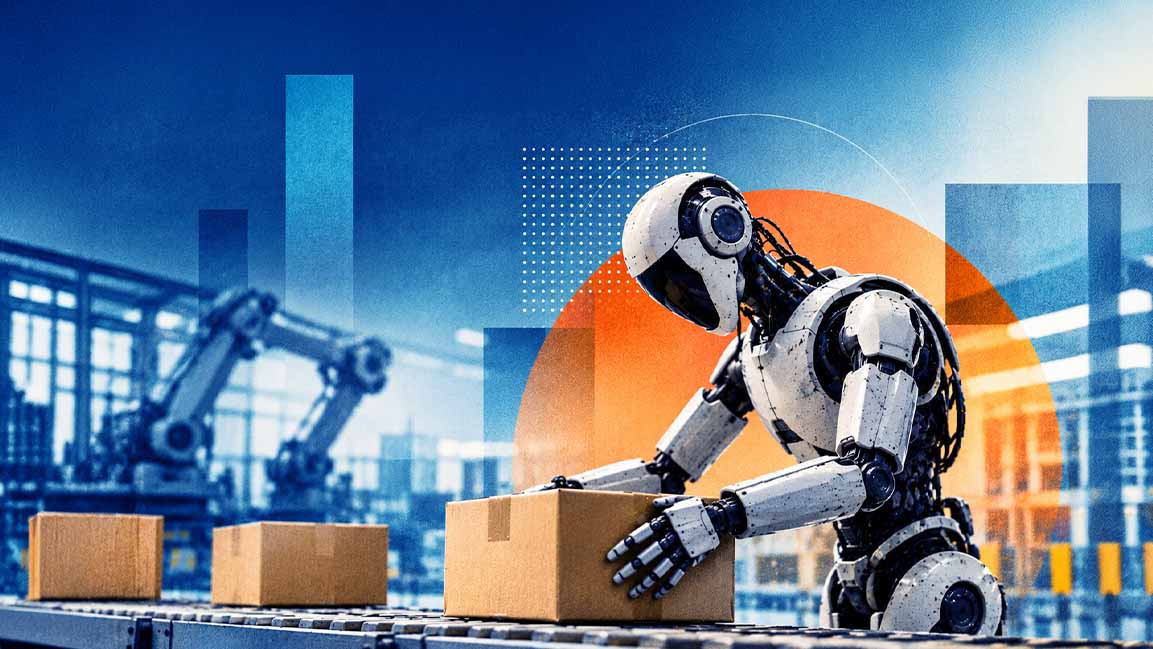


At Kinevera Robotics’ testing center, an AI-powered robot uses its two arms to open a cardboard box. With its claw-like grippers, it removes the contents one by one, arranging them before moving on to the next carton.
The task looks familiar. The slow, stiff movements make clear how much work remains.
“Agentic robot models are still slower than humans,” said Samy Karim, CEO and founder of Kinevera Robotics. “But they are improving fast.”
Kinevera’s robot is what engineers call an AI-embodied bimanual robot. Unlike conventional robots, which are typically one-armed and programmed for repetitive jobs such as welding car frames, these robots come equipped with two human-like arms, guided by agentic AI that allows the robots to read their surroundings, make decisions, and adapt as conditions change. These robots can do anything from sorting electronics to handling materials and packing boxes.
That adaptability is drawing interest from manufacturers across the Middle East as governments push to expand intelligent manufacturing across industrial sectors. The regional industrial robotics market is projected to grow 22% in 2026, while collaborative robots, or cobots, are forecasted to rise by nearly 30%, according to Grand View Research.
Much of the demand reflects the promise these technologies purport to offer — higher productivity, solving skilled-worker shortages and reducing reliance on imports as the region expands its manufacturing base. While AI has advanced rapidly across software and enterprise systems, translating that same ability in the physical world has been far more difficult. As the region’s manufacturing ambitions grow, experts caution that enthusiasm for the technology may be outpacing its readiness for large-scale deployment.
“Robot models are at a very early stage. Their success rates are still quite low, whether that is handling locomotion or manipulation,” said Karim. Robots can perform these tasks, but mistakes still make them difficult to rely on at scale. “Early adopters are taking a risk because the technology doesn’t work perfectly yet,” Karim added. Unlike conventional machinery, which performs consistently once installed, these robots operate differently.
“With agentic robots, it is really the opposite. The reality is that these systems don’t work well on day one—it’s their worst day of performance because of the nature of the technology and the model. They need iteration to improve,” he said. “The challenge is using the data, especially failure data, to improve autonomy and reliability over time. That requires a shift in thinking about conventional robotics and this new form of robotics.
As for humanoid robots, Karim sees this still down the line.
“Humanoids are coming, but they’re just one of several form factors,” Karim said, adding that industrial robots range from humanoids to robot arms, cobots and so-called “gantry robots” that can ferry goods along perpendicular axes.
“In industrial robotics, there’s a question of whether robots really need locomotion—whether they need to walk. Many factories don’t have stairs on the floor, so a robot can move on wheels and still do the job. A wheeled, semi-humanoid design avoids many of the issues that come with legged humanoids, such as battery life. I think we’ll see more practical form factors adopted before humanoids.”
A PROVING GROUND FOR ROBOTICS
Despite the challenges, Gulf governments are pressing ahead with plans to make intelligent manufacturing a driver of growth. Dubai aims to deploy 200,000 robots by 2032 and raise robotics and automation’s contribution to GDP to 9%, while Saudi Arabia’s Future Factories Program targets automation upgrades at 4,000 factories. In Qatar, the Manarat hub is helping manufacturers adopt AI, robotics and other advanced technologies.
The region’s large industrial sites, ports and energy facilities also create opportunities to test robots in demanding real-world conditions.
“We are moving from automation that does one task in one fixed place to systems that can perceive, adapt and move through real working environments,” said Dr. Paola Ardon, research director at the Technology Innovation Institute’s Autonomous Robotics Research Center. “That shift matters a lot in the Gulf, where many of the most important industries operate across large, harsh and often remote sites.”
The clearest impact so far is in logistics and warehousing, where mobile robots and autonomous vehicles move materials. Construction, manufacturing and aviation ground operations are close behind.
In Abu Dhabi, for example, Chinese automaker ROX Motor opened the Middle East’s first AI manufacturing center at KEZAD, with support from the Abu Dhabi Investment Office and the Ministry of Industry and Advanced Technology. AI-powered robots are doing the work throughout, assisting with component assembly and vehicle inspection. Since opening in September, the facility has already produced more than 100 ROX ADAMAS SUVs bearing the “Made in the Emirates” mark, with production expected to reach 20,000 vehicles in 2027.
Ardon sees facilities like this as an important step toward building local robotics capabilities. The greater advantage, she said, will come from developing technology tailored to the region’s industries, climate and data.
“Imported systems are usually designed and trained for other environments, so they often struggle with local conditions, local processes and local priorities,” Ardon said. “When we develop the technology here, we can build it for our climate, our industries and our data from day one.”
Building local expertise across hardware, software, data and AI models can also help the region develop talent, startups and supply chains, she said. “That ecosystem is what turns a technology program into lasting industrial capability.”
Karim agrees that reducing reliance on imported solutions matters, but says the priority should also be around building the expertise to adapt them for local use.
“It’s not only about making GCC-built hardware, but more importantly about making the hardware work and making it useful in this part of the world,” he said. “That requires engineering capability. It’s a critical opportunity for manufacturers here.”
The Gulf may also have an advantage in designing new factories around robotics from the outset. “One of the greatest advantages in the Gulf is that many new factories are still being built,” he said. “That creates a different set of decisions from those facing existing factories in Europe, which have to consider their current costs and how to replace or retrofit existing systems. With new construction, factories can be designed for these types of systems.
CAN FACTORIES BECOME FULLY AUTONOMOUS?
Not entirely—not yet. Even as robots take on more tasks, people will remain essential to teaching them new jobs, managing their performance and stepping in when something goes wrong.
“This isn’t about replacing labor,” Karim said. “Robot learning and agentic AI depend on people teaching the machine.” The goal, he said, is to design systems that make workers and businesses more productive.
Ardon sees the same shift underway. While robotics can eliminate certain tasks and roles, “New roles are already emerging, from fleet supervisors and remote operators to specialists who collect and prepare the data robots learn from.”
As for the future, Ardon believes the companies that pull ahead will be those that build the capability to work with robots, rather than simply buying them. “The difference will be between companies that bought equipment and companies that built capability,” she said. That means investing in data infrastructure, training workers and learning how to adapt and redeploy systems as production needs change.
“They will also be far more resilient, able to respond to labor shortages, supply chain disruption, or new opportunities quickly. A decade from now, I expect the leaders to be those who started early, accepted that the first deployments are learning exercises, and invested in people as much as in machines.
Back at the cardboard box, the robot has demonstrated that it can remove and arrange the contents. The next test is how many cartons it can handle before someone has to step in.