- | 9:00 am
The UAE’s mission to 269 Justitia marks its next step in deep-space exploration
The UAE-built probe will travel 5 billion kilometers and attempt to land on an asteroid as the country pushes deeper into space exploration.
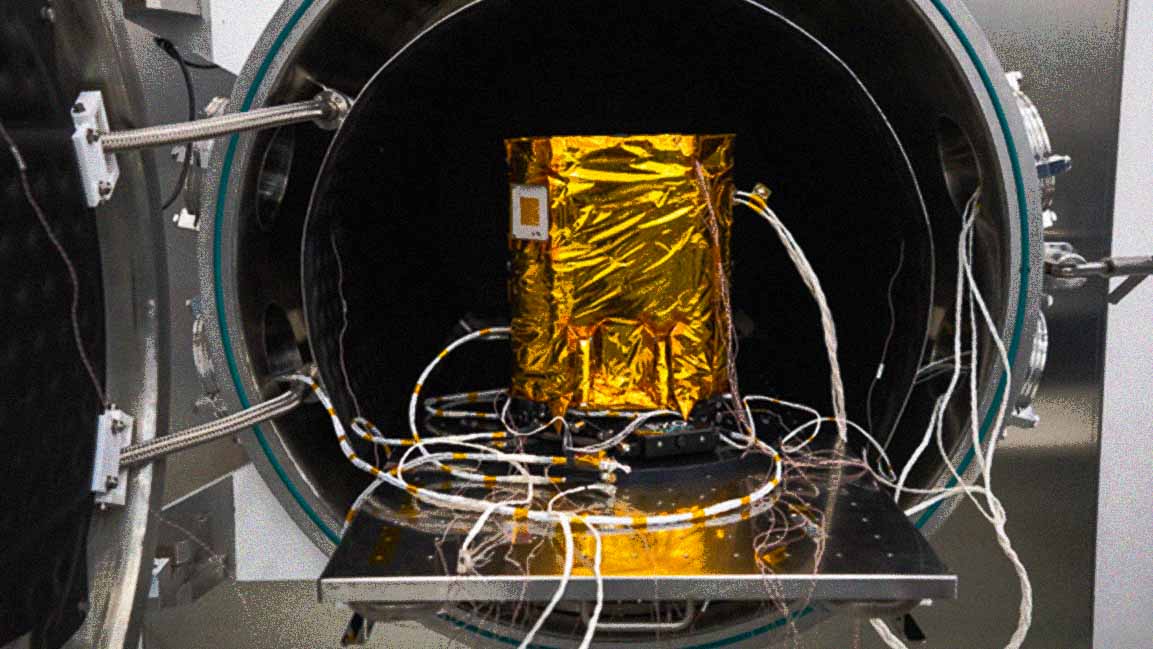


The UAE recently unveiled its homegrown probe bound for asteroid 269 Justitia, marking a new step in the country’s deep-space ambitions.
The probe is the centerpiece of the Emirates Mission to the Asteroid Belt, which will study two planets and seven asteroids to provide deeper insights into the universe and its cosmic environments.
Developed by the UAE Space Agency, in cooperation with the Technology Innovation Institute (TII) in Abu Dhabi, the probe is now en route to Colorado, where it will be integrated with the Mohammed bin Rashid Explorer. It will then return to the UAE for final testing before heading to Japan ahead of its planned launch in March 2028.
The mission, spanning eight years, will cover about 5 billion kilometers through the solar system, making flybys of six asteroids before the probe attempts to land on 269 Justitia.
The mission is also a test of how far the UAE’s space program has progressed since the Mars Hope Probe in 2021, and how much of the technology required for future exploration the country can now develop.
At a recent press conference, H.E. Faisal Al Bannai, Adviser to the President of the UAE and Secretary General of the Advanced Technology Research Council, said, “It is a landmark achievement in the space industry to have the ambition and vision that have enabled us to reach this point. The Emirates Mission to the Asteroid Belt will mark the start of many programs to be launched in the future.”
“Our teams in the UAE have the courage and confidence to build technology that will conduct missions not just for us, but for the whole scientific community, to further understand the galaxy, the universe, and many other things that we still need answers to, paving the way for many more missions to come,” H.E. Al Bannai added.
The mission reflects the UAE’s capabilities to develop sovereign technology. “Sovereignty means you know the technology, you’re able to evolve it, you’re able to change it, and you’re able to use that knowledge in other programs,” he added.
H.E. Ahmed Bilhoul Al Falasi, Minister of Sports and Chairman of the UAE Space Agency, said the value of a deep-space mission extends beyond what happens when a spacecraft reaches its destination. “Deep-space exploration creates extreme engineering constraints that can lead to innovations on Earth,” he said.
The mission is also building on the expertise developed through the Hope Probe. Engineers who worked on the Mars mission have moved into leadership positions on the asteroid program, with some who were entry-level engineers at the time now leading parts of the current mission.
H.E. Al Falasi said the aim is for the UAE to have, within the next decade, a team capable of developing more complex technologies, supported by a stronger local supply chain.
“The ambition is to build and launch a mission start to finish with one hundred percent capabilities covered within the UAE,” said Dr. Najwa Aaraj, CEO of TII.
The country’s space program has also had an impact on education. Al Falasi said STEM enrollment increased by more than 30% following the Mars mission.
The project started in July of 2024 and has marked the UAE’s first interplanetary spacecraft in under two years. “This project reflects our system engineering capabilities and a national team of engineers whose work will provide new science data,” said Dr. Anton Ivanov, Executive Director – Space, Propulsion and Space Research Center, TII.
“The breakthrough is not the hardware. It is the team, it is the human capital,” he said.
The UAE’s longer-term ambition is to keep raising the bar. The current mission is the next step in that progression, testing the country’s technology, engineering expertise and ability to operate independently in deep space.
The probe is now moving into the next stage of preparation ahead of launch. Once it leaves Earth, engineers will have limited ability to intervene in the autonomous probe, putting the mission’s systems to the ultimate test.

Featured Videos
Today's Top Stories:
More Top Stories:




FROM OUR PARTNERS