
- | 10:00 am
LEAP 2026 marks progress for Saudi Arabia’s AI infrastructure
AWS, HUMAIN, AMD, and Cisco used Riyadh’s tech show to announce compute that is live now, with much more planned.
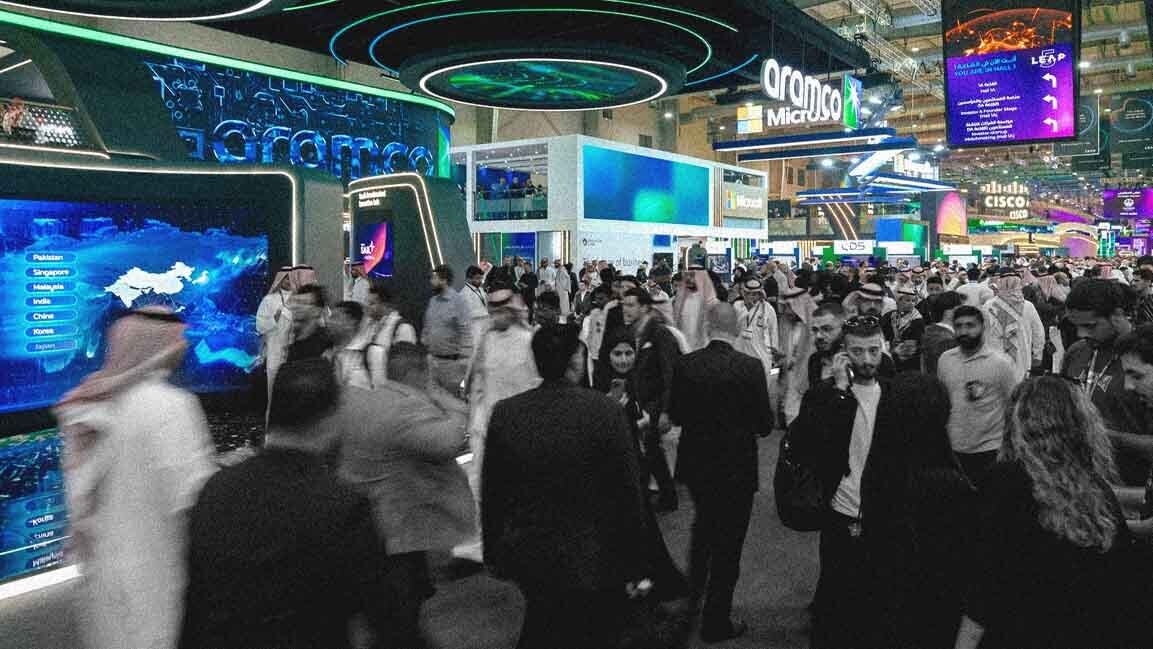


The agenda for LEAP 2026 is built for spectacle: dancing robots, robotaxis, flying-taxi displays, and an F1 simulator. But the event’s most consequential opening-day news came without much visual drama. It was about GPU clusters switching on, data-center construction beginning, and a long-promised cloud region finally getting a delivery date.
On August 31, AMD, Cisco, and PIF-owned HUMAIN said their first AMD Instinct GPU systems had gone live in Saudi Arabia, serving HUMAIN customers in the Kingdom and beyond. The companies also said they plan to add up to 250 megawatts of AI infrastructure starting in 2027, while remaining on track for a 1-gigawatt buildout by 2030. Separately, AWS said its first Saudi cloud region is on track to open in December 2026 and that its expanded partnership with HUMAIN will make up to 50 megawatts of capacity available in the country’s first AI Zone by 2028.
That is the real story of LEAP’s fifth Riyadh edition. The event, which runs through September 3 at RECC Malham, continues to feature product theater, celebrity keynotes, and eye-catching demos. But the more important test is whether Saudi Arabia can turn a technology show’s attention and investment headlines into the compute, cloud services, talent, and commercial workloads that make an AI economy durable.
FROM ANNOUNCEMENTS TO OPERATIONS
Saudi officials said the opening day generated more than $15 billion in technology launches, investments, and partnerships. It is an eye-catching total, and it continues a familiar LEAP pattern: the Ministry of Communications and Information Technology says the first four Riyadh editions generated $44.2 billion in combined launches and investments. But headline values are not the same thing as running infrastructure. They can include multiyear commitments, agreements, and plans that take years to reach customers. Both figures come from the ministry itself.
The AMD-Cisco-HUMAIN announcement matters because it contains a more concrete marker. The companies say the MI355X GPU systems are already operating and that HUMAIN can offer GPU-as-a-service for training and inference. “Putting this infrastructure into production demonstrates HUMAIN’s ability to build, operate and deliver advanced AI infrastructure at scale,” Tareq Amin, HUMAIN’s CEO, said in the joint announcement.
The distinction is especially important for Saudi Arabia’s AI strategy. Demand for local compute is not only about access to high-performance hardware. It is also about where enterprise data sits, how models are customized, and whether government agencies and regulated industries can use advanced tools under local controls. Cisco, AMD, and HUMAIN describe their platform as locally operated and built around open software and models. That is as much a commercial proposition as a national one.
The planned numbers should still be read as targets. The next 250-megawatt phase is scheduled to begin in 2027, with capacity expected in the second half of that year; the 1-gigawatt figure is an ambition for 2030. It is also a different generation of hardware: that phase is planned around AMD’s Instinct MI400 Series, not the MI355X now in service. For now, the relevant change is that the first systems are in service, not merely in a memorandum of understanding.
CLOUD IS THE NEXT TEST
AWS’s update gives LEAP a second measure of delivery. Its Saudi cloud region was first announced in 2024; AWS now says the launch is on track for December. The company says the project represents more than $5.3 billion in planned cloud-infrastructure investment and will expand its global footprint to 40 regions. For Saudi enterprises, that potentially means running applications and AI workloads from data centers in the Kingdom rather than routing them abroad.
The AWS-HUMAIN agreement extends beyond a data center address. AWS said HUMAIN’s Arabic large language model, ALLAM, will be available through Amazon Bedrock. At the same time, HUMAIN Fabric, a data platform and component of its HUMAIN ONE system, will be available through AWS Marketplace. The promise is straightforward: local computing capacity paired with Arabic-language AI and familiar cloud tools. The harder question is whether enterprises adopt it at a scale that justifies the buildout.
Matt Garman, AWS’s CEO, framed the region as infrastructure for the next phase of Saudi innovation. The more practical consequence is choice. AWS introduces a major global cloud operator with a domestic region at the same moment HUMAIN is building its own stack with AMD, Cisco, and other suppliers. That mix matters: it gives customers more options for how they source chips, cloud, models, and data controls, rather than tying the country’s AI ambitions to a single technical path.
CAPACITY WITHOUT BUILDERS IS JUST CAPACITY
LEAP’s infrastructure announcements were paired with a quieter but necessary update. AMD, MCIT, and the Digital Cooperation Organization launched an open developer initiative at the event, combining AMD’s AI Developer Program and ROCm software with DCO training on AI ethics and governance. Dr. Lisa Su, AMD’s chair and CEO, put the point simply: “The real power of AI will come from what people build with it.”
That is not a side project. Saudi Arabia can buy servers faster than it can create a base of developers who know how to train, tune, deploy, secure, and govern AI systems. The value of an AI zone or cloud region ultimately depends on the companies that use it to build products, not on the hardware itself. The first workshop is modest compared with the capital figures announced at LEAP, but it speaks directly to the more stubborn part of the strategy.
It also helps explain why LEAP has become more than an annual showcase. The 2026 edition brings together more than 1,800 technology brands, 600 startups, 1,900 investors, and 1,000 speakers, according to organizers. Its expansion into Hong Kong in July, through the inaugural LEAP East, attracted more than 25,000 visitors, 450 exhibitors, and 600 investors, according to MCIT.
THE PHYSICAL BUILDOUT
Another opening-day announcement underscored the point. HUMAIN and DataVolt said construction has begun on a 100-megawatt portion of a 360-megawatt AI-ready data-center project at Oxagon, NEOM’s industrial city on the Red Sea. The first 100 megawatts are expected in 2028; the wider campus is planned to reach 1.5 gigawatts over time. The campus itself is not new: DataVolt and NEOM signed a $5 billion agreement for the same 1.5-gigawatt site at LEAP 2025. What changed this year is that HUMAIN has committed to developing 100 megawatts in the first phase, and ground has been broken. “AI ambition only matters when you can turn it into infrastructure, compute and capacity that customers can use,” Amin said.
That formulation may be corporate messaging, but it is the right standard. In the next 18 months, the signal to watch is not just how many deals LEAP announces. It is whether the AWS region opens as promised, whether production compute scales beyond the initial deployment, how quickly the Oxagon site advances, and whether Saudi companies use those resources to create services that work in Arabic and can compete beyond the Kingdom.
The exhibition’s robots and simulators will draw the crowds. The bigger story will be harder to photograph: contracts turning into fiber, power, cooling, chips, developers, and customers. If LEAP can make that conversion repeatedly, its most valuable export will not be an event format. It will be a credible Saudi role in the region’s AI supply chain.