- | 8:00 am
How delayed gratification can make achieving goals faster
‘It’s like exercise: You definitely see benefits from it,’ says one psychologist.


Each week, Vera Vaslova makes herself wait until Friday to enjoy her favorite iced coffee.
“And that makes me disgustingly productive,” she says in a video she posted on TikTok.
“Getting coffee out is one of my favorite things in this entire world, but I only let myself do it on Friday morning so that I have something to look forward to all week,” she explains. “And that’s what we call delayed gratification training.”
Delayed gratification, or the idea that good things come to those who wait, is a concept many are familiar with. Those who are able to delay gratification tend to have stronger emotional regulation and decision-making skills, and often reap the rewards in both their personal and professional lives.
And yet, in a frictionless world of next-day delivery, instant notifications, and get-rich-quick schemes promising overnight success, delaying gratification is a muscle many have let atrophy.
“It’s a very weak muscle because it’s hard work,” says Philip Gable, a professor in the department of psychological and brain sciences at the University of Delaware. “It’s like exercise: You definitely see benefits from it, but they’re delayed.”
Like exercise, it’s also a muscle you can train.
Pivoting from short-term to long-term payoffs
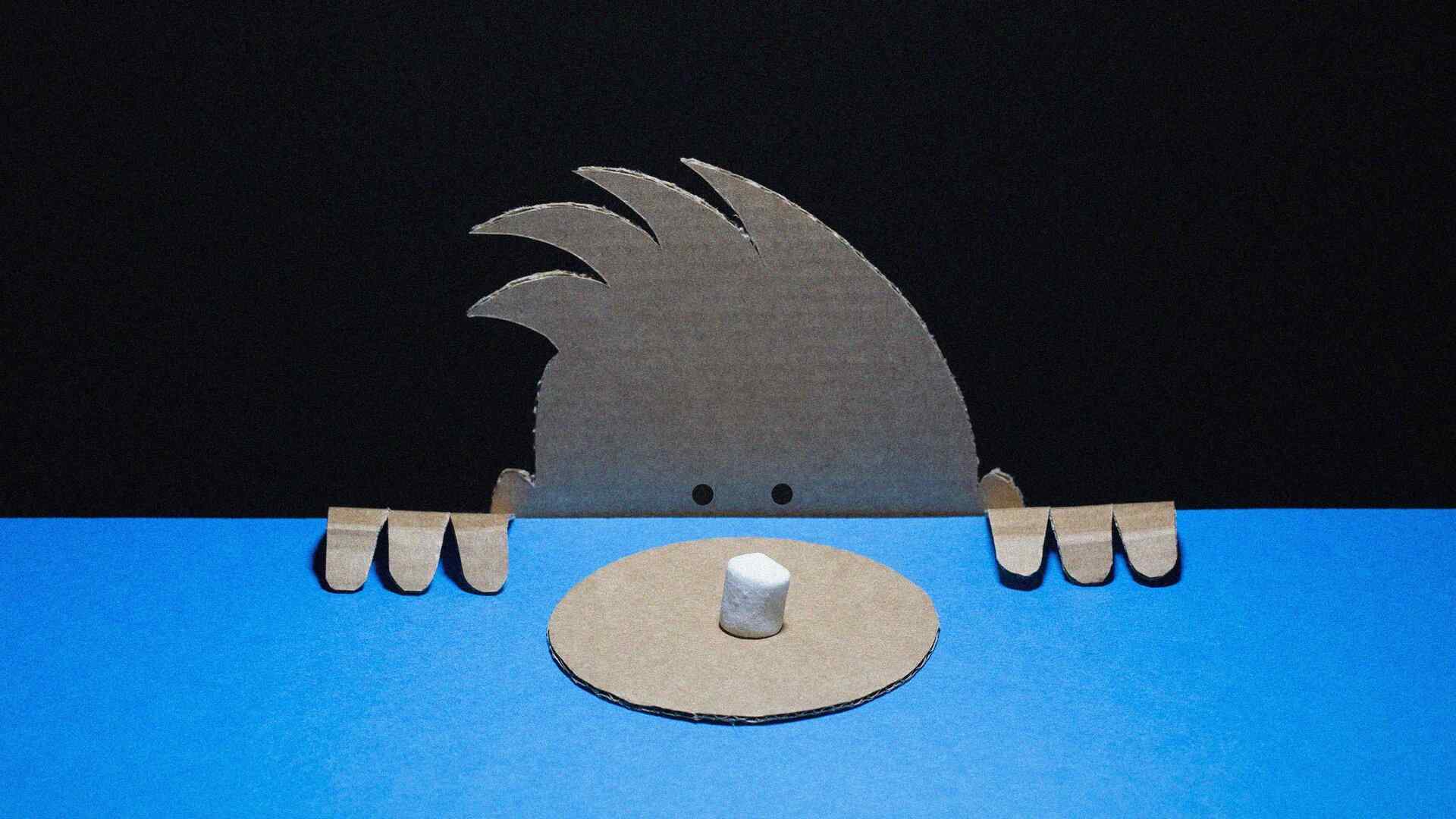
Stanford psychologist Walter Mischel’s famous “marshmallow studies”—in which he left a bunch of preschool-age kids alone in a room with a marshmallow to see if they could exert self-control and be rewarded with two for their trouble—is the most commonly cited research on the psychology of delayed gratification.
The study found that those who resisted the marshmallow, or delayed gratification, tended to do better later on in life: scoring higher on academic tests and demonstrating better social skills and stress management. A 2020 study, meanwhile, found a game designed to build delay of gratification also increased preschoolers’ wait times on the actual marshmallow test.
“These are concepts that are really important,” Gable says. “In a society that tries to sell you on instant gratification, those who can delay gratification have a lot of benefits.”
A 2022 study of students in China found those with greater willingness to delay gratification in their careers, and sacrifice in short-term payoffs for longer-term ones, tended to have stronger psychological skills, including resilience and self-efficacy. They also reported stronger intentions of becoming entrepreneurs one day.
A 2026 study of nursing students in China found that just wanting long-term goals is not enough on its own: It found that the ability to delay gratification is part of what turns that future-oriented mindset into actual follow-through—for example, skipping a night out with friends or resisting switching on the TV to study for an assignment.
These benefits are particularly apparent for entrepreneurs, many of whom have turned to social media to extol delayed gratification as the secret to their success.
British serial entrepreneur Simon Squibb recently shared in a LinkedIn post that of the 19 businesses he has founded or started throughout his career, he has always paid himself the least.
“Every single spare bit of money I used to pay someone else, I’d use to grow the business, invest in the business,” he says in the clip. “It was only when I hit my forties and I managed to sell my company that I bought a big house and a nice car. I had delayed gratification.” He then called it “one of the most important skills you’ll ever need if you want to be successful in business.”
This is because rewards can be distracting to us, Gable explains.
“One of the great psychological benefits of delayed gratification is that we’re no longer dependent on instant gratification,” he says. “If you’re trying to get that next hit, you’re not focusing on something that’s a little more difficult—something that requires more of your attention.”
If you’re busy enjoying the spoils of your hard work before the hard work is done, you may end up taking your eye off the ball. If you’re constantly seeking out quick dopamine hits throughout the workday—refreshing your emails, checking your connection requests on Linkedin—you’re only denying yourself the gratification of reaching the goals you set.
“Being strategic when you use rewards”
If we are constantly rewarding ourselves, the rewards themselves become less gratifying. “A good example is dessert. I love dessert, but I also have to confess that the first few bites are much better than the last few bites,” Gable says. “When your brain gets used to instant gratification, you need more stimulation to get the same reward you once got.”
Sabine Doebel, an associate professor of psychology at George Mason University, demonstrates the same idea with her son. “‘I’m only gonna have ice cream like once a week, or after I’ve accomplished something’” she tells him, noting, “It’s about being strategic when you use rewards.” Here, similar to the famous marshmallow study, she’s encouraging him to think of rewards that come after doing something constructive.
It’s not just children who can practice delayed gratification. Replace ice cream with your favorite coffee order, then use it as a reward at the end of a productive week, like Vaslova. Or make a note when you next want to buy something, and instead wait a week rather than impulsively clicking “add to cart.”
There’s even a cottage industry of delayed gratification apps like Brick, which temporarily blocks distracting apps until you physically touch your phone to the device. Such services have surged in popularity as people look for ways to curb instant gratification impulses. A 2023 study found that higher social media use reduces our ability to delay gratification.
Delayed gratification is not about denying pleasure, but about making choices that lead to greater rewards in the future.
“There’s a caveat to this,” Gable says. “Some of the research shows that when we’re having to exert effort to control ourselves, it actually makes us more indulgent later on.” But by reframing it as delayed gratification training, rather than denying yourself pleasure in the moment, you are more likely to stick to it.
Gable recommends first figuring out what is impeding productivity and then applying the concept of delayed gratification from there. For example, if you procrastinate at work by treating yourself to a takeaway coffee each morning, instead, turn it into a reward for getting done what first needs doing.
“It’s identifying what’s in our way,” he notes, “and then saying, ‘I can enjoy it more if I’ve already done the work.’”